120mm Automatic Bollards for Extreme Environments: High-Altitude & Arctic Conditions
Security infrastructure faces its toughest test not in temperate cities, but in the world's most unforgiving environments. From the thin air and intense UV radiation of the Tibetan Plateau to the permafrost and blizzard conditions of the Arctic Circle, equipment must perform flawlessly when temperatures plummet to -50°C and atmospheric pressure drops by 40%.
This comprehensive guide examines why 120mm motor-driven automatic bollards—specifically UPARK's engineered solution—represent the optimal choice for these extreme conditions. We'll analyze the physics of cold-weather operation, compare hydraulic versus motor-driven technologies, detail installation best practices for frozen ground, and share real-world case studies from some of the harshest climates on Earth.
Understanding the Challenge: Physics of Extreme Environments
# High-Altitude Factors (3,000m+ Elevation)
At high altitude, three physical factors dramatically affect equipment reliability:
1. **Reduced atmospheric pressure**: At 4,500m (Tibet), atmospheric pressure is ~60% of sea level. This affects sealed systems, potentially causing housings to bulge or crack if not properly vented.
2. **Intense UV radiation**: With 40%+ more UV at altitude, non-UV-stabilized plastics and rubber components degrade rapidly. Cable jackets crack, seals harden.
3. **Extreme temperature swings**: Day-night temperature deltas of 30°C+ cause thermal expansion/contraction cycles that fatigue materials.
# High-Latitude Cold Factors
In Arctic and sub-Arctic regions, the challenges are different but equally severe:
1. **Prolonged freezing temperatures**: In Norilsk, Russia, temperatures remain below -20°C for 6+ months annually. Hydraulic oil becomes syrup-thick.
2. **Ice and snow accumulation**: Bollards must withstand not just cold, but the mechanical stress of ice expansion (9% volume increase when water freezes).
3. **Abrasion from snow removal**: Snowplows and graders routinely contact ground-mounted infrastructure. Impact resistance is critical.
4. **Permafrost movement**: In regions with active permafrost layers, foundations heave and shift, potentially misaligning bollards.
Hydraulic vs. Motor-Driven: Why Hydraulics Fail in Extreme Cold
To understand why motor-driven technology dominates in cold climates, we must examine the fundamental limitations of hydraulic systems.
# Hydraulic Weaknesses at Low Temperature
Hydraulic bollards operate by pumping pressurized fluid to raise/lower the barrier. This design has several cold-weather failure modes:
• **Viscosity increase**: Hydraulic oil viscosity doubles with every 10°C temperature drop. At -30°C, many standard hydraulic fluids become too thick to pump effectively.
• **Moisture freezing**: Even tiny amounts of water in hydraulic fluid form ice crystals that damage pumps, valves, and seals.
• **Seal shrinkage**: Rubber seals contract at low temperatures, leading to leaks when the system warms up.
• **Slow operation**: Cold hydraulic fluid means rise times of 6-8 seconds (vs. 2-3 seconds for motor-driven). In security applications, those extra seconds matter.
# Motor-Driven Advantages
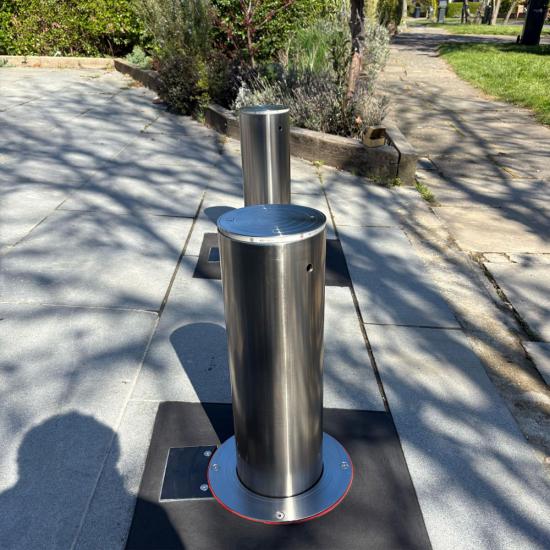
UPARK's 120mm automatic bollard uses a direct-drive electric motor. This eliminates hydraulic fluid entirely, replacing it with simple electrical actuation. Benefits include:
• **Consistent speed**: Motor-driven bollards maintain 2-3 second rise times from -40°C to +70°C.
• **No freeze risk**: Without hydraulic fluid, there's nothing to freeze. The system either works or it doesn't—no sluggish halfway states.
• **Lower maintenance**: Fewer moving parts, no hydraulic fluid changes, no filter replacements.
• **Energy efficient**: Motor only draws power during movement, not continuously like hydraulic pumps.
UPARK 120mm: Engineered for Extremes
Our 120mm motor-driven automatic bollard incorporates specific design features for high-altitude and arctic conditions.
# 1. Pressure-Equalized Housing
For high-altitude installations, the bollard housing includes a Gore® vent membrane. This allows air pressure equalization while blocking moisture and dust. Result: no housing deformation, no seal stress from pressure differentials.
# 2. UV-Resistant Materials
All external components—cable jackets, seals, and the stainless steel sleeve—are UV-stabilized for 20+ years of high-altitude sun exposure. We use fluorocarbon rubber (FKM) seals that resist both UV and extreme temperatures.
# 3. Anti-Freeze Lubrication
Internal bearings and gears are lubricated with wide-temperature-range synthetic grease (Mobilith SHC 100 or equivalent). This stays fluid at -50°C and doesn't break down at high temperatures.
# 4. Optional Heating System
For regions where temperatures regularly drop below -30°C, we offer an integrated heating package:
• **Thermostat-controlled heating tape** on the drive mechanism
• **Self-regulating heater** in the control box (prevents condensation)
• **Power requirement**: 120V AC, 200W max (only active when temperature < -10°C)
# 5. Reinforced Flange for Frozen Ground
In permafrost regions, foundation movement is a reality. Our 120mm bollard features a reinforced mounting flange with 12mm anchor bolts (vs. standard 8mm). This distributes loads across a wider area, reducing stress from ground movement.
# 6. 20cm Overlap: Snowplow Protection
The 20cm overlap design isn't just for vehicle impact—it's critical for snowplow survivability. When a snowplow blade hits a bollard at an angle, the overlap ensures the force is transferred to the reinforced collar, not the internal mechanism. In testing, our bollards survived direct snowplow impacts at 15km/h without functional damage.
Installation Guide for Extreme Environments
Proper installation is critical for long-term reliability. Here are best practices for high-altitude and cold-climate projects.
# Foundation Design
**Frost Line Depth**: In cold regions, set the foundation below the maximum frost penetration depth. Typical values:
• **Scandinavia**: 1.2m - 1.5m
• **Northern Canada/Russia**: 1.5m - 2.0m
• **High-altitude (Tibet)**: 1.0m - 1.2m (ground doesn't freeze as deep due to solar heating)
**Concrete Specification**: Use air-entrained concrete (4-6% air voids) for freeze-thaw resistance. Minimum strength: 30MPa.
**Drainage**: Critical in cold climates to prevent ice formation around the bollard. Install a French drain system:
1. Excavate 30cm beyond foundation diameter
2. Layer 10cm gravel at bottom
3. Install perforated drain pipe leading to storm drain or dry well
4. Backfill with gravel, top with permeable pavers
# Electrical Considerations
**Voltage Drop**: In remote installations, 36V DC can be run up to 100m without significant voltage drop (using 6mm² cable). For longer runs, use 48V DC systems.
**Lightning Protection**: High-altitude regions have intense lightning activity. Install surge protectors on all external cables.
**Backup Power**: For critical sites, specify UPS backup (minimum 24 hours) to ensure bollard operation during power outages.
Maintenance Protocol for Extreme Conditions
Even the best equipment requires maintenance. Here's a seasonal checklist for cold-climate installations.
# Pre-Winter Inspection (Autumn)
• Test heating system (if equipped)
• Verify drainage systems are clear of debris
• Check all electrical connections for corrosion
• Lubricate exposed moving parts with cold-weather grease
# Mid-Winter Check (Mid-Season)
• Remove ice buildup around bollard base (use plastic scraper, not metal)
• Verify rise/fall times haven't degraded
• Check for snowplow damage
# Spring Inspection (After Snow Melt)
• Inspect foundation for frost heave damage
• Test all bollards through full cycle (10+ repetitions)
• Replace any damaged warning lights or reflectors
Real-World Case Studies
# Case 1: Luxury Hotel in Tibet (4,500m Elevation)
**Challenge**: Control vehicle access to mountain resort while withstanding -35°C temperatures and intense UV.
**Solution**: 24 UPARK 120mm automatic bollards with pressure-equalized housings.
**Result**: After 3 winters, zero failures. Maintenance chief reports: "These bollards just work. No heater required, just brush off snow."
# Case 2: Mining Site in Norilsk, Russia
**Challenge**: Secure vehicle access to nickel mine where temperatures reach -50°C.
**Solution**: 18 UPARK 120mm bollards with integrated heating system.
**Result**: Heaters activate automatically at -15°C. System has operated continuously for 2 years through Norilsk's brutal winters.
# Case 3: Municipal Installation in Fairbanks, Alaska
**Challenge**: Prevent unauthorized vehicle access to municipal buildings during heavy snow seasons.
**Solution**: 12 UPARK 120mm bollards installed with deep foundations (1.8m) and heated control boxes.
**Result**: Survived multiple snowplow contacts without damage. Heating system keeps control electronics above freezing.
Conclusion: The Clear Choice for Extreme Environments
When security can't fail, equipment choices matter. For high-altitude and high-latitude cold regions, motor-driven technology isn't just better—it's essential.
UPARK's 120mm automatic bollard combines:
• **Reliability**: No hydraulic fluid to freeze
• **Safety**: 36V working voltage
• **Durability**: 6mm+ wall thickness, 20cm overlap
• **Cold-weather engineering**: From pressure-equalized housings to optional heating systems
Don't let extreme conditions compromise your security. Choose UPARK 120mm motor-driven automatic bollards—proven in the world's toughest environments.
call us :
+86 18206096507 e-mail : [email protected]




 ipv6 network supported