Automatic Bollards South Africa: Luxury Estate Security for Cape Town and Johannesburg
South Africa's luxury residential market is defined by a paradox: extraordinary natural beauty combined with some of the world's most acute security challenges. Cape Town's Atlantic Seaboard — encompassing Clifton, Camps Bay, Bantry Bay, and the V&A Waterfront residential precinct — is consistently ranked among the world's most scenic luxury residential addresses. Johannesburg's Sandton, Hyde Park, and Morningside districts house the continent's highest concentration of corporate wealth. Stellenbosch's wine estates and the Garden Route's Plettenberg Bay and Knysna properties attract international buyers seeking South Africa's outdoor lifestyle at its finest.
For all these markets, physical security infrastructure is not a luxury add-on — it is a baseline requirement. South Africa's residential security sector is one of the most sophisticated in the world, driven by necessity, and high-net-worth homeowners routinely invest in multi-layer protection: perimeter walls, electric fencing, CCTV, armed response contracts, and increasingly, vehicle access control systems that prevent forced entry via the driveway — a historically vulnerable point in South African residential security.
The Driveway Security Problem
In South Africa's luxury residential context, the driveway gate has historically been the primary physical security vulnerability. Swing or sliding gates that open inward or outward for vehicle entry create a moment of exposure that opportunistic criminals exploit — the so-called "gate-rushing" threat. A vehicle following an authorized resident through an opening gate can force entry before the gate closes, bypassing the entire perimeter barrier.
Automatic bollards address this vulnerability directly. A bollard that rises behind an entering vehicle prevents a following vehicle from tailgating through the same opening. For properties with circular driveways, a bollard at the exit point prevents unauthorized vehicles from using the entry gate as a vehicle exit during a rush incident. The combination of entry gate and bollard creates a "vehicle airlock" configuration increasingly specified by South African security consultants for high-value residential properties.
Cape Town: Atlantic Seaboard and Constantia
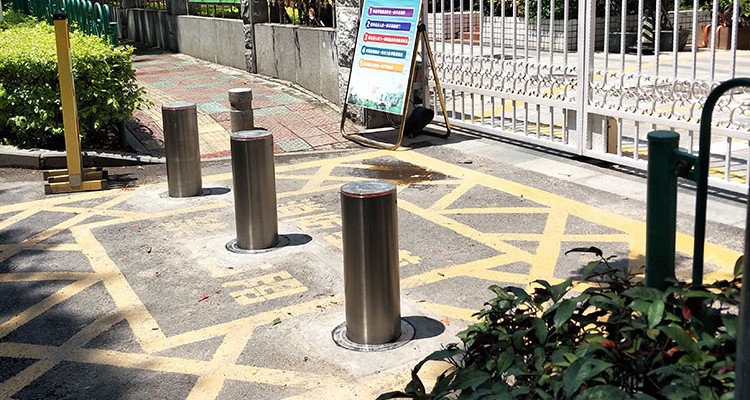
Clifton and Camps Bay properties sit on steep slopes above the Atlantic, with narrow access roads and driveways that make conventional boom barriers and large gate systems impractical. UPARK bollards' 219mm-diameter housing and flush-retract profile are ideally suited to these constrained coastal driveways. The 316L marine-grade stainless steel option is recommended for Atlantic Seaboard properties, where salt-laden south-easter winds accelerate corrosion of lesser-grade metals.
Constantia's wine estate properties — large-format suburban farms in the Cape Winelands immediately south of Table Mountain — manage multiple daily vehicle movements from farm staff, cellar tour visitors, and private family use. UPARK multi-zone bollard systems allow estate managers to configure independent access schedules for each zone, with time-locked restrictions for public-access areas outside tour operating hours.
Johannesburg: Sandton and Waterfall Estate
Sandton's luxury residential belt — running from Hyde Park through Morningside to Melrose Arch — represents South Africa's highest-value real estate. Properties here often feature double security perimeters: an outer electric fence and wall, and an inner driveway gate with a staffed guardhouse. UPARK bollards are increasingly specified at the inner perimeter, providing a secondary physical barrier that operates independently of the guardhouse gate.
Waterfall Estate in Midrand — the integrated mixed-use development that has attracted the headquarters of several major South African corporations — includes luxury residential units where UPARK bollards form part of the estate's designed access control infrastructure, coordinated through the estate's central security management platform.
Power Reliability Considerations
South Africa's well-documented challenges with electricity supply reliability (load-shedding) make backup power capability a non-negotiable requirement for any security system. UPARK bollards are available with UPS (Uninterruptible Power Supply) battery backup modules that maintain operation through power outages of up to 12 hours, covering all but the most extended load-shedding periods. The 36V low-voltage system is energy-efficient, meaning a relatively modest battery capacity provides extended operation time compared with higher-voltage hydraulic alternatives.
South African Electrical Standards
South Africa's electrical installations are governed by SANS 10142 (The Wiring of Premises). UPARK bollards at 36V fall within the Extra Low Voltage (ELV) classification, allowing integration with the property's existing ELV infrastructure — access control, CCTV, intercom — under a single ELV installation scope. Connection to the main distribution board requires a qualified electrician registered with the Electrical Contractors Association (ECA).
Conclusion
For Cape Town Atlantic Seaboard villas, Johannesburg Sandton estates, and Stellenbosch wine country properties, UPARK automatic bollards provide the vehicle access security, marine-grade durability, and load-shedding resilience that South Africa's demanding luxury residential market requires.
call us :
+86 18206096507 e-mail : [email protected]




 ipv6 network supported