Controlling which vehicles drive onto a site sounds straightforward until you have to buy the hardware. Three options show up in almost every specification: automatic bollards, boom barrier arms, and gates. They all stop cars, but they stop them in very different ways, and the wrong pick creates problems you live with for years.
How the three actually work
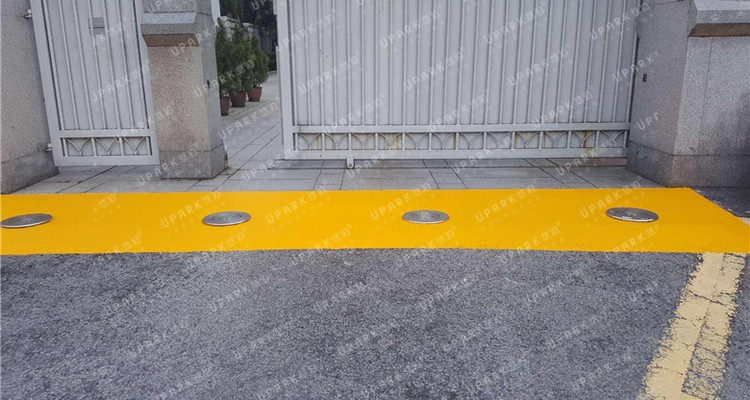
Automatic bollards are posts that rise out of the ground and sink back flush with the pavement. A boom barrier is a pole on a hinge that lifts to let a vehicle through. A gate is a panel, sliding or swinging, that closes an opening in a fence or wall. Same job on paper, completely different behavior under pressure.
Security strength is where they split
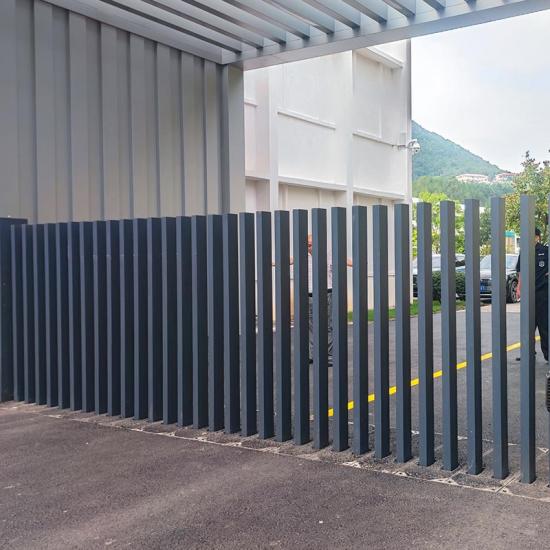
A line of bollards forms a continuous physical wall a vehicle cannot drive around or crash through. Crash-rated models are tested to stop a truck travelling at set speeds, so the protection is measurable, not assumed. A barrier arm is a thin pole: a driver can go around the end of the lane, and a determined vehicle simply pushes through it. Gates close a gap, but the surface is a panel that a heavy vehicle can dent, breach, or ram, and most gates leave a ground-level gap underneath.
Day-to-day access and traffic flow
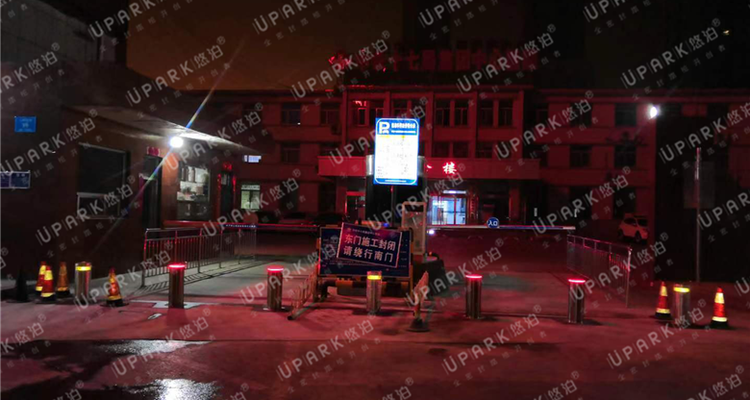
Bollards retract fully into the ground, so emergency and authorized vehicles pass when needed and you keep control post by post. They suit sites where security and openness trade places through the day, like a plaza that is open by day and locked at night. Barrier arms are faster for high-volume lanes such as parking exits and toll roads. Gates handle wide vehicle entrances but cycle more slowly, which matters when trucks queue up.
What they do to the streetscape
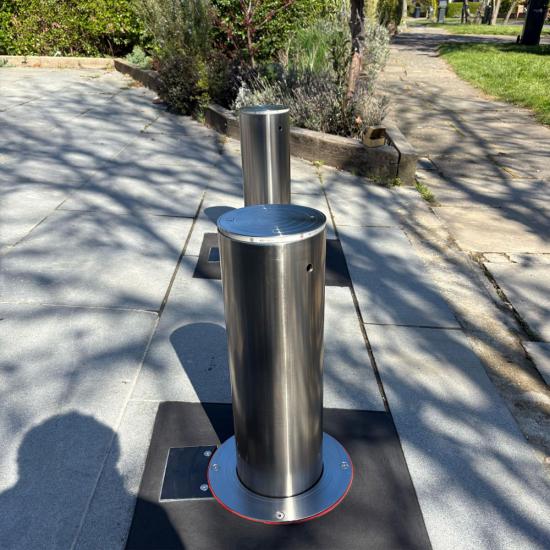
Retractable stainless steel bollards disappear when down, leaving a clean pavement with almost no visual weight. They read as street furniture, not security hardware, which is why planners use them in historic districts and pedestrian zones. Barrier arms and gates look like exactly what they are: access-control equipment. That is fine at a depot, less so at a civic square.
Maintenance and failure modes
Bollards keep their working parts underground in a sealed unit, with a low-voltage 36V electromechanical drive that is cheap to run. Barrier arms sit exposed to wind, impact, and someone leaning on them. Gates need tracks, rollers, or hinges that collect dirt and ice. For a high-security site, the bollard's fewer exposed parts usually mean fewer callouts.
Rough cost picture
Upfront, a boom barrier is the cheapest, a gate sits in the middle, and a bollard system costs more to install because of the underground foundation. Over ten years the math moves: bollards tend to win on sites where a single bypassed barrier or a damaged gate would mean a real security incident.
Which one should you choose
Pick automatic bollards when you need a genuine vehicle stop, a pedestrian-friendly look, or anti-ram protection, such as around transit entrances, government buildings, and crowded public spaces. Pick a boom barrier for fast car lanes where a light discouragement is enough. Pick a gate for wide service yards where a solid closure matters more than speed. You can see the full range on our Automatic Bollards and Fence Gates pages.
The right choice comes down to threat level, traffic volume, and how the place should look when nothing is happening. For sites that need real stopping power without turning into a fortress, automatic bollards are hard to beat. If you are scoping a project, our team can help match a model to your site and local standards.
call us :
+86 18206096507 e-mail : [email protected]




 ipv6 network supported