Bollards at Checkpoints & Border Crossings: Deployment Strategies That Work
The Unique Security Challenge of Checkpoints and Border Crossings
Border crossings, highway inspection stations, and secure facility checkpoints face a distinct vehicle access challenge: they must allow authorized vehicles to pass efficiently while maintaining the ability to stop unauthorized or hostile vehicles instantly. Unlike a retail parking lot where wrong entry is merely a nuisance, a breached checkpoint can have national security implications.
Bollards — particularly automatic rising models — are the preferred solution for checkpoint vehicle access control because they can be raised and lowered rapidly in coordination with vehicle identification systems, without creating a permanent visual barrier.
Checkpoint Bollard Deployment Planning
1. Lane Configuration and Bollard Spacing
Most inspection checkpoints operate multiple lanes (passenger vehicles, commercial trucks, buses). Each lane requires its own bollard group, spaced at 1.2-1.5 meters (4-5 ft) to prevent vehicle squeezing through. For truck lanes, bollards must be rated for higher impact energy due to heavier vehicle weights.
2. Vehicle Detection and Surveillance Integration
Effective checkpoints integrate bollards with:
License Plate Recognition (LPR/ANPR): Cameras read the plate; the system checks against watchlists and permits; bollards lower automatically for authorized vehicles
Weigh-in-Motion (WIM): For commercial vehicle lanes, weight data confirms declared cargo weight
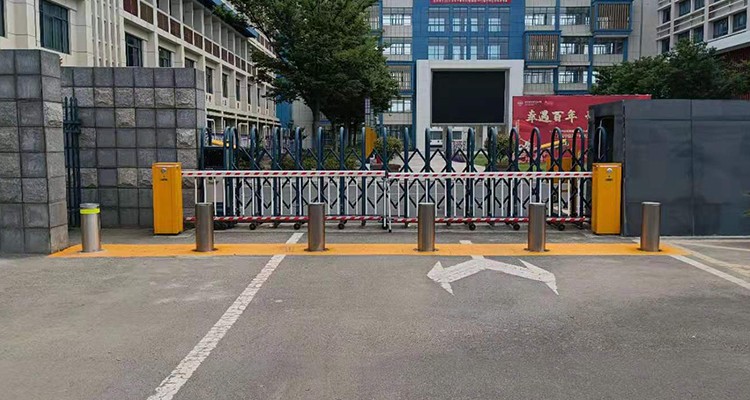
Under-Vehicle Inspection Systems (UVIS): Bollards hold the vehicle while cameras scan the undercarriage
Barrier Arm Gates (Secondary): Bollards provide primary stopping power; barrier arms provide visual deterrence
3. Emergency Override and Fail-Safe Operation
Checkpoint bollards must never prevent emergency egress. Requirements include:
Fire Alarm Interface: On fire alarm activation, all lane bollards auto-lower
Manual Emergency Release: Local push-button or key switch at each lane
Backup Power: Battery or UPS ensures bollards can lower during power outage
Remote Command Center Override: Central security operations center can lower all bollards remotely
Special Considerations for Border Environments
Extreme Temperature Operation
Border crossings in northern climates (Mongolia-Russia border, Canada-US border, Nordic checkpoints) require bollards that operate reliably at -40°C. UPARK 36V DC bollards with IP67 rating and low-temperature hydraulic oil options are deployed at border facilities where winter temperatures exceed the operating range of standard equipment.
Dust and Sand Protection
Arid border regions (Middle East, Central Asia) present sand ingress challenges. IP67-rated bollards with sealed electrical enclosures prevent sand-related failures. Additional air filtration for equipment cabinets may be required in extreme dust environments.
High-Cycle Durability
Busy border crossings process 500-2000 vehicles per day per lane. This requires bollards rated for 1,000,000+ cycles. UPARK bollards are cycle-tested to 1,000,000 operations, making them suitable for high-throughput checkpoint applications without premature wear.
Case Study: Highway Inspection Station Bollard System
A provincial highway inspection station installed UPARK automatic bollards at 6 truck inspection lanes and 4 passenger vehicle lanes. The system integrates with license plate recognition, under-vehicle inspection, and a central command center. Since installation, unauthorized vehicle intrusion incidents have dropped to zero, while average lane processing time has decreased by 18% due to automated bollard operation.
UPARK Checkpoint Bollard Solutions
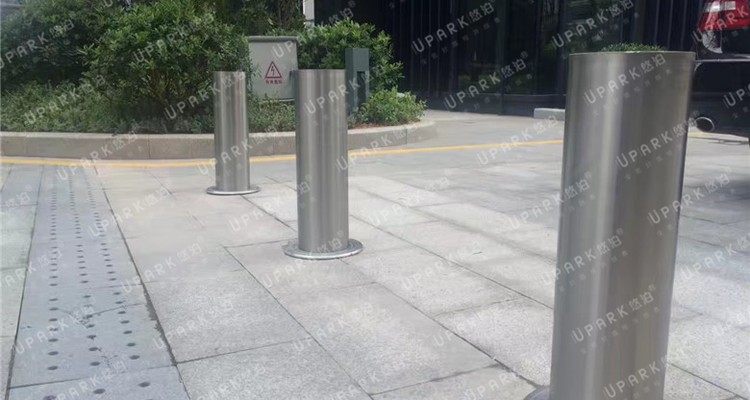
UPARK provides integrated bollard systems for checkpoint, border crossing, and inspection station applications worldwide. Our solutions include PLC-based control logic, surveillance system integration interfaces, emergency override systems, and 24/7 technical support. Contact our engineering team for a checkpoint security assessment and bollard system design proposal.
call us :
+86 18206096507 e-mail : [email protected]




 ipv6 network supported