Bollards vs Mobile Barriers: When Permanent Protection Wins
In perimeter security circles, a debate has emerged between two schools of thought: permanently installed bollards and portable mobile barriers. Both products can stop a vehicle at speed. Both hold crash-test certifications under PAS 68, IWA 14-1, or ASTM standards. But choosing between them is not a contest of pure stopping power. It is a matter of operational fit. And for many sites, permanent bollards remain the superior choice.
Mobile barrier systems such as the Archer 1200 have earned attention for their flexibility. No excavation, no wiring, no concrete curing period. You drop a unit on the ground, anchor it, and within ten minutes you have a certified vehicle barrier. This is genuinely impressive for parade routes, street festivals, construction zones, and pop-up security checkpoints.
But here is what mobile barrier marketing rarely emphasizes: flexibility comes at the cost of permanence. When the event ends and the barriers go back to the warehouse, the site is unprotected. For locations that need security every single day, every single hour, the math favors bollards.
The Always-On Difference
A permanent automatic bollard does not need to be deployed. It sits flush with the pavement when traffic flows, rises in seconds when access is restricted, and lowers again when an authorized vehicle approaches. This happens hundreds of times per day at busy commercial and residential entry points.
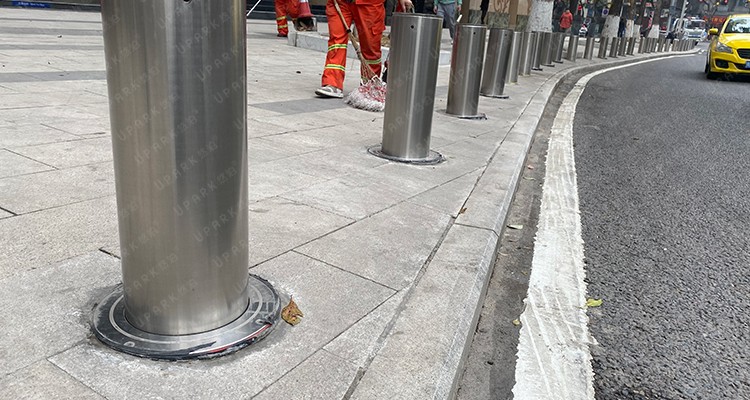
The zero deployment time factor is not just a convenience. It means security is functional 24 hours a day, 7 days a week, 365 days a year. There is no gap between needing protection and having barriers in position. If a threat emerges at 3 AM on a Sunday, a permanent bollard is already there. A mobile barrier, by contrast, is sitting in a storage depot.
For data centers processing financial transactions around the clock, for embassies that could become targets without warning, and for government buildings that face constant threat levels, this always-on posture is the reason permanent bollards are the default specification.
Daily Access Control: Where Bollards Dominate
Picture a luxury residential compound with 500 vehicle movements per day. Residents enter via RFID tag. Delivery trucks are authorized through a guard station. Visitors are let in after a phone verification. An automatic bollard lowers and rises for each event in 3 to 5 seconds. The entire workflow is seamless, electronic, and fast.
Now imagine replacing that bollard with a mobile barrier. Every entry and exit would require a person to drag a heavy steel unit across the roadway. Even with a trailer-mounted system, the logistics would be absurd. Mobile barriers are designed for temporary checkpoints, not for continuous throughput. This is the core operational distinction: bollards serve daily life. Mobile barriers serve temporary events.
The same logic applies to corporate campuses, hospital emergency bays, airport service roads, and military base entries. These are sites where access control happens thousands of times per month. You cannot redeploy a mobile barrier thousands of times. You need a system that handles it silently and automatically.
Permanent Protection, No Storage Headaches
Mobile barriers consume real estate even when they are not protecting anything. A fleet of Archer 1200 units or similar systems requires a storage yard, a transport vehicle, maintenance staff, and deployment training. When they sit idle for weeks between events, they are still costing money in depreciation, space, and readiness drills.
Permanent bollards have no storage requirement. They live in the ground where they do their job. Their footprint is measured in centimeters, not square meters of warehouse space. For urban environments where real estate is expensive, this alone can justify the installation cost of bollards over a mobile barrier fleet.
Certification Parity with Operational Divergence
Both bollards and mobile barriers can achieve identical crash ratings. PAS 68 V/7500(N3)/80/90 means the same thing whether the product is a bollard or a barrier. A vehicle of 7,500 kg at 80 km/h was stopped within a specified penetration distance. The test standard does not care about deployment method.

This means the security buyer faces a real question: two products, same rating, but entirely different operational profiles. If your site needs protection right now, and will need it again in ten minutes, and every ten minutes after that for the next decade, bollards are the correct technical answer.
When Mobile Barriers Make Sense
To be fair, mobile barriers do have their place. Temporary events. Seasonal markets. Emergency road closures. Short-term construction projects lasting weeks rather than years. In these scenarios, the portability of a mobile barrier is a genuine advantage, and no one should be digging a permanent bollard foundation for a three-week job site.
The best security architectures sometimes use both. Permanent bollards at the main entrance of a stadium, mobile barriers for the overflow crowd control zone on game day. This layered approach is what sophisticated security consultants recommend. But when the question is about the primary, always-active layer of defense, bollards remain the industry standard for a reason.
The Bottom Line
Mobile barriers are excellent tools for temporary, event-driven security needs. But for sites that require 24/7/365 protection with seamless daily access control, permanent automatic bollards offer an operational advantage that no portable system can match. Zero deployment time, zero storage footprint, zero staffing requirements for routine operation, and the same crash ratings as mobile alternatives. If security is not a one-day event but a permanent requirement, the answer is in the ground, not on a trailer.
call us :
+86 18206096507 e-mail : [email protected]




 ipv6 network supported