The Problem: Heat and Hydraulic Systems Don't Mix
As global temperatures break records — with summers in the Middle East, South Asia, and southern Europe regularly exceeding 45 °C — the reliability of automatic bollard systems is under increasing scrutiny. Facilities managers in Riyadh, Chennai, Dubai, and Phoenix are reporting hydraulic bollard failures at a disproportionate rate during peak summer months. The root cause is physics, not poor manufacturing: hydraulic systems are fundamentally incompatible with sustained extreme heat.
Electromechanical bollards, by contrast, operate on entirely different principles — and those principles make them inherently more suitable for high-temperature environments.
How Heat Destroys Hydraulic Bollard Performance
A hydraulic bollard system relies on pressurized oil to extend and retract the bollard post. Three components are critically vulnerable to heat:
**1. Hydraulic Oil Viscosity**
ISO VG 46 hydraulic oil — the most common grade used in bollard systems — has a kinematic viscosity of approximately 46 cSt at 40 °C. At 60 °C, this drops to roughly 20 cSt; at 80 °C, it falls below 10 cSt. Thin oil cannot maintain the pressure differential required to lift a 50–80 kg bollard post reliably. The bollard rises slowly, partially, or not at all. In worst cases, thermal expansion of oil inside a sealed circuit causes unintended upward movement — a safety hazard.
**2. Seal Degradation**
Standard nitrile (NBR) seals used in hydraulic cylinders are rated to approximately 80–100 °C. In regions where summer pavement temperatures exceed 60 °C and direct sunlight heats above-ground hydraulic unit housings to 70–90 °C, these seals are operating at or beyond their design limits. Hardening and micro-cracking begin within 1–2 seasons, leading to oil weeping, pressure loss, and ultimately catastrophic seal failure.
**3. Heat Exchanger / Cooling Requirements**
High-cycle hydraulic bollard systems (>50 operations per day) generate additional heat through pump inefficiency and friction. In ambient temperatures above 40 °C, the oil temperature inside the reservoir can reach 95 °C during peak operation. Most bollard manufacturers do not include active cooling, meaning oil degradation accelerates with every cycle.
Electromechanical Architecture: No Oil, No Problem
An electromechanical bollard replaces the hydraulic pump, valve block, oil reservoir, and cylinder with a DC gear motor driving a precision leadscrew mechanism. The physics of heat interaction is fundamentally different:
**Motor Performance vs. Temperature**
DC motors experience a gradual reduction in torque as winding temperature rises, governed by the copper resistance increase coefficient of ~0.4% per °C. A motor rated at 70 °C operating temperature loses approximately 12% torque at that limit — easily compensated by modest overrating. Compare this to hydraulic oil, which loses 60–70% of its viscosity across a similar temperature range.
**No Seals Under Pressure**
The leadscrew mechanism uses only lubricated ball bearings and a polymer anti-backlash nut. There are no pressurized fluid seals. The IP67 outer housing prevents ingress of dust and moisture without relying on dynamic seals that degrade under heat cycling.
**Thermal Mass and Dissipation**
A typical electromechanical bollard motor weighs 2–4 kg of copper and iron — materials with high thermal mass. Heat from a single cycle (typically 3–5 seconds) is trivial compared to the motor's capacity. The housing acts as a passive heatsink. No active cooling is required even at 100+ cycles per day.
Side-by-Side Data Comparison
| Parameter | Hydraulic Bollard | Electromechanical Bollard |
|---|---|---|

| Max reliable ambient temperature | ~35–40 °C | ~65–70 °C |
| Oil viscosity loss at 60 °C | −55% (causes malfunction) | N/A — no oil |
| Seal lifespan in hot climates | 2–4 years | No pressurized seals |
| Performance at 100 cycles/day in heat | Degraded; oil temp ~90–95 °C | Consistent; no heat buildup |
| Maintenance interval (hot climate) | 3–6 months (oil + seals) | 12–24 months (bearing inspection) |
| Unplanned failure risk in summer | High (seal failure, viscosity loss) | Low (motor thermal protection) |
| 10-year TCO (per unit, hot climate) | $8,500–$12,000 | $2,200–$2,800 |
Real-World Failure Scenarios
**Airport Entrance, UAE (2022):** A 12-unit hydraulic bollard installation at a commercial airport began experiencing intermittent failures during summer. Investigation revealed that oil temperature in the reservoir reached 97 °C during peak afternoon operation (ambient 48 °C). Three units suffered seal blowouts within the same week. Replacement cost exceeded $18,000 including excavation.
**Hospital Campus, India (2023):** Six hydraulic bollards at a hospital entrance in Tamil Nadu (ambient summer temperature regularly 42–45 °C) required seal replacement every 14 months — twice the manufacturer's stated interval. The facility switched to electromechanical bollards; two years later, zero unplanned failures.
These cases illustrate that hydraulic bollard specifications written for temperate climates do not translate to hot environments.
The Right Choice for Hot Climate Installations
For any installation where the average summer temperature exceeds 38 °C, or where pavement temperatures will regularly exceed 55 °C, electromechanical bollards are the technically correct choice. The lower acquisition cost differential (typically 10–20% higher upfront for electromechanical) is recovered in the first 2–3 years through reduced maintenance, and the 10-year total cost is 65–75% lower.
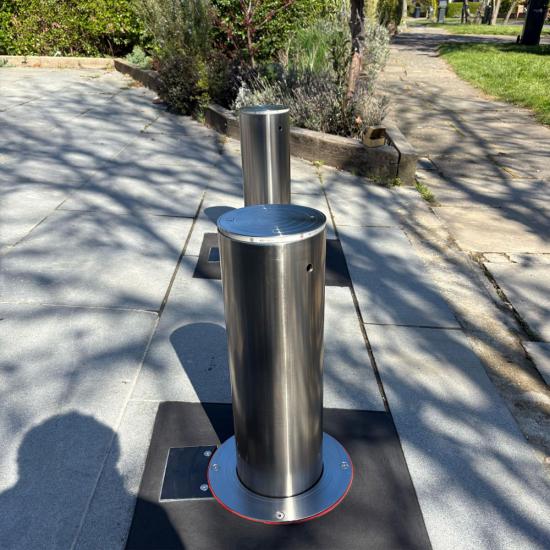
UPARK's 120 mm electromechanical bollard is specifically engineered for demanding environments: 36 V low-voltage motor, IP67 housing, −30 °C to +70 °C operating range, and a 3 mm wall thickness steel post for physical security. It is the right specification for hot climates — from the Arabian Peninsula to the Indian subcontinent to the southern United States.
call us :
+86 18206096507 e-mail : [email protected]




 ipv6 network supported