Residential security has traditionally focused on alarms, cameras, and fencing. But physical vehicle access control — preventing an unauthorized vehicle from entering the property in the first place — is increasingly part of the security conversation, particularly for gated communities, private estates, and high-value residential developments.

The most common residential vehicle security concern is not a deliberate attack but opportunistic vehicle theft and residential burglary. Criminals increasingly use vehicles to block driveways, force garage doors, or create distraction incidents. A bollard at the driveway entrance creates a physical barrier that no amount of opportunism can quickly overcome.
For gated communities with multiple points of vehicle entry, automatic bollards at secondary entrances — the pedestrian gate, the service entrance, the emergency exit — close the gaps that card-access gates leave open. A vehicle cannot tailgate through a bollard.
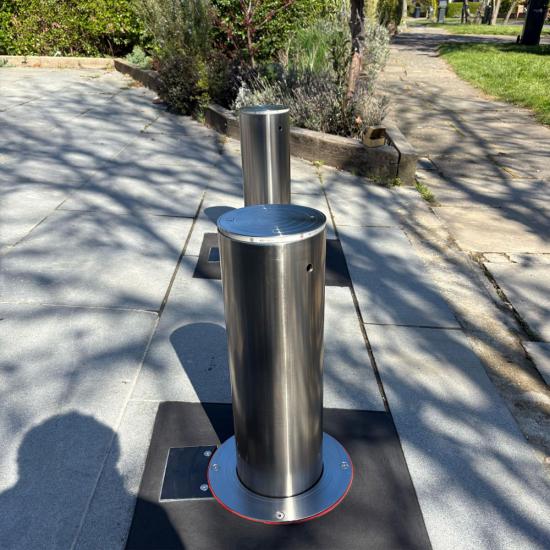
Individual homeowners with high-value properties often install a single automatic bollard or a pair at the driveway entrance. The bollard is lowered by a key fob or smartphone app to allow entry and exit, and raised the rest of the time. This is functionally similar to a gate but with a smaller footprint and no swing clearance requirement.
The 36V low-voltage bollard system is particularly well-suited for residential applications because it eliminates the high-voltage wiring that a traditional gate motor requires. Installation is simpler, and there are no safety concerns about children or pets contacting energized components.
For larger residential communities, the challenge is managing multiple access points while keeping residents' lives convenient. Automatic bollards paired with license plate recognition systems allow registered resident vehicles to enter without stopping. Delivery vehicles, contractors, and guests receive temporary access codes that lower the bollard for a single entry. Emergency vehicles trigger automatic retraction through the same strobe-detection system used in commercial installations.
The ability to grant and revoke access credentials remotely — through a cloud-connected control system — means the community management office can handle access changes without sending anyone to the gate. A resident selling their home? Their vehicle credentials are revoked the moment the management office is notified of the sale.
Private roads on large estates face the specific challenge of managing access over long perimeters with limited staff. Bollards at the primary vehicle entrance, combined with fixed bollards along the road verge, create a defined channel that keeps vehicles on the road and out of landscaped areas or agricultural land.
Remote-controlled operation is especially valuable on large properties where the distance between the gatehouse and the entrance means a staff member cannot visually verify approaching vehicles before opening the gate. With a camera at the bollard and remote control in the gatehouse, the operator has both visual confirmation and physical control without leaving their post.
Residential installations place more emphasis on visual appearance than commercial ones. Stainless steel bollards with brushed or polished finishes complement modern architectural styles. Powder-coated options in black, bronze, or RAL colors blend into traditional and heritage settings. Some manufacturers offer bollard covers in natural stone or hardwood-look finishes for formal garden or estate environments.
Height matters for residential aesthetics as well as function. A 600mm bollard is effective against vehicle intrusion while remaining low enough that it does not dominate the visual field. Pairing bollards with matching planters or low lighting fixtures integrates them into the landscaping rather than making them look like security hardware.
Surface-mount residential bollards install in a concrete pad that can be poured as a standalone project. The 36V DC wiring can typically be run alongside existing landscape lighting cable, eliminating the cost of dedicated conduit installation. Most residential bollard projects can be completed in a single day by a small crew.
Maintenance requirements are minimal: the internal mechanism should be lubricated annually, and the housing should be cleaned of road salt or grime buildup in climates with winter conditions. IP67 waterproofing ensures that neither rain nor irrigation overspray damages the internal components.

call us :
+86 18206096507 e-mail : [email protected]




 ipv6 network supported