Browse almost any supplier catalog and the word 'secure' shows up on nearly every bollard page. A lighted bollard from a landscape focused maker is often described as durable, secure, and stylish in the same breath. The first two words deserve a closer look. A post that glows at night is secure in the sense that it is present and visible. It is not automatically secure in the sense that it will stop a vehicle that decides to keep going. A museum forecourt and a data center entrance get sold with the same label, yet only one of them truly needs a post rated to stop a truck.
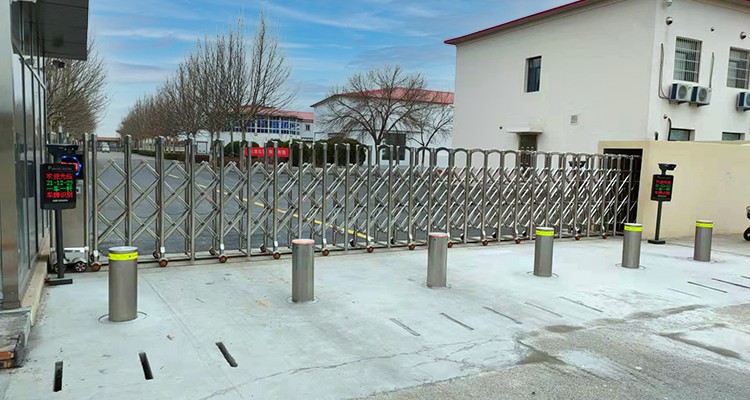
Most decorative lighted posts are sized and anchored for looks and for a glancing bump, not for a deliberate impact. Their foundations are shallow, their cores are slender, and their job was never to absorb the energy of a moving car. If your real concern is a vehicle breaching a perimeter, a post chosen for its lighting will let you down at the worst possible moment.
Fixed and removable security bollards
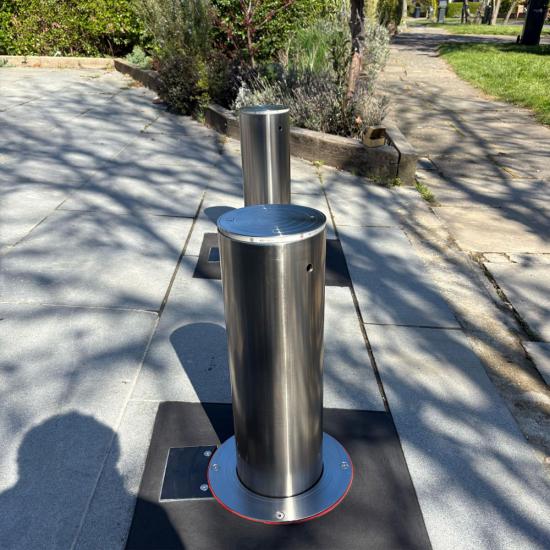
UPARK's security bollards are built around the impact question first. Fixed bollards are set deep and act as a permanent physical wall on foot, a line a vehicle cannot cross. Removable bollards use the same crashworthy body but lift out of their sockets, so a plaza can stay open for a market day and close for a secured event without pouring new foundations. Both are available with the same outdoor ready build: 36V on powered versions, IP67 or IP68 sealing, and a no drainage installation that skips the pump pit entirely.
Why the low voltage build matters
Lighted posts from landscape catalogs are usually tied to a hardwired circuit or a solar battery. Hardwired units pull mains voltage out to every post along a path, which means trenching, conduit, and a fault surface spread across a long line. Solar units avoid the wire but hand you a battery replacement cycle. A security bollard that needs power uses 36V instead, keeping dangerous voltage away from public space and concentrating the electronics in one controller rather than at each post.
Matching the post to the risk

Banks, embassies, utility sites, and government frontages tend to want fixed bollards: a barrier that holds whether anyone is watching or not. Town squares, festival streets, and loading bays want removable ones, because the same ground has to be open on some days and closed on others. The mistake is buying a decorative lighted post and hoping it covers the security job. It covers the lighting job, not the stopping job.
The honest test is simple. Stand at the site after dark and ask what happens if someone drives at the post on purpose. If the answer is 'it might bend,' you have a light, not a barrier. If the answer is 'it holds the line,' you have a security bollard doing the job it was rated for.
There is a middle option people forget. A security bollard and a light are not mutually exclusive. You can mount a low fixture on or beside a crash rated post, or place illuminated markers just outside the secure line to show where the hard barrier begins. The point is to keep the stopping structure honest about what it is, instead of assuming a pretty post will somehow do both jobs at once.
Pick the post for the task it was engineered for. For a permanent line that holds, see our fixed bollards. For ground that has to open and close on a schedule, our removable bollards do the same work without fresh concrete each time.
call us :
+86 18206096507 e-mail : [email protected]




 ipv6 network supported