Vehicle Ramming Attacks and Bollards: How Fixed Protection Saves Lives
Vehicle ramming attacks are not a new threat, but they have become the most common form of mass-casualty urban terrorism in the past decade. A truck, van, or SUV — easily rented, hard to trace, requiring no explosives expertise — can turn a crowded street into a kill zone in seconds. The pattern is grimly consistent: a vehicle accelerates into a dense pedestrian area, causing maximum casualties before law enforcement can respond.
Governments and security agencies around the world have converged on the same solution: physical barriers. And among physical barriers, crash-rated bollards are consistently ranked as the most effective and aesthetically acceptable option for urban environments. Here is the evidence.
The Attack Pattern: Why Vehicles Are the Weapon of Choice

Since 2014, vehicle ramming has been explicitly promoted in extremist propaganda as a low-tech, high-impact tactic. The attacks that — Nice, France (2016, 86 dead); Berlin Christmas market (2016, 12 dead); Stockholm (2017, 5 dead); New York City bike path (2017, 8 dead); Toronto van attack (2018, 10 dead); Waukesha parade (2021, 6 dead); New Orleans (2025, 14 dead) — share a common thread. The attacker chose a location with high pedestrian density and no physical barriers between the roadway and the crowd.
In every single one of these cases, crash-rated bollards installed at the vehicle entry points would have either prevented the attack entirely or forced the vehicle to stop before reaching the crowd. This is not speculation. It is the conclusion of post-incident security reviews conducted by governments in the UK, France, Germany, Australia, and the United States.
How Crash-Rated Bollards Stop an Attack
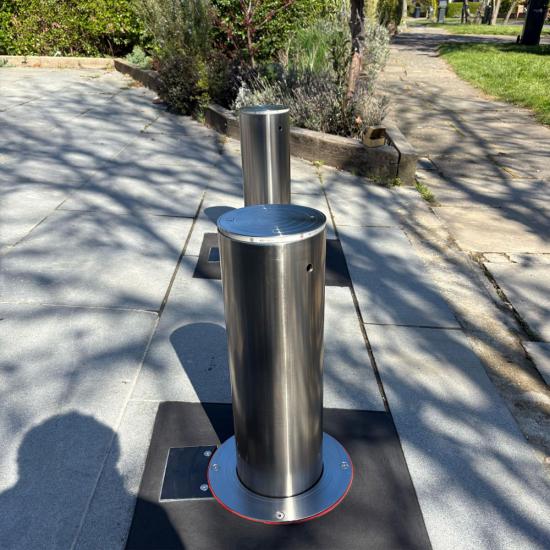
Bollards stop vehicles through a combination of mass, structural engineering, and foundation design, not through sheer weight. A typical K8-rated bollard (PAS 68 equivalent) can stop a 7.5-tonne truck traveling at 80 kilometers per hour. The kinetic energy involved is approximately 1.85 million joules. The bollard absorbs and transfers this energy into its deep concrete foundation, stopping the vehicle within a penetration distance measured in centimeters rather than meters.
Critically, properly engineered bollards remain functional after impact. This is a key distinction from barriers that rely on deformation and replacement. After stopping a vehicle, a high-quality bollard may require a surface inspection and possibly column replacement, but the foundation and surrounding infrastructure remain intact. The security perimeter is restored quickly.
Standards That Define Protection Levels
Not all bollards are crash-rated, and not all crash ratings are equal. The three dominant international standards are:

PAS 68 (UK): Tests vehicle type, impact speed, and penetration distance. A rating of V/7500(N3)/80/90 means a 7,500 kg N3 truck at 80 km/h with less than 0.9 meters of penetration. IWA 14-1: The international adaptation of PAS 68, designed for global comparability across markets. ASTM F2656/F3016 (USA): Uses M-rating (M30, M50) and P-rating (P1-P4) to classify stopping power and penetration depth.
When procuring bollards for anti-ram applications, always verify that the certification matches the threat profile. A M30/P1 bollard that stops a 6,800 kg truck at 50 km/h will fail against the same truck at 80 km/h. Match the rating to the risk.
Where Bollards Belong: The Vulnerability Map
Security consultants use a threat-vulnerability-consequence framework to identify sites that need bollard protection. High-consequence targets include: pedestrian shopping streets where thousands gather daily; stadium and arena plazas during events; government buildings and courthouses; transportation hubs including airports, train stations, and bus terminals; places of worship during services and holidays; outdoor festivals and seasonal markets; and critical infrastructure entry points.
The common factor: all are locations where a vehicle can approach at sufficient speed to cause mass casualties, and where the consequence of a successful attack would be catastrophic. In each case, crash-rated bollards form the most reliable and architecturally compatible protection layer.
Addressing the Bollard Criticism
Some mobile barrier manufacturers argue that permanent bollards are inflexible because they cannot be redeployed. This misunderstands the purpose. Bollards are not meant to be redeployed. They protect a fixed location against a permanent threat. The operational requirement is not flexibility. It is reliability.
Others point to maintenance failures like Bourbon Street as evidence that bollards are unreliable. This is a maintenance problem, not a bollard problem. A car with no oil will seize its engine. A security barrier with no maintenance will fail when needed. Properly specified, installed, and maintained bollards have been protecting government buildings, embassies, and military bases for decades without failure.
The Regulatory Push
Governments are increasingly mandating hostile vehicle mitigation measures in building codes and public space design guidelines. The UK Crowded Places guidance, the US Department of Homeland Security Countering Vehicular Borne Improvised Explosive Devices program, and Australia Strategy for Protecting Crowded Places from Terrorism all explicitly recommend crash-rated bollards as a primary mitigation measure.
Insurance is also driving adoption. Property insurers and event liability carriers are beginning to require documented HVM measures before writing coverage for high-footfall venues. Bollards are becoming not just a security best practice but a business necessity.
The Bottom Line
Vehicle ramming is a persistent, low-cost, high-impact attack method. It will not go away. The only reliable countermeasure is a properly specified, certified, and maintained physical barrier system. Among all barrier types, crash-rated bollards offer the best combination of stopping power, daily usability, aesthetic integration, and long service life. When crowds gather and vehicles approach, what stands between them is a matter of life and death. Choose accordingly.
call us :
+86 18206096507 e-mail : [email protected]




 ipv6 network supported