Not every site that needs an automatic bollard has a mains power supply within easy reach. Construction sites, temporary event venues, rural estates, remote parking areas and perimeter gates often sit far from the nearest electrical cabinet. A battery bollard solves this problem by storing its own energy and operating without a permanent grid connection.
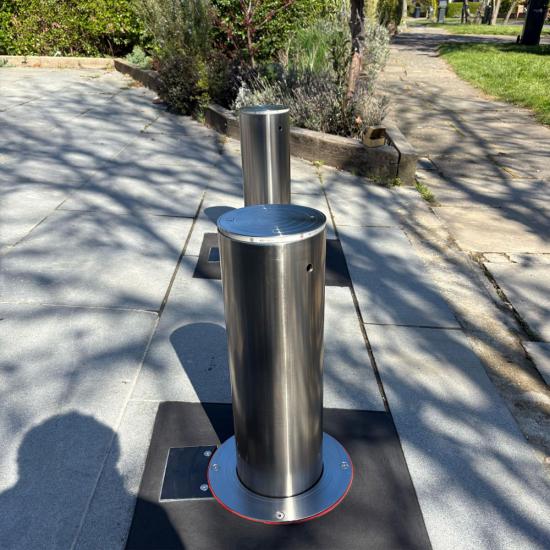
So what is a battery bollard? Put simply, it is an automatic rising bollard that is powered by an internal rechargeable battery pack instead of being wired continuously to mains electricity. The battery can be recharged in several ways: by a small solar panel, by a trickle charger connected periodically, or by a vehicle loop or manual charging cycle. The control unit, motor and sensors are optimized for low energy consumption so the bollard can perform dozens or even hundreds of cycles between charges.
Battery bollards are not the same as solar bollards, although the two terms overlap. A solar bollard always includes a photovoltaic panel. A battery bollard may be solar, but it can also be charged by other means. The defining feature is the on-board energy storage, not the charging source.
Why choose a battery-powered bollard?
The main reason is location flexibility. Trenching cables across a long driveway, a farm road or a festival field can cost more than the bollards themselves. Battery bollards eliminate excavation, conduit runs and electrical permits in many cases. They can be installed at points where wiring is technically possible but economically impractical.
Speed of deployment is another advantage. A battery bollard can often be installed in a single day. Because it is self-contained, there is no need to coordinate with electricians, utility locating services or local power authorities. For temporary sites such as outdoor concerts, sporting events or seasonal markets, this means security can be put in place and removed again without leaving infrastructure behind.
How long does the battery last?
Cycle capacity depends on the battery size, motor efficiency and the weight of the bollard. Modern low-voltage electromechanical bollards running on 36V DC can deliver several hundred cycles on a single charge. Standby time can stretch from a few weeks to several months depending on the controller and whether the bollard is actively monitoring vehicle loops or RFID readers.
Solar charging keeps the battery topped up during daylight hours. In sunny climates, a properly sized panel can make the system effectively self-sustaining. In regions with long winters or heavy cloud cover, the solar panel extends cycle life but may not fully replace manual charging, so specifying the right panel wattage and battery capacity matters.
What about safety and reliability?
Battery bollards use the same low-voltage safety benefits as mains-powered electromechanical bollards. A 36V DC system is far safer than 220V or 380V AC in wet environments. IP67 or IP68 waterproof enclosures protect the battery and controller from rain, dust and road spray. Battery management systems monitor temperature, charge levels and discharge rates to prevent overcharging and extend cell life.
For reliability, the weak point of any battery system is the battery itself. Lithium iron phosphate cells are preferred over standard lithium-ion for outdoor bollards because they tolerate temperature swings better and offer more charge cycles. The controller should also warn the operator when the battery falls below a threshold, so the bollard does not get stuck in the wrong position at a critical moment.
Typical applications
Remote estate entrances, farm and vineyard access points, forestry roads, construction sites, off-grid parking lots, temporary event perimeters, marinas and island resorts all use battery bollards. Anywhere that needs vehicle control but cannot justify the cost of a mains connection is a candidate.
Battery bollards are also used as backup systems for mains-powered installations. In the event of a power outage, a battery backup can allow the bollards to continue operating for hours or days, keeping access controlled during grid failures.
What to check before buying
Ask for the cycle count per full charge, not just the battery amp-hour rating. Check the operating temperature range, especially if the site experiences freezing winters. Confirm whether the solar panel is included or optional, and whether the charge controller supports the local solar conditions. Verify the ingress protection rating of the underground housing. Finally, make sure the control interface supports your preferred access method, whether that is remote fob, keypad, loop detector or mobile app.
Browse UPARK off-grid and battery-powered bollard solutions at Automatic Bollards and learn more about our engineering approach at About UPARK.
call us :
+86 18206096507 e-mail : [email protected]




 ipv6 network supported