Keywords: burglary car theft, 2 in 1 burglary, home break in car theft, keyless car theft 2026, automatic bollards driveway, UPARK bollards

If you drive a modern car with keyless entry, the good news is that automakers have finally gotten serious about closing the relay attack loophole. The bad news is that thieves have found a simpler workaround: breaking into your house to take the keys directly.
This trend, known as a "2-in-1 burglary," is reshaping vehicle crime across the UK and showing early signs of spreading to other markets. Instead of using signal amplifiers to clone your key fob from the driveway, criminals now walk through your front door. One crime becomes two: a home invasion and a vehicle theft.
The irony is hard to miss. Cars got harder to steal electronically, so theft became more physical and more dangerous.
How we got here
For the better part of a decade, keyless car theft was dominated by relay attacks. Two thieves work together: one stands near your front door with a device that captures the signal from your key fob, the other waits by the car with a receiver. The signal gets relayed, the car thinks the key is present, and the doors unlock. No forced entry, no alarm, often no trace. By 2025, relay attacks accounted for 93 percent of all tracked stolen vehicle recoveries in the UK, according to data from vehicle recovery firm Tracker.
Automakers responded. Jaguar Land Rover alone invested ten million pounds in security upgrades and rolled out free firmware updates for existing vehicles. Newer keyless entry systems now use ultra-wideband technology that measures the actual physical distance between the key and the car, making signal relay mathematically impossible to spoof. Other manufacturers adopted motion-sensing key fobs that go dormant when stationary for more than a few minutes, cutting off the signal at the source.
These fixes work. Relay theft of late-model vehicles is declining. But the criminal response has been disturbingly predictable.
The 2-in-1 model
If you cannot spoof the key, you steal the key. If the key is inside the house, you go inside the house.
Tracker police liaison head Clive Wain described the situation bluntly in a February 2026 interview: "While the numbers we are seeing are currently low, they are rising, and we should be mindful of this becoming a nationwide trend." The West Midlands has emerged as a particular hotspot for 2-in-1 burglaries, with clusters of incidents reported in residential neighborhoods where organized theft rings are active.
The shift changes the risk profile entirely. A relay attack is property crime. A 2-in-1 burglary is a confrontation waiting to happen. Homeowners who installed signal-blocking pouches and turned off their key fobs at night are now facing a threat that those precautions do nothing to stop. A Faraday pouch will not help if someone kicks your back door in.
The vehicles being targeted have also shifted. While luxury SUVs like the Range Rover remain high-value prizes for organized export rings, the 2-in-1 trend has broadened the pool. Mainstream models from Toyota, Ford, and Hyundai are now being stolen to order, with the vehicles either shipped overseas or stripped for parts at illegal chop shops. A stolen Toyota Corolla can generate more profit in parts than its intact resale value, which is why even economy cars are now on the target list.
The economics of vehicle theft in 2026
The global vehicle theft economy is enormous. In the United States alone, annual losses from vehicle theft exceed 150 billion dollars, including eighty billion in insurance payouts and fifty billion in uninsured losses suffered by victims who never recover their vehicles. Organized crime networks generate an estimated twenty billion dollars annually from stolen vehicle trafficking and resale.
In Europe, the picture is equally stark. France leads the continent with 248 vehicle thefts per 100,000 residents, equivalent to roughly 451 vehicles stolen every single day. Germany saw a twenty percent year-over-year increase, with losses exceeding 310 million euros. Berlin alone recorded 4,266 thefts, a 46 percent surge that translates to roughly one vehicle disappearing every two hours.
The UK, where the 2-in-1 trend is most acute, reports 142 thefts per 100,000 residents, or about 268 vehicles stolen daily. An estimated sixty percent of thefts in London now involve some form of electronic compromise, and the new Crime and Policing Act 2026 has made it a criminal offense simply to possess, import, or distribute vehicle theft devices, with penalties of up to five years in prison and unlimited fines.
But legislation addresses the tools, not the tactic. The 2-in-1 burglary requires no special equipment at all. Just a crowbar and a willingness to enter an occupied home.
Physical barriers: the layer most homeowners skip
For years, vehicle security advice has been overwhelmingly electronic. Hide your key fob. Buy a signal-blocking pouch. Install a GPS tracker. Update your firmware. All of these are sensible measures, and they have collectively forced thieves to abandon relay attacks on newer vehicles.
But they do nothing to stop someone who has decided to walk through your door.
Physical security is the missing layer, and it starts at the boundary between public access and private property. A driveway with no barrier is an invitation. A driveway with something solid in the way is a problem that adds minutes and noise to a crime that thrives on seconds and silence.
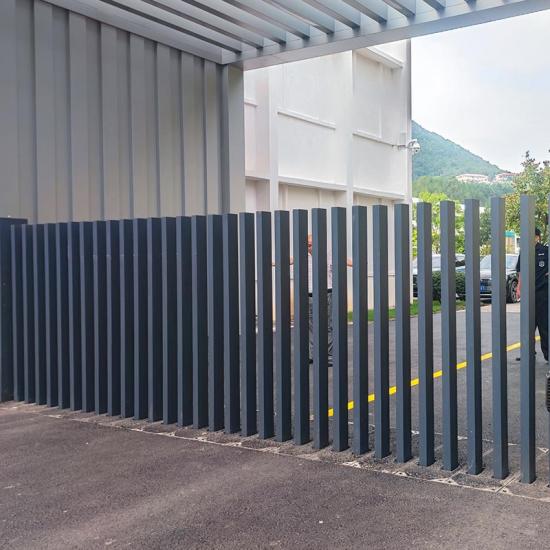
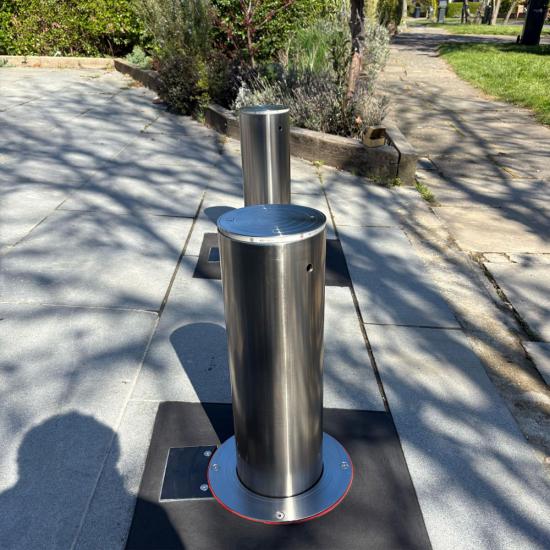
Automatic rising bollards are the most effective physical deterrent for residential driveways because they combine visibility with immovability. Unlike a gate that can be climbed or a chain that can be cut, a retracted bollard sits flush with the ground and presents no obstacle to daily use. When raised, it creates a steel barrier that stops a vehicle cold. Thieves cannot drive your car away if they cannot get the car off the driveway in the first place.
This is not theoretical. Police forces across the UK routinely recommend physical barriers as a first-line defense against vehicle theft. The logic is straightforward: even if a thief successfully enters your home and takes your keys, they still need to get past the bollard to move the vehicle. That extra step is often enough to make the crime not worth the risk.
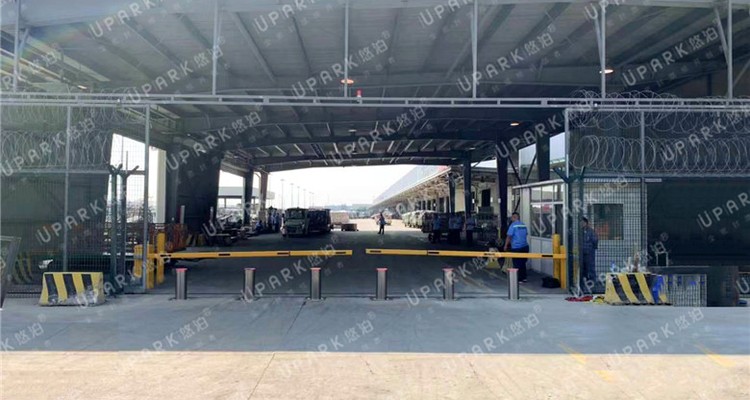
The same principle applies to commercial and fleet parking. Forty percent of commercial vehicle thefts occur at warehouse and depot locations, where large parking areas with minimal physical security make for easy targets. A set of automatic bollards at entry and exit points creates a controlled perimeter that forces every vehicle to pass through a verifiable access point.
What to look for in a residential bollard
Not all bollards are built for residential use. Here are the features that matter.
Low-voltage operation. A 36-volt DC system is safer for residential installation than high-voltage alternatives, eliminates the risk of electric shock in wet conditions, and is often easier to connect to existing home power. UPARK bollards operate on a 36V DC platform specifically designed for residential and light commercial applications. Lower voltage also means lower standby power consumption, which matters when the bollard needs to stay powered 24 hours a day.
Full waterproofing. An outdoor bollard will be exposed to rain, snow, and standing water. IP67-rated construction means the unit is fully sealed against dust and can withstand immersion in water. Critically, a bollard with IP67 certification and a no-drainage design eliminates the need for a drainage system in the foundation, which dramatically simplifies installation and reduces long-term maintenance. Drainage pipes clog, freeze, and fill with debris. A bollard that does not need them is one less thing to fail.
Emergency operation. Power outages happen. A residential bollard must include a manual release or backup lowering mechanism so that you are never trapped inside or locked out. Electromechanical models with a mechanical override are the standard in this category.
Quiet operation. You raise and lower this bollard every day. A hydraulic bollard with a loud pump and a slow cycle time becomes annoying fast. Electromechanical drive systems offer faster cycle times and quieter operation, which matters when you are coming home late or leaving early.
A layered approach to vehicle security
No single measure stops a determined thief. What stops them is a combination of deterrents that make the crime too slow, too noisy, and too risky.
Layer one: physical perimeter. Automatic bollards or lockable posts at the driveway entrance. These create a visible, immovable barrier that prevents a vehicle from being driven off the property even if the keys are stolen. This is the layer that directly addresses the 2-in-1 burglary scenario.
Layer two: electronic immobilization. A hidden engine kill switch or GPS-based immobilizer that prevents the engine from starting even with the correct key. Thieves who get past the bollard by other means still cannot start the vehicle.
Layer three: tracking and recovery. A concealed GPS tracker with a backup battery that continues transmitting location data even if the main vehicle battery is disconnected. Combined with the first two layers, this gives law enforcement a small window to recover the vehicle before it reaches a chop shop or a shipping container.
This three-layer model changes the cost-benefit calculation for criminals. A relay attack requires a few hundred dollars in equipment and thirty seconds of time. A 2-in-1 burglary requires physical entry into an occupied home and carries far higher legal risk. A 2-in-1 burglary where the vehicle is blocked by a bollard, disabled by an immobilizer, and tracked by GPS is a crime with a near-zero probability of success. Most thieves will simply move on to a softer target.
The bottom line
Vehicle security has entered a new phase. The technological arms race between automakers and thieves did not end with better encryption and motion-sensing key fobs. It simply shifted the battlefield. Thieves adapted by becoming more physically aggressive, trading signal amplifiers for crowbars and trading the driveway for the living room.
The solution is not to retreat from technology. It is to add the physical layer that has been missing from most security discussions. A bollard at the end of your driveway is not an inconvenience. It is the difference between waking up to a quiet morning and waking up to an empty parking spot, or worse, a stranger in your hallway.
The 2-in-1 trend is still in its early stages. The numbers are rising, but they have not yet reached the scale that forces systemic change. That makes this the right moment to act, before the problem becomes widespread enough that bollard lead times stretch to months and installation slots disappear.
Physical security is not the whole answer. But it is the part of the answer that most people have not yet taken seriously. And in 2026, that gap is exactly what thieves are counting on.
Learn more about UPARK automatic bollards and how they can protect your driveway from vehicle theft.

call us :
+86 18206096507 e-mail : [email protected]




 ipv6 network supported