Keywords: fleet theft, commercial vehicle theft, warehouse security, depot security, fleet parking protection, automatic bollards commercial, UPARK bollards, commercial parking security
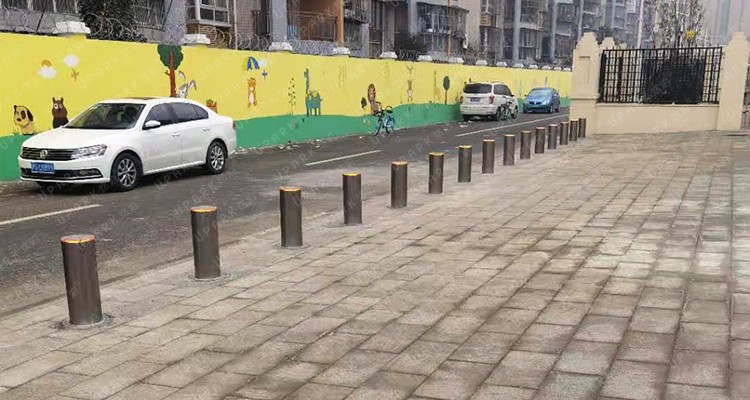
A logistics depot in the West Midlands lost seven vans in one night last year. The thieves cut through a chain-link fence, hotwired the vehicles one by one, and drove them out through the same hole they came in. Total loss: just under three hundred thousand pounds. The depot had CCTV. It had motion sensor lights. It had a security patrol that came by twice a night. What it did not have was anything physically stopping a vehicle from leaving the premises once it was started.
This story is not exceptional. It is typical. And it is happening more often.
Commercial vehicle theft is no longer a nuisance cost that fleet managers bury in an insurance line item. It is becoming a boardroom-level operational risk. The numbers are climbing, the methods are getting more sophisticated, and the insurance market is responding in ways that make physical security not just smart but financially compulsory.
Automatic bollards are the fastest, most reliable way to close the perimeter security gap that most commercial parking facilities still have. Here is why that gap exists, what it is costing businesses, and how to close it before your depot becomes the next headline.
The scale of the problem
Commercial vehicle theft is not just large. It is concentrated. Approximately forty percent of all commercial vehicle thefts occur at the owner's own facility — depots, warehouses, distribution centers, and construction yards. These are not random street crimes. These are planned, targeted attacks on locations where thieves know they will find multiple high-value vehicles parked in predictable patterns with minimal physical security.
The economics are brutal. A single stolen delivery van represents a direct loss of thirty to fifty thousand dollars. But that is only the beginning. The cargo inside could be worth more than the vehicle. The downtime while a replacement is sourced and fitted out costs thousands per day in lost delivery capacity. The insurance premium hike after a claim can add five figures to annual operating costs. And if the theft makes local news, customers start asking questions about supply chain reliability that no fleet manager wants to answer.
In the United States, where annual vehicle theft losses exceed 150 billion dollars, commercial theft accounts for a growing share as organized crime rings shift focus from individual cars to fleet vehicles. The reasoning is simple: a parking lot with twenty identical white vans is a higher-value target than a residential driveway with one car, and the security is often worse.
In Europe, the picture is equally concerning. Germany saw vehicle theft losses of 310 million euros in 2025, with commercial vehicles accounting for a disproportionate share of the increase. France, which leads Europe at 248 thefts per 100,000 residents, has seen organized groups specifically target logistics hubs along major highway corridors. In the UK, where 268 vehicles are stolen daily on average, police forces in the West Midlands and Greater Manchester have issued specific warnings to fleet operators about organized theft rings conducting reconnaissance on depot facilities.
How commercial theft happens
The methods break down into three categories, each requiring a different security response.
Category one: the drive-through. This is the most common. Thieves breach a perimeter — usually a fence, sometimes a gate that was left open — and drive vehicles straight out. The entire operation takes minutes. The security guard, if there is one, might be at the other end of the facility or might not exist at all. CCTV captures everything in high definition, which is useful for the insurance claim and useless for prevention.
Category two: the inside job. A current or former employee with knowledge of key storage, alarm codes, and vehicle locations facilitates the theft. Sometimes the employee is complicit. Sometimes their access credentials have been stolen or cloned. Either way, the thieves know exactly where to go and how to bypass whatever electronic security exists.
Category three: the flatbed extraction. For high-value vehicles like construction equipment, specialized trucks, or armored cash-in-transit vehicles, thieves bring a flatbed truck and a winch. They do not need keys. They do not need to start the engine. They winch the vehicle onto the flatbed and drive away. A running engine attracts attention. A flatbed loading a vehicle at two in the morning looks like a legitimate repossession.
All three methods share a common vulnerability: once a vehicle is moving, there is nothing physically stopping it from leaving the premises. Electronic security — immobilizers, GPS trackers, key management systems — addresses the question of whether a vehicle can be started and whether it can be found after it is stolen. It does not address the question of whether a vehicle that has been started can physically exit the parking area. That is a perimeter problem, and it requires a perimeter solution.
The insurance math
This is where the conversation shifts from security philosophy to hard numbers that CFOs understand.
Commercial fleet insurance premiums have risen sharply across all major markets in 2025 and 2026. In the UK, some fleet operators have seen renewal quotes increase by thirty to fifty percent year over year, even without a claims history. The reason is portfolio-level risk: insurers are repricing commercial auto coverage across the board because theft losses are rising faster than premiums can absorb.
The response from insurers has been increasingly prescriptive. More policies now include explicit security requirements as conditions of coverage. A typical clause might read: "The insured must maintain physical perimeter security including lockable gates or barriers at all vehicle access points during non-operational hours." If a theft occurs and the insurer determines that the required physical barriers were not in place, the claim can be denied.
Some insurers have gone further, offering premium discounts of ten to fifteen percent for facilities that install certified physical security measures including automatic bollards, crash-rated barriers, and monitored access control systems. For a fleet of fifty vehicles paying two hundred thousand dollars a year in premiums, a fifteen percent discount is thirty thousand dollars — enough to pay for a bollard installation at every access point in a medium-sized depot within twelve to eighteen months.
The math gets even better when you factor in avoided losses. A theft incident costs far more than the vehicle's book value. Cargo loss, business interruption, insurance excess, premium increases, reputational damage, and management time spent dealing with police and insurers can push the total cost of a single incident past a hundred thousand dollars. A bollard installation costs a fraction of that and lasts for years.
What effective commercial perimeter security looks like
Effective perimeter security for a commercial parking facility has four components, and they have to work together.
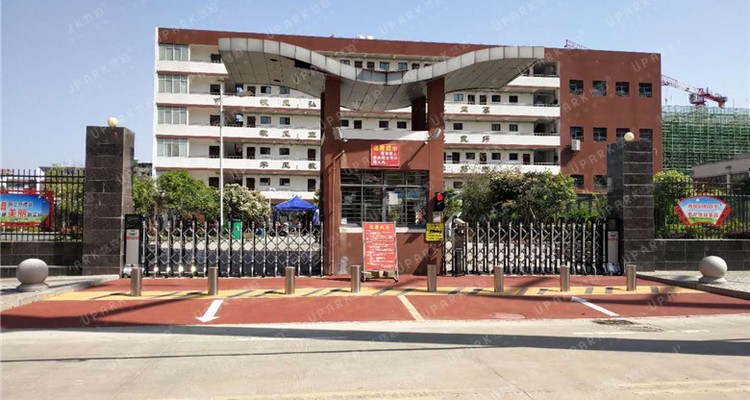
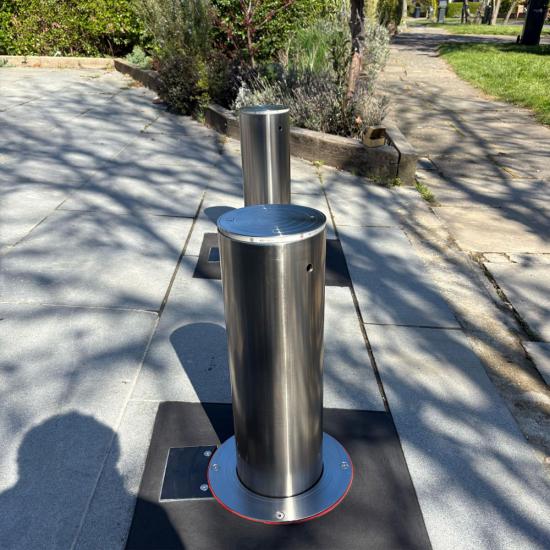
Physical barriers. This is the foundation. Without physical barriers that can stop a moving vehicle, everything else is theater. Automatic bollards are the preferred solution for vehicle access points because they can be raised and lowered on demand, integrate with access control systems, and present no obstacle to authorized traffic during operating hours. For facilities with multiple entry and exit points, each one needs its own barrier. A fence with a single guarded gate and three unguarded service entrances is not a perimeter — it is a suggestion.
Access control integration. Bollards need to know when to go up and when to go down. Integration with RFID card readers, license plate recognition cameras, or keypad entry systems ensures that only authorized vehicles pass through. A bollard that stays raised all the time is a bollard that someone will eventually find a way to bypass. A bollard that lowers automatically for authorized vehicles and stays raised for everyone else is a bollard that actually works at scale.
Surveillance and deterrence. Cameras do not prevent theft. They document it. Their value is as a deterrent and as an investigative tool. But cameras work much better when they are part of a system that includes physical barriers, because a camera that shows a vehicle approaching a bollard and being forced to stop is far more useful than a camera that shows a vehicle driving away unchallenged. Good lighting is equally important — thieves avoid well-lit areas because they increase the chance of being seen and identified.
Procedural discipline. The best security system in the world is useless if someone leaves the gate open or shares an access code with a friend. Commercial facilities need clear procedures: who raises the bollards at the end of the day, who verifies that they are raised, what happens if a bollard malfunctions, how temporary access is granted to contractors and delivery drivers. Security is a process, not a product. But the products make the process enforceable.
Bollard features that matter for commercial applications
Commercial installations have different requirements than residential ones. Here is what fleet operators should look for.
High cycle durability. A bollard at a busy depot entrance might raise and lower fifty times a day. Over a year, that is over eighteen thousand cycles. At a residential driveway, the same bollard might cycle four times a day. The commercial bollard needs to be built for that duty cycle, with components rated for continuous operation and a maintenance schedule that matches actual usage.
Fast cycle time. When a delivery truck is waiting to enter the depot, every second the bollard takes to lower is a second of lost productivity. Electromechanical drive systems offer cycle times of three to five seconds. Hydraulic systems are slower — often ten to fifteen seconds — and become slower in cold weather when hydraulic fluid thickens. For a facility processing dozens of vehicles per hour, the difference between three-second and ten-second cycle times adds up to real operational delays.
Crash resistance. Commercial bollards should be rated to stop a vehicle of known weight at a known speed. Ratings like PAS 68 and ASTM F3016 provide standardized testing that tells you exactly what a bollard will stop. A bollard rated to stop a 7.5-tonne truck at 80 kilometers per hour is a different product from one rated to stop a passenger car at 50 kilometers per hour. The rating needs to match the threat: a distribution center that handles articulated lorries has different needs from a car rental lot.
Low-voltage safety. A 36-volt DC system like the one used by UPARK eliminates the risk of electric shock in wet conditions and simplifies compliance with workplace safety regulations. High-voltage systems require additional safety measures, particularly in outdoor environments where water, snow, and de-icing chemicals are present.
Weatherproofing. IP67-rated construction with a no-drainage design means the bollard is fully sealed against water and dust ingress. This matters especially for commercial installations where drainage systems are already managing large volumes of surface water from parking areas. A bollard that does not need its own drainage does not add to that load and can be installed without disrupting existing water management infrastructure.
Manual override. Every commercial installation needs a manual lowering mechanism for each bollard, accessible to authorized personnel. Power failures, system malfunctions, and emergency situations require the ability to lower bollards without electrical power. This is not optional for commercial sites — it is a basic operational requirement.
The case for acting now
There is a pattern to how security investments happen in commercial fleets. First, the industry ignores the problem. Then a few high-profile incidents make the news. Then insurance companies start attaching conditions to coverage. Then the early adopters install physical barriers and watch their premiums drop while their competitors scramble to catch up. Then bollard lead times stretch from weeks to months and installation contractors get booked solid.
We are somewhere between stages three and four right now. The insurance market is tightening. The theft numbers are rising. The early adopters are moving. The window for getting ahead of the curve — for installing physical security before it becomes an insurance mandate and before everyone else tries to do the same thing — is open right now. It will not stay open forever.
The question to ask is not "can we afford to install bollards." The question is "can we afford not to." A single theft incident at a depot can cost more than the entire bollard installation. Two incidents in a year can trigger a premium increase that makes the bollard cost look trivial. And one incident that involves stolen cargo, environmental damage, or — worst case — injury to an employee who confronted a thief can escalate into a legal and regulatory nightmare that no amount of insurance can fully resolve.
The bottom line
Commercial vehicle theft is a growing threat that existing security measures are not designed to handle. Electronic immobilizers, GPS trackers, and key management systems are useful layers. But they do not address the fundamental vulnerability that most commercial parking facilities share: nothing physically prevents a vehicle from leaving once it has been started or loaded onto a truck.
Automatic bollards close that gap. They create a physical perimeter that stops unauthorized vehicle movement at the most critical point — the exit. Integrated with access control systems, they allow authorized traffic to flow freely during operating hours while maintaining a hard barrier against after-hours intrusion. Combined with surveillance, lighting, and procedural discipline, they form the foundation of a security posture that deters the opportunistic thief, frustrates the organized ring, and satisfies the increasingly demanding requirements of commercial fleet insurers.
Every fleet manager knows that the overnight hours between depot close and morning opening are the vulnerable window. A bollard that stands guard during those hours, that does not get tired, does not get distracted, and does not get intimidated — that is not a cost center. It is a night watchman that never calls in sick and never asks for overtime.
Learn more about UPARK automatic bollards and secure your commercial fleet parking against the growing threat of organized vehicle theft.
call us :
+86 18206096507 e-mail : [email protected]




 ipv6 network supported