Keywords: EV theft, hybrid vehicle theft, electric car stolen, catalytic converter theft, EV charging station security, automatic bollards EV, UPARK bollards

If you bought an electric or hybrid vehicle in the last three years, you probably thought about range, charging infrastructure, and battery life. You probably did not think about theft. But the data says you should.
Electric vehicle theft in the United States has surged nearly 200 percent over the past three years, according to the National Insurance Crime Bureau. Hybrids are not far behind. And the reasons go far beyond the obvious fact that EVs are expensive. Thieves have figured out that electric and hybrid vehicles present a unique combination of high parts value, quiet operation, and predictable parking patterns that make them unusually attractive targets.
The trend is global. In France, which tops European vehicle theft rankings at 248 thefts per 100,000 residents, hybrid and electric models are disproportionately represented among stolen vehicles. In Germany, where vehicle theft losses exceeded 310 million euros in 2025, electric models command higher insurance premiums specifically because of elevated theft risk. The UK, already grappling with a 2-in-1 burglary trend, is seeing EV thefts rise faster than the overall vehicle theft rate.
Automatic rising bollards are not the first thing that comes to mind when people think about EV security. But as this article will show, they should be.
Why thieves target EVs and hybrids
The first reason is straightforward: parts. An electric vehicle battery pack is worth thousands of dollars on the black market. A hybrid catalytic converter contains rhodium, palladium, and platinum — precious metals whose prices have spiked dramatically. Rhodium alone has risen 126 percent in the past two years, triggering a global resurgence in catalytic converter theft. In Sao Paulo, Brazil, catalytic converter thefts surged 193 percent in the first half of 2025 alone. Cities across the United States, Europe, and Australia are seeing the same pattern.
A stolen Prius catalytic converter can sell for over a thousand dollars to a scrap dealer. The thief needs about ninety seconds with a battery-powered saw to remove it. The victim faces a repair bill of two to three thousand dollars and weeks of waiting for parts. For organized theft rings, the math is simple: five cars a night, five nights a week, and the revenue stream rivals mid-level drug trafficking — with far lower legal risk in most jurisdictions.
The second reason is behavioral. EV and hybrid owners follow predictable parking patterns. They charge at home overnight. They park at public charging stations for thirty minutes to several hours. They leave vehicles unattended in designated EV parking spots at workplaces, shopping centers, and highway rest stops. All of these are environments where a thief can predict with high confidence how long the vehicle will sit unattended. Predictability is the thief's best friend.
The third reason is operational. Electric vehicles are quiet. A thief pulling a gasoline car out of a driveway produces engine noise that can wake a homeowner or alert a neighbor. An EV in motion is nearly silent. For theft rings targeting residential areas at night, that silence is a tactical advantage.
The charging station vulnerability
Public charging infrastructure has expanded rapidly, and security has not kept pace. Most charging stations are designed for convenience and throughput, not for theft prevention. They are located in parking lots with open access, minimal surveillance, and no physical barriers between the charging vehicle and the nearest exit.
A thief watching a charging station knows exactly how long a vehicle will be there. The charging session timer is often visible on the vehicle's dashboard or the charging unit's display. If a driver plugs in at a 50 kW fast charger and the battery is at twenty percent, the thief has a forty-five minute window. That is more than enough time to strip a catalytic converter, clone a key signal, or, in the case of organized theft rings, bring a flatbed truck and load the entire vehicle.
The International Association of Auto Theft Investigators has flagged charging stations as emerging theft hotspots, particularly along highway corridors where vehicles are left overnight at hotel charging points. A Tesla or Hyundai Ioniq sitting unattended in a poorly lit hotel parking lot with a charging cable attached is not just a target — it is a target with a built-in countdown timer.
The catalytic converter resurgence
Catalytic converter theft is not new. It peaked around 2021-2022, then declined as law enforcement cracked down and precious metal prices stabilized. But 2025-2026 has brought a sharp resurgence, driven by rhodium and palladium price spikes that have made converters more valuable than ever.

Hybrids are disproportionately affected because their catalytic converters contain higher concentrations of precious metals. A hybrid engine runs less frequently than a conventional one, so the catalytic converter needs more active material to stay effective at lower exhaust temperatures. That means more rhodium, more palladium, and more profit for thieves.
The National Insurance Crime Bureau reports that catalytic converter theft claims in the US rose sharply in late 2025 after a brief decline, with California, Texas, and New York leading the nation. Repair costs for a stolen converter now average between two thousand and four thousand dollars, and in some cases the damage extends to the oxygen sensor, exhaust manifold, and underbody wiring — pushing total repair costs past five figures.
For fleet operators running hybrid delivery vans or company cars, the risk is compounded. A fleet of ten Priuses parked in an unsecured lot overnight represents a potential six-figure loss in a single evening. And commercial auto policies increasingly exclude catalytic converter theft or impose deductibles so high that the coverage is effectively useless.
The residential risk
EV and hybrid owners who charge at home face a different kind of exposure. A vehicle parked in a driveway with a charging cable connected is visibly, unmistakably an EV. The charging port door is open. The cable runs from the wall or charging unit to the car. Any thief driving through a residential neighborhood can identify EV-owning households in seconds, no reconnaissance required.
This is not speculative. Police departments in California have documented cases where thieves specifically canvassed neighborhoods for homes with visible charging equipment, returning later to steal the vehicle or strip its catalytic converter. The charging cable itself is also a target — copper prices have risen, and a high-quality Level 2 charging cable contains enough copper to be worth stealing on its own.
The 2-in-1 burglary trend, already discussed in our previous coverage, compounds this risk. If thieves cannot relay-attack a keyless entry system, they break into the house and take the keys. An EV parked in the driveway with a charging cable attached tells the thief not just that a valuable vehicle is present, but exactly where to find the keys — likely on a hook near the front door or in the kitchen, where most people keep them.
Physical security for EV owners
Electronic security measures have value. Signal-blocking pouches prevent relay attacks. GPS trackers aid in recovery. Engine immobilizers prevent hotwiring. But none of these measures stop a thief from physically accessing the vehicle to strip its catalytic converter, steal its charging cable, or load it onto a flatbed truck.
Physical barriers do.
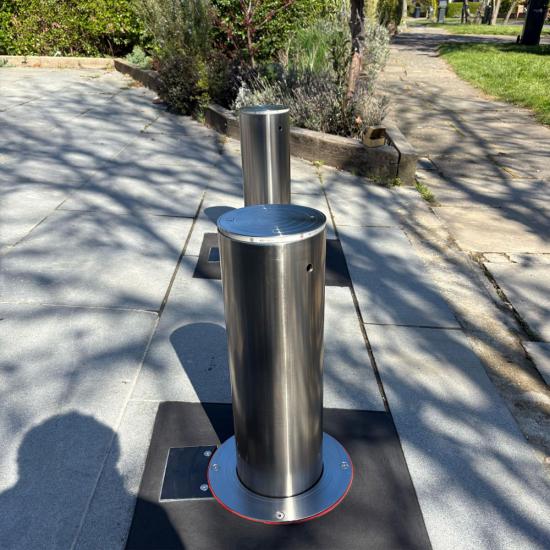
An automatic rising bollard installed at the driveway entrance creates a steel barrier that physically prevents a vehicle from being driven off the property. For catalytic converter theft, a bollard does not stop the thief from crawling under the car — but it does prevent the getaway vehicle from approaching close enough to make a quick escape, and it signals to anyone watching that this property has active security measures in place. Thieves overwhelmingly choose the path of least resistance. A bollard makes your property the path of more resistance.
For charging station security, the logic is the same but the scale is different. A commercial charging station with bollards at entry and exit points creates a controlled perimeter where every vehicle must pass through a verifiable access point. Combined with surveillance cameras and adequate lighting, this turns an open, unmonitored lot into a secured facility. The cost of a few bollards is trivial compared to the liability and reputational damage of a theft incident at a charging station that bears your brand name.
Features that matter for EV security applications
Low-voltage operation. EV charging infrastructure is already pushing the limits of residential and commercial electrical systems. Adding a high-voltage bollard system on top of a Level 2 charger, HVAC, and household appliances can require a service upgrade. A 36-volt DC bollard system like the one used by UPARK draws minimal power and integrates cleanly into existing electrical panels without modification. Lower voltage also means safer operation around water, which matters when the bollard is installed outdoors near a charging station.
Full waterproofing and no drainage. Outdoor bollards face rain, snow, and standing water. An IP67-rated bollard with a no-drainage design eliminates the need for a drainage system in the foundation. This matters particularly for EV installations because charging stations are often located in parking areas with existing drainage systems that should not be disrupted. A bollard that does not need its own drainage is a bollard that can be installed without re-engineering the entire parking lot.
Fast cycle time. EV owners already wait for their cars to charge. They do not want to wait for a bollard to lower. Electromechanical drive systems offer cycle times of three to five seconds, compared to ten to fifteen seconds for hydraulic alternatives. When you are coming home with a low battery and it is raining, those seconds matter.
Silent operation. An EV is quiet. A bollard should be too. Hydraulic pumps are loud and intrusive in residential settings. UPARK's electromechanical bollards operate at noise levels low enough that they will not wake a sleeping household or draw attention from neighbors. In a residential context where the bollard is raised and lowered multiple times per day, quiet operation is not a luxury — it is a basic usability requirement.
Emergency manual override. Power outages are the nightmare scenario for EV owners: the car needs charging, the grid is down, and now the bollard will not lower. A manual release mechanism that allows the bollard to be mechanically lowered without power is non-negotiable. All UPARK automatic bollards include this feature as standard.
A security strategy that makes sense for 2026
The vehicle theft landscape in 2026 rewards preparation and punishes assumption. Assuming that keyless encryption will protect your car is exactly what thieves are counting on. Assuming that a public charging station is safe because it is well-lit is exactly what theft rings exploit. Assuming that your neighborhood is too quiet for catalytic converter theft is exactly what makes quiet neighborhoods the best hunting grounds.
A practical EV security strategy has three layers.
Layer one: make the vehicle inaccessible. An automatic bollard at the driveway or parking space entrance prevents the vehicle from being driven away or loaded onto a truck. For commercial charging stations, bollards at site entry and exit points create a controlled perimeter. This is the layer that stops the theft before it starts.
Layer two: make the vehicle unstartable. A hidden kill switch or GPS-based immobilizer that cuts power to the drive motor prevents the vehicle from being driven even if a thief gains physical access. For EVs, this can be integrated with the vehicle's existing battery management system.
Layer three: make the vehicle trackable. A concealed GPS tracker with an independent battery that continues transmitting after the main battery is disconnected. In an EV, the main battery is large and difficult to disconnect quickly, which actually makes tracking more reliable than in gasoline vehicles — but a backup battery is still essential for the tracker itself.
This three-layer model works because each layer addresses a different type of threat. The bollard stops the opportunistic thief and the flatbed truck. The immobilizer stops the thief who gets past the bollard. The tracker gives law enforcement a chance to recover the vehicle if both previous layers fail. No single layer is perfect. Together, they change the risk calculation enough that most thieves will look elsewhere.
The bottom line
Electric vehicles represent the future of transportation. They also represent the future of vehicle theft, because criminals follow value the same way water follows gravity. High parts prices, predictable parking patterns, quiet operation, and visible charging equipment make EVs and hybrids unusually attractive targets. The data from 2025 and early 2026 confirms that thieves have noticed, and they are adapting their methods accordingly.
The response does not need to be complicated. Electronic security has its role, but the most effective single measure an EV owner can take is to install a physical barrier between their vehicle and the outside world. A bollard at the end of your driveway does not care whether your car is electric or gasoline. It does not care whether the thief has a signal amplifier, a crowbar, or a flatbed truck. It just stops the vehicle from moving.
In a security environment where threats are evolving faster than most people's defenses, that kind of brute-force reliability is worth more than any amount of clever technology.
Learn more about UPARK automatic bollards and protect your EV from theft with physical security that actually works.

call us :
+86 18206096507 e-mail : [email protected]





 ipv6 network supported