Keywords: UK Crime and Policing Act 2026, vehicle theft law UK, keyless car theft ban, car theft device possession illegal, automatic bollards UK, UPARK bollards, physical security UK law
For the first time in British legal history, simply owning a device that could be used to steal a car is now a crime. The Crime and Policing Act 2026, which came into force earlier this year, marks the most significant shift in UK vehicle theft legislation in decades. Possession, importation, and distribution of vehicle theft tools — including signal relays, key programmers, and diagnostic bypass devices — now carry penalties of up to five years in prison and unlimited fines.
The law is a direct response to the epidemic of keyless car theft that has plagued the UK, where an estimated sixty percent of vehicle thefts in London alone involve some form of electronic compromise. But as with any legislation, the gap between what the law prohibits and what it prevents is where the real story lies.
This article examines what the Act actually does, what it does not do, and why the new legal landscape makes physical security measures like automatic bollards more relevant — not less.
What the Act actually changed
Before 2026, UK law treated vehicle theft devices the same way it treated any other tool: possession was legal unless the police could prove intent to use the device for a crime. A signal relay amplifier, a key programming tablet, or an OBD port bypass device could be carried in a vehicle or stored in a home without any legal consequence, as long as the owner did not leave a paper trail of criminal intent.
This created a nearly impossible enforcement challenge. Police officers who stopped a vehicle and found a bag full of key cloning equipment could do little more than note it in their report, unless they could connect the equipment to a specific theft. Organized crime rings exploited this gap ruthlessly, with couriers openly transporting theft equipment between cities knowing that even if caught, they faced no charges.
The 2026 Act closes this loophole entirely. The key provisions are:
Section 14: Possession of vehicle theft devices. It is now a criminal offense to possess, without lawful authority, any device designed or adapted for use in the theft of a vehicle. The burden of proof shifts: a person found in possession of such a device must demonstrate a legitimate reason for having it. A locksmith with professional credentials and a registered business has lawful authority. A twenty-year-old in a hoodie with a signal relay and no locksmith license does not.
Section 15: Importation and supply. Importing, manufacturing, selling, or distributing vehicle theft devices is prohibited. This targets the supply chain that has made theft equipment available through online marketplaces and specialist forums. Conviction carries up to five years imprisonment and an unlimited fine.
Section 16: Forced entry and vehicle theft. The Act introduces aggravated sentencing provisions for thefts that involve forced entry to a dwelling. This provision is aimed squarely at the 2-in-1 burglary trend, where thieves break into homes to steal car keys. The message from Parliament is unambiguous: breaking into someone's home to steal their car is not just burglary — it is an aggravated offense that will attract substantially longer sentences.
Section 17: Electronic compromise. Using any electronic device to bypass a vehicle's security system is now a standalone offense, separate from the theft itself. This means a thief caught with a relay device outside a targeted vehicle can be charged even if the theft has not yet occurred. Previously, police had to wait for the vehicle to actually be stolen before making an arrest. Now, the act of attempting electronic compromise is sufficient.
What the Act does not cover
The legislation is a significant step forward, but it has clear boundaries that homeowners and businesses need to understand.
It does not prevent theft. Making possession of relay devices illegal reduces the availability of those devices, but it does not eliminate them. The devices already in circulation will remain in circulation. Organized crime groups stockpiled equipment before the Act came into force, anticipating exactly this legislation. And the black market for prohibited devices will find ways to operate, just as it does for every other category of prohibited goods.
It does not address physical theft methods. A crowbar, a brick through a window, or a flatbed truck with a winch are not covered by the Act. The 2-in-1 burglary trend — which the Act does address through aggravated sentencing — involves breaking into a home to steal keys, but once the keys are stolen, the vehicle can be driven away normally. The Act punishes the burglary more severely, but it does not physically prevent the vehicle from being taken.
It does not protect vehicles parked in publicly accessible areas. The Act targets the tools and the criminals, not the environment. A vehicle parked on a street, in a public car park, or at a charging station remains as physically accessible as it was before the Act. The law makes it harder to steal the car electronically, but it does nothing to stop someone from loading it onto a flatbed truck.
It relies on enforcement. The Metropolitan Police and other UK forces have welcomed the new powers, but policing resources are finite. Vehicle theft is a high-volume crime that competes for attention with violent crime, domestic abuse, and counter-terrorism. The Act gives police the legal tools to act; it does not give them the officers to make those tools universally effective.

The unintended consequence: more aggressive theft methods
Legislation that closes one avenue of crime often opens another. When electronic compromise became harder — first through manufacturer security upgrades, now through criminalization — thieves did not retire. They adapted.
The 2-in-1 burglary trend is the most visible adaptation. Instead of standing outside a house with a relay antenna, thieves now enter the house. The risk-reward calculus has shifted from low-risk property crime to high-risk personal confrontation, and the question that worries police forces is whether the next adaptation will be even more aggressive.
There is precedent for this. When catalytic converter thefts surged in 2021-2022 and police crackdowns , thieves responded by targeting vehicles parked in more isolated locations and carrying weapons to deter intervention. When immobilizers became standard in the 1990s, carjacking rates rose because thieves could no longer steal parked cars. Each security improvement creates pressure that pushes criminal behavior toward more direct confrontation.
This is not an argument against the 2026 Act. The Act is necessary and overdue. But it is an argument for understanding that legislation alone does not solve the problem — it reshapes the problem. And the new shape of the problem, in 2026, is one where physical security barriers are the only thing standing between a determined thief and a vehicle.
What this means for homeowners
The Act strengthens the case for physical security in three ways.
First, it acknowledges that electronic security alone is insufficient. If Parliament believed that better encryption, motion-sensing key fobs, and signal-blocking pouches were enough, it would not have needed to criminalize the possession of relay devices. The fact that the Act exists at all is an admission that electronic security measures have not solved the problem.
Second, it creates a legal environment where deterrence works on multiple levels. A thief who knows that possessing a relay device carries a five-year sentence is less likely to carry one. A thief who knows that breaking into a home to steal keys carries aggravated sentencing is less likely to attempt a 2-in-1 burglary. A thief who sees an automatic bollard at the end of a driveway knows that even if they get the keys, the vehicle is not going anywhere. Each layer increases the risk and reduces the reward, and the cumulative effect is what makes a property unattractive as a target.
Third, it raises the stakes for being caught. Before the Act, a thief caught with theft equipment might face a minor charge or none at all. After the Act, the same situation carries a potential prison sentence. This does not deter the most determined criminals, but it deters the opportunistic ones — the teenagers recruited by organized rings to act as couriers, the small-time thieves who drift in and out of vehicle crime. These are the people who account for a large share of theft volume, and they are the people most sensitive to changes in the legal risk equation.
What this means for businesses
For businesses that operate vehicle fleets, the Act has a specific commercial implication: insurance requirements are tightening in lockstep with the legislation.
Commercial fleet insurers have been raising premiums across the board, with some UK operators seeing thirty to fifty percent increases at renewal. But the 2026 Act has accelerated a parallel trend: insurers are now writing physical security requirements into policy conditions. A typical clause now reads: "The insured must maintain physical perimeter security including lockable gates or barriers at all vehicle access points during non-operational hours."
This is not a recommendation. It is a condition of coverage. If a theft occurs and the insurer determines that physical barriers were not in place, the claim can be denied. The Act has given insurers the legal and public-policy justification to demand what they have wanted to demand for years: that fleet operators take physical perimeter security seriously.
The financial incentive is equally clear. Insurers are offering premium discounts of ten to fifteen percent for facilities with certified physical security measures including automatic bollards and crash-rated barriers. For a fleet of fifty vehicles paying two hundred thousand pounds a year in premiums, that is a saving of twenty to thirty thousand pounds annually — enough to cover the cost of a bollard installation at every depot access point within a single year.
The practical response: physical barriers
If the 2026 Act teaches one lesson, it is that security is a layered problem that requires layered solutions. Legislation punishes criminals after the fact. Electronic security slows down electronic attacks. Physical security prevents the vehicle from being moved regardless of how the thief obtained access.
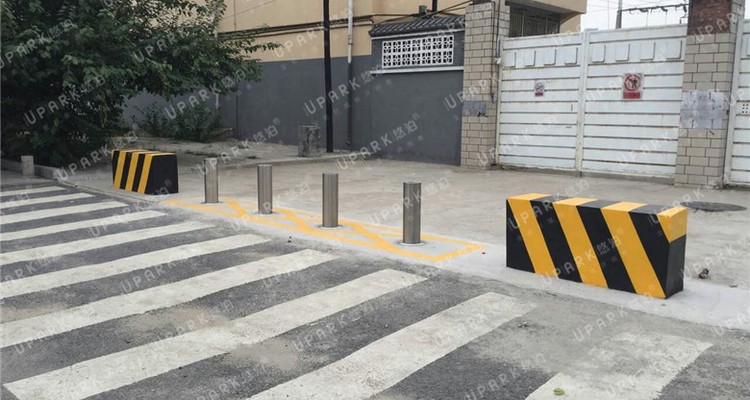
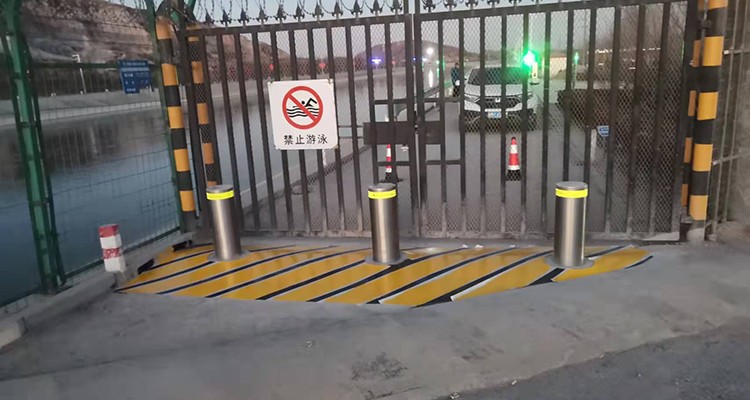
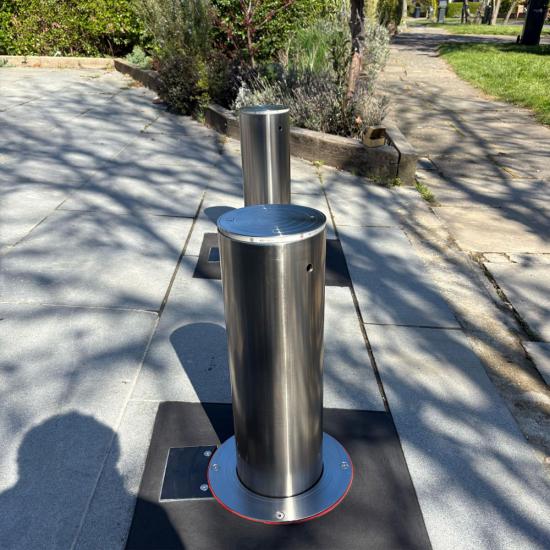
An automatic bollard is the most effective physical barrier for residential driveways and commercial vehicle access points because it combines three qualities that no other solution offers.
It is visible. A raised bollard is an unambiguous signal that this property takes security seriously. Thieves survey neighborhoods before targeting them, and a bollard visible from the street is a deterrent before anyone even approaches the property. A hidden GPS tracker does not deter anyone until after the theft has occurred.
It is immovable. A properly installed bollard stops a vehicle cold. Unlike a gate that can be forced open or a chain that can be cut, a steel bollard rated to stop a 2.5-tonne vehicle at speed is not something a thief can bypass with hand tools. The vehicle simply cannot be driven past it.
It is integrated into daily life. An automatic bollard raises and lowers with a remote control or key fob. It does not require the homeowner to get out of the car in the rain to unlock a gate. It does not add friction to the daily routine. It is there when needed and invisible when not — which is exactly what makes it sustainable as a long-term security measure.
Features to look for
For UK homeowners and businesses shopping for bollards in the post-Act landscape, here are the specifications that matter.
Compliance with UK standards. Bollards installed in the UK should meet PAS 68 or equivalent impact-testing standards. This ensures that the bollard has been independently tested to stop a vehicle of known weight at a known speed, rather than relying on manufacturer claims that have not been verified.
Low-voltage operation. A 36-volt DC system, like the one used by UPARK bollards, is safer for residential installation than mains-voltage alternatives. It eliminates the risk of electric shock in wet conditions — which, in the UK, means most conditions — and is easier to connect to existing domestic electrical systems without requiring a dedicated high-voltage circuit.
IP67 waterproofing with no drainage requirement. Outdoor bollards in the UK face rain, snow, frost, and standing water. An IP67 rating means the bollard is fully sealed against water and dust ingress. A no-drainage design eliminates the need for a drainage system in the foundation, which simplifies installation and reduces the risk of freeze damage in winter. Drainage pipes that fill with water and freeze are a common failure point for outdoor installations — a bollard that does not have them is one less thing to go wrong.
Emergency manual override. UK power grids are reliable but not infallible. Storm-related outages, planned maintenance, and local faults all happen. A bollard without a manual lowering mechanism is a bollard that could trap a vehicle inside or outside the property during a power failure. Every residential and commercial bollard should include a mechanical override that allows the bollard to be lowered without electrical power.
Quiet operation. A bollard at a residential driveway that raises and lowers multiple times per day needs to operate quietly. Hydraulic systems are louder and slower. Electromechanical drive systems offer faster cycle times and noise levels low enough that the operation does not disturb neighbors or wake a sleeping household. In the UK, where houses are often close together and noise travels easily through terraced walls, quiet operation is not optional.
The bottom line
The Crime and Policing Act 2026 is the most significant piece of vehicle theft legislation the UK has ever passed. It criminalizes the possession of theft devices, targets the supply chain, imposes aggravated sentences for home-invasion thefts, and creates a standalone offense for electronic compromise. These are real, meaningful changes that give police and prosecutors tools they have needed for years.
But legislation does not stop a thief from breaking a window, stealing a key, and driving away. It does not stop a flatbed truck from loading a vehicle in a public car park. It does not replace the need for physical barriers at the point where private property meets public access.
The smartest response to the Act is not to assume that the problem is solved. It is to recognize that the Act is one layer of a multi-layer defense, and that the most important layer — the one that physically prevents a vehicle from being taken — has nothing to do with the law at all.
An automatic bollard at your driveway does not care about the Crime and Policing Act. It does not care whether a thief is carrying a relay device, a crowbar, or a set of stolen keys. It just stops the vehicle from moving. In a security environment where every other layer can be defeated by a sufficiently determined criminal, that kind of brute-force reliability is not just valuable — it is irreplaceable.
Learn more about UPARK automatic bollards and secure your property with physical security that works regardless of what the law says.
call us :
+86 18206096507 e-mail : [email protected]





 ipv6 network supported