In 2026, stealing a car doesn't need a crowbar. The tool of choice plugs into a headlight connector, and 90 seconds later the car is gone — no broken glass, no triggered alarm, no forced entry.
This is not theoretical. CAN-bus injection attacks are the fastest-growing vehicle theft method in the world right now. Criminals buy $2,000 hacking tools on Telegram, watch a YouTube tutorial, and drive off with Toyota Land Cruisers and Ford Raptors while the owner is asleep inside the house.
How the CAN bus works — and how thieves exploit it
Every modern vehicle runs on a Controller Area Network — the CAN bus. Think of it as the car's internal internet. The engine, transmission, brakes, door locks, alarm, and immobilizer all talk to each other through this network. When you press unlock on your key fob, the signal travels through the CAN bus. When you start the engine, the immobilizer checks the key through the CAN bus.
Here's the problem: the CAN bus has physical access points all over the vehicle. The headlight wiring harness. The taillight connector. The star connector behind the dashboard. Pry off a trim panel, locate the right wire pair, and you're on the network.
From there, an attacker sends commands the car trusts without question. "Unlock the doors." "The key is present — disable the immobilizer." "Start the engine." The car obeys. It cannot distinguish between a command from your key fob and a command from a hacker's laptop plugged into the headlight.
Which cars are vulnerable
The list keeps growing. The Northeast chapter of the International Association of Auto Theft Investigators (IAATI) flagged these models as primary targets in their 2026 white paper:
Toyota Land Cruiser, RAV4
Lexus RX, NX, LX
Honda CR-V, Civic
Ford F-150, Raptor, Mustang Mach-E
Chrysler 300, Dodge Charger
Kia Telluride, Hyundai Palisade
Thieves have developed model-specific "CAN rewiring kits" for each of these vehicles. The kits sell on Telegram and Instagram alongside video walkthroughs showing exactly which wire to tap, in which car, in what order. The barrier to entry keeps dropping.
The organized crime pipeline
This is not isolated hobbyist stuff. The IAATI white paper names CAN-bus injection as the number one auto theft trend for 2026, driven overwhelmingly by transnational crime groups.
The economics work because they are brutally simple. A $3,000 tool steals a $50,000 SUV. The vehicle goes into a shipping container labeled "auto parts" and arrives in Dubai or Iraq three weeks later, selling near retail. In March 2026, federal agents dismantled a Detroit-based ring that moved 400 vehicles through this exact pipeline — $40 million worth — before they got caught. Most of the cars were already overseas.
Why software fixes aren't enough

Automakers are reacting. Toyota is rolling out encrypted CAN bus security gateways on new models. Ford pushes over-the-air patches for keyless entry vulnerabilities. Hyundai and Kia added software immobilizers after their models became national news for being stolen with USB cables.
These fixes matter. But they have hard limits. Owners have to actually install the updates — and many don't. Even when they do, the hacking community adapts within months. A new encryption protocol ships, and six months later a bypass tool appears on Telegram.
More to the point: software protects the car's digital boundary. It does nothing to stop a thief from walking up to your vehicle at 3 a.m. and spending two minutes at the headlight connector. If physical access is possible, the digital battle is already half lost.
Layered defense: why physical barriers close the gap
Security engineers talk about the "Swiss cheese model." Every layer has holes. Stack enough layers, and no single hole passes all the way through.
The digital layer gets the attention: software updates, Faraday pouches for key fobs, aftermarket immobilizers that sit outside the CAN bus. All good. But the physical layer is the one that actually prevents the attack from starting.
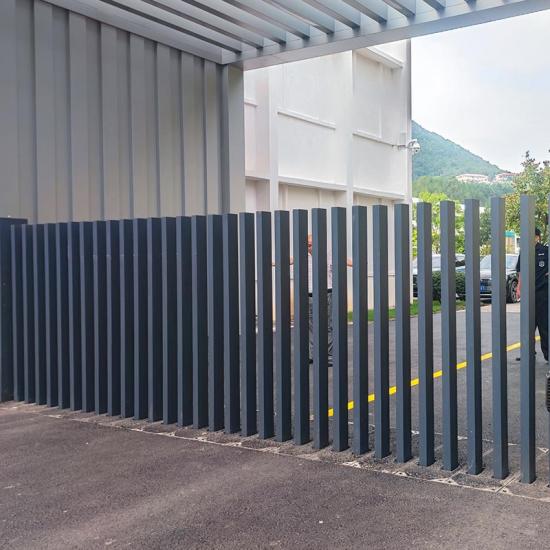
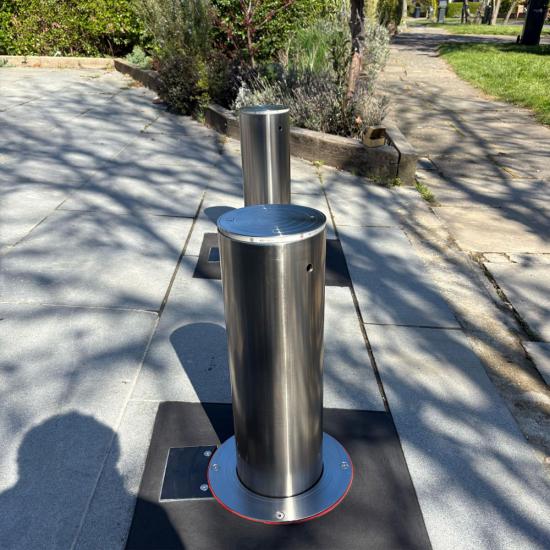
Rising bollards, automatic security posts, and perimeter barriers create a hard boundary between a thief and your vehicle. A CAN-bus attack requires the attacker to touch the car. If they can't reach it, they can't hack it. No amount of electronic trickery drives a vehicle through a steel post rated to stop 5 tons at 30 mph.
For a homeowner with a Toyota Land Cruiser or Lexus LX parked in the driveway, an automatic bollard at the entrance eliminates the most common attack scenario entirely. The guy who planned a quiet 90-second CAN-bus job now faces a steel column that needs industrial cutting equipment and makes far more noise than any car alarm.
For fleet managers and dealerships, the math is even clearer. The 2026 IAATI report specifically calls out "dealer lot intrusions and fleet yard raids" as a rising trend — crews using drones and thermal cameras to case locations before hitting them at night. A gated perimeter with retractable bollards turns a soft target into a hard one, and most crews will simply move on to the next unprotected lot.

Summary
Car theft in 2026 looks nothing like it did five years ago. The attackers are smarter, the tools are cheaper, and the target list covers everything from economy sedans to six-figure SUVs. Software patches and Faraday pouches are part of the answer. But the single most effective countermeasure is the simplest one: make the vehicle physically unreachable.
A bollard does not care what commands you pump into the CAN bus. It stands there. And that is usually enough.
call us :
+86 18206096507 e-mail : [email protected]




 ipv6 network supported