20cm Overlap in Automatic Bollards: Engineering Detail That Prevents Failure
Automatic bollards are precision machines buried in the ground. They operate in rain, snow, dust, and vibration, rising and lowering thousands of times over their service life. The difference between a bollard that lasts 15 years and one that fails in 18 months often comes down to engineering details that spec sheets barely mention. One of the most important is the overlap dimension.
## What Is Bollard Overlap?
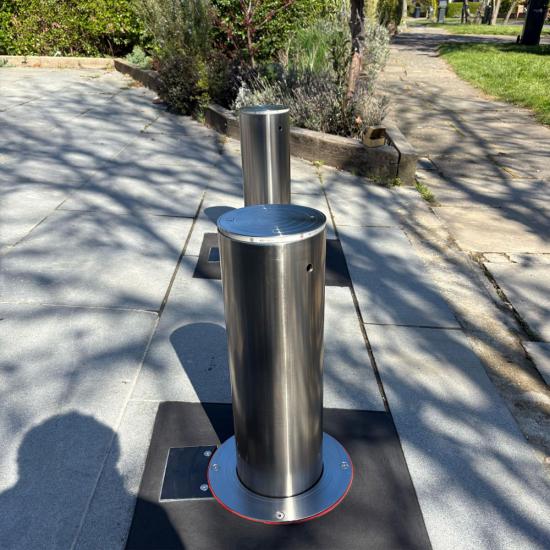
Overlap is the vertical distance that the moving post (the part that rises and lowers) inserts into the fixed ground sleeve (the part permanently embedded in concrete) when the bollard is in the fully lowered position. If the moving post is 80cm tall and 20cm of it sits inside the ground sleeve when lowered, the overlap is 20cm.
Many manufacturers reduce overlap to save material and simplify manufacturing. A shorter overlap means a shorter ground sleeve, less steel, and a shallower foundation. It also means a cheaper bollard. But the tradeoff is reliability—and the cost of that tradeoff shows up within the first two to three years of installation.
UPARK specifies a 20cm overlap across its automatic bollard line. Here is why this matters.
## Water Exclusion: The Number One Failure Mode

Water is the enemy of underground machinery. In a typical bollard installation, the ground sleeve sits in a foundation pit that collects rainwater, irrigation runoff, and melted snow. Without adequate overlap, water finds its way past the gap between the moving post and the sleeve wall, reaching the motor, gears, and electronics inside.
A 20cm overlap creates a sufficient contact length between the post and sleeve to act as an effective water barrier. Rainwater that enters the top of the sleeve must travel 20cm down a tight annular gap before reaching any internal component. In practice, surface tension and the narrow gap width prevent most water from traveling that far.
Shorter overlaps—10cm or less—do not provide this protection. Water reaches the mechanism, and the following failure chain begins:
• Corrosion of internal steel components, particularly bearings and gear teeth
• Freeze-thaw damage in cold climates, where trapped water expands and cracks housings
• Electrical short circuits in motor windings and control boards
• Lubricant washout, leading to accelerated mechanical wear
## Debris Protection: The Labyrinth Effect
The 20cm overlap creates a natural labyrinth seal. As sand, gravel, leaves, and organic matter enter the top of the ground sleeve, they encounter the narrow gap between the moving post and the sleeve wall. The long contact path means most debris gets trapped in the upper portion of the sleeve, where it can be cleaned out during routine maintenance.
With a shorter overlap, debris reaches the mechanism directly. Grit enters gear teeth, jams limit switches, and abrades sealing surfaces. The result is sluggish operation, eventual mechanical seizure, and costly repair bills.
## Impact Distribution: Surviving Real-World Hits
Bollards in the field get hit. Not always by attacking vehicles—often by delivery trucks backing up, snowplows clearing parking lots, or maintenance equipment brushing past. When a lateral force hits the top of a raised bollard, the post acts as a lever, and the fulcrum is the overlap region.
A 20cm overlap distributes the bending moment across a longer section of the ground sleeve. The reinforced collar at the top of the sleeve absorbs the force, protecting the internal mechanism. In shorter overlap designs, the same impact concentrates force on a smaller area, often bending the post or damaging the internal guide system.
This is particularly important in cold regions where snowplow contact is a routine occurrence. UPARK's 20cm overlap has been tested against direct snowplow impacts at 15km/h without functional damage—a scenario that would destroy a typical shallow-overlap bollard.
## Maintenance Implications
The 20cm overlap also simplifies maintenance. Debris that accumulates in the upper sleeve can be removed through the inspection port without removing the bollard. The deep overlap keeps the guide surfaces clean and lubricated, reducing the frequency of service intervals.
For installations where maintenance access is difficult—remote sites, high-traffic areas, or locations with seasonal access limitations—the 20cm overlap is not just a reliability feature. It is a maintenance cost reduction feature.
## Conclusion
The 20cm overlap is not the most visible specification on a bollard data sheet. But for anyone who has serviced bollards in the field, it is one of the most important. It prevents water ingress, blocks debris, distributes impact force, and reduces maintenance frequency. Combined with UPARK's 36V safe voltage operation and 6mm+ wall thickness, it represents an engineering approach that prioritizes long-term reliability over short-term cost savings.
call us :
+86 18206096507 e-mail : [email protected]




 ipv6 network supported