36V vs 120V/240V Bollards: Complete Safety and Cost Comparison
Most buyers select automatic bollards based on crash rating, diameter, or rise height. Voltage rarely enters the conversation until the electrician hands over the first bill. By then, it's too late. The voltage your bollard system runs on determines who can install it, how much it costs to maintain, and—most importantly—whether a wiring fault could injure or kill someone.
This article compares 36V low voltage systems against the 120V and 240V high voltage systems that dominate the bollard industry, with specific attention to safety, cost, and practical installation realities.
## Understanding Voltage Classes in Bollard Systems
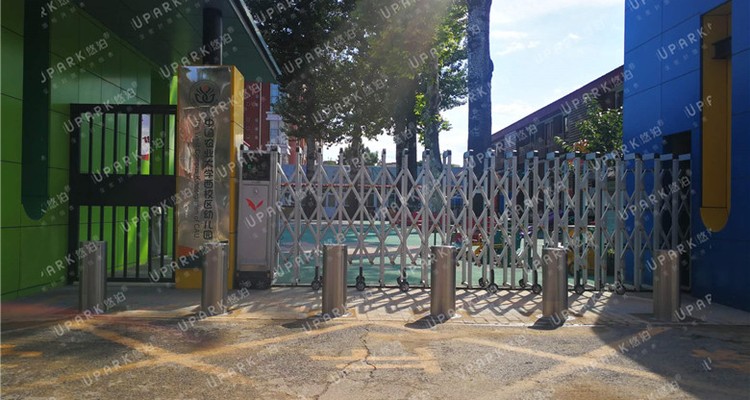
Automatic bollards fall into two voltage categories:
**High voltage (120V/240V AC):** Used by most hydraulic and some electromechanical bollards. These systems require a hydraulic power unit (HPU) or large motor running on mains electricity. The HPU is typically housed in a separate cabinet, and high-voltage wiring runs from the cabinet to each bollard.
**Low voltage (36V DC):** Used by UPARK's motor-driven bollards. Each bollard has a self-contained motor that operates on 36V DC, supplied by a small external driver. The driver itself connects to mains power, but all field wiring between the driver and bollards carries only 36V.
This distinction matters because of what happens when things go wrong.
## Safety: The Fundamental Difference

The International Electrotechnical Commission (IEC) defines 36V DC as a safe voltage under normal conditions—meaning it cannot drive enough current through the human body to cause ventricular fibrillation. In wet conditions, the threshold drops further, but 36V remains well below danger levels.
120V and 240V are a different story. A 120V shock in dry conditions causes painful muscle contraction. In wet conditions—the exact environment where bollards operate—it can be lethal. A 240V shock is dangerous in any condition.
Consider a realistic failure scenario: a bollard installed in a driveway where rainwater collects in the foundation pit. Over years, cable insulation degrades from UV exposure, thermal cycling, and rodent damage. Water enters the conduit. In a 240V system, this creates a serious electrocution hazard for anyone touching the bollard or standing in the puddle around it. In a 36V system, the same damage produces no shock risk.
## Installation Cost and Complexity
High voltage bollard installations carry regulatory overhead that most buyers don't anticipate:
• **Licensed electrician required**: In the US, Canada, EU, and Australia, any wiring carrying 120V+ must be performed by a licensed electrician. This adds $150–$300 per hour to installation costs.
• **Conduit requirements**: NEC and IEC codes mandate metal conduit for high-voltage outdoor wiring, doubling material costs versus low-voltage direct burial cable.
• **GFCI/AFCI protection**: Required for outdoor high-voltage circuits, adding $50–$100 per bollard in protection devices.
• **Permit fees**: Electrical permits for high-voltage outdoor installations range from $200–$800 depending on jurisdiction.
A 36V system sidesteps most of these requirements. Low voltage wiring can often be run by the installation crew directly, without a separate electrician visit. Direct burial cable replaces metal conduit. No GFCI devices needed at each bollard. Permit costs are lower or eliminated entirely.
The total installation savings for a 6-bollard system typically run $3,000–$8,000 depending on local labor rates and code requirements.
## Maintenance and Long-Term Reliability
High voltage systems demand periodic electrical safety inspections in many jurisdictions. Insurance companies may require annual certification. Any maintenance on a live 240V system requires lockout/tagout procedures and often two technicians.
A 36V system can be serviced by a single technician without lockout/tagout. The reduced shock risk means faster troubleshooting, simpler repairs, and lower ongoing labor costs. For property managers overseeing multiple installations, this difference compounds over years of operation.
## Why UPARK Chose 36V
UPARK's engineering team selected 36V DC as the operating voltage for our motor-driven bollard line for three reasons: safety, simplicity, and performance. The 36V motor delivers 2–3 second rise times matching or exceeding most hydraulic systems. The low voltage design eliminates the hydraulic power unit entirely, removing the most failure-prone component from the system. And the safety margin means our bollards can be installed in schools, residential driveways, and public spaces without the liability concerns that accompany high-voltage equipment.
Combined with our 20cm overlap design for impact resistance and 6mm+ wall thickness for structural durability, the 36V system represents a complete engineering philosophy: professional security without professional-grade electrical hazards.
## Making the Switch: What to Ask Your Supplier
If you are currently specifying or bidding bollard projects, add these questions to your evaluation criteria:
1. What is the operating voltage at the bollard head? Not at the control panel—at the bollard itself.
2. Does the system require a licensed electrician for field wiring, or can the installation crew complete all connections?
3. What happens if water enters the cable run? Is there a shock hazard, or just a service call?
4. Are annual electrical safety inspections required by code or by the manufacturer?
The answers to these questions will reveal the true cost and risk of your bollard system—and in most cases, they will point toward 36V.
call us :
+86 18206096507 e-mail : [email protected]




 ipv6 network supported