Hungary is not just another European market. It is now the fastest-growing logistics hub in Central Europe — and that makes it a target.
In 2025, Hungarian police recorded 836 vehicle thefts nationwide. Budapest alone accounted for 121 of those cases, roughly 31 percent of the total. While the absolute number is lower than in previous decades, the pattern has shifted. Theft is no longer concentrated in the capital. Cities like Kecskemet and Eger, with far smaller populations, now rank among the worst-hit areas per capita. Suzuki, Ford, and Opel topped the list of stolen brands in 2025.
At the same time, Hungary is pouring billions of euros into logistics infrastructure. Tesco opened a 100,000-square-metre warehouse near Budapest. Rossmann built a semi-automated distribution centre in Ullo. Panattoni completed its first Hungarian facility. Gebruder Weiss now runs 100,000 square metres of warehousing across eight Hungarian cities. Intermodal freight volumes jumped more than 120 percent year-on-year in 2024.
More warehouses, more trucks, more goods in transit — and more reasons for criminals to target commercial lots, distribution centres, and fleet yards.
Why Hungarian Businesses Are Installing Automatic Bollards
Automatic retractable bollards do one thing that cameras and alarms cannot: they physically stop a vehicle from entering or leaving. For a logistics park in Vecses or a dealership on the outskirts of Budapest, that difference matters.
Here is what is driving bollard adoption in Hungary right now:
1. Logistics park expansion. Every new warehouse needs controlled vehicle access. Bollards at loading bays, truck entrances, and staff parking areas prevent unauthorized vehicles from entering during off-hours.
2. The EU CER Directive. Hungary transposed the Critical Entities Resilience Directive into national law through Act LXXXVIII of 2023. Critical entities — including transport operators, energy providers, and logistics hubs — must now assess physical security risks and implement mitigation measures. Automatic bollards are one of the most straightforward ways to meet that requirement.
3. Car dealership security. With Suzuki, Ford, and Opel being the most-stolen brands in Hungary, dealerships holding dozens of vehicles on open lots face a clear risk. Bollards at lot entrances and exits are a one-time cost that protects inventory worth millions of forints.
4. Smash-and-grab prevention. Retail storefronts in Budapest and regional cities have been targeted by thieves using vehicles as battering rams. A row of automatic bollards in front of a store makes that kind of attack impossible.
What to Look for in Bollards for Hungarian Installations
Hungarian winters reach minus 20 degrees Celsius. Summer heatwaves push past 35. Equipment that works in Western Europe does not automatically work in the Carpathian Basin.
Key features for Hungarian conditions:
- Cold-weather hydraulics. The hydraulic system must operate reliably below minus 25 degrees. Cheaper systems using standard hydraulic fluid will thicken and fail in a Hungarian January.
- Corrosion resistance. Budapest sits on the Danube. Winter road salt is used heavily across the country. Stainless steel 304 or 316 construction is not optional — it is the minimum.
- EU compliance. Bollards installed at critical infrastructure sites in Hungary must meet crash-rating standards recognized under EU regulations. ASTM F2656 and PAS 68 are the two most widely accepted certifications.
- Low-voltage operation. 36V DC systems eliminate the risk of electric shock, simplify permitting, and work well with solar panels — increasingly common at Hungarian logistics parks aiming for green certification.
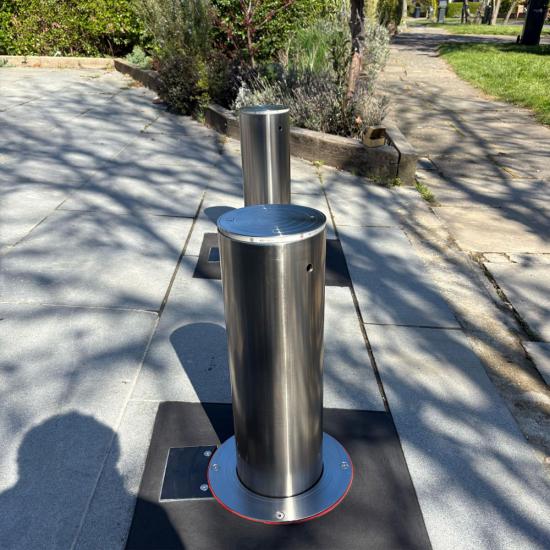
UPARK automatic bollards are built for these conditions. The 36V DC low-voltage design removes the need for high-voltage electrical permits. The 304 stainless steel body handles Danube-region humidity and winter road salt. The hydraulic drive system has been tested from minus 35 to plus 60 degrees Celsius — a temperature range that covers a Hungarian winter and a Hungarian summer with room to spare.
Where Bollards Make the Most Sense in Hungary
Not every property needs automatic bollards. But for these types of Hungarian sites, the case is strong:
- Logistics parks and distribution centres. Vecses, Dunaharaszti, and the Csepel Port area are seeing massive warehouse construction. Each new facility needs perimeter vehicle-access control.
- Car dealerships. With 471 passenger cars stolen in Hungary in 2025, dealership lots are the obvious target. Bollards at entry and exit points reduce inventory loss to near zero.
- Critical infrastructure. Under the CER Directive, Hungarian transport hubs, energy facilities, and water treatment plants must now demonstrate physical security measures. Bollards are among the most cost-effective options.
- Retail parks and shopping centres. As Budapest's retail sector grows, vehicle-ramming protection at storefronts is becoming standard practice, following the lead of Western European markets.
- Government and municipal buildings. Hungary's public-sector facilities are increasingly specifying crash-rated perimeter protection in new construction and renovation projects.
Frequently Asked Questions
Do I need a permit to install automatic bollards in Hungary?
Yes, but the requirements depend on the site. For commercial properties, building permits are typically required if excavation is involved. Sites designated as critical infrastructure under Act LXXXVIII of 2023 may have additional compliance requirements. Your local onkormanyzat (municipal government) can advise on the specific process for your location.
How much do automatic bollards cost in Hungary?
Automatic bollard systems in Hungary typically range from 1.2 million to 3.5 million forint per unit installed, depending on the model, crash rating, and site conditions. For a typical dealership entrance requiring two bollards, the total installation cost is roughly comparable to the value of a single mid-range stolen vehicle.
Can automatic bollards operate during Hungarian winters?
Yes, if the hydraulic system is rated for low temperatures. UPARK bollards use low-temperature hydraulic fluid and sealed stainless steel construction that operates reliably at minus 35 degrees Celsius — well below Hungary's coldest recorded temperatures.
Are automatic bollards compliant with EU security regulations?
Crash-rated automatic bollards tested to PAS 68 or ASTM F2656 standards meet the physical security requirements under the EU CER Directive. For critical infrastructure sites in Hungary, choosing certified bollards is the simplest way to demonstrate compliance during a regulatory audit.
Why Hungarian Companies Choose UPARK
UPARK automatic bollards are installed at commercial and industrial sites across Europe and North America. For Hungarian buyers, three features stand out:
The 36V low-voltage system means no special high-voltage permits, no risk to maintenance staff, and easy integration with solar power — a growing priority for Hungarian logistics parks pursuing BREEAM or LEED certification.
The 20-centimetre overlap between the rising post and the ground sleeve keeps out water, ice, and road debris. In a country where winter road salt and spring flooding are facts of life, this design detail prevents the most common cause of bollard failure in Central Europe: a jammed mechanism.
And the hydraulic drive has been tested across a temperature range that covers everything from a Miskolc winter to a Szeged summer. No seasonal adjustments needed.
For Hungarian businesses managing vehicle fleets, warehouse inventory, or critical infrastructure, automatic bollards are not a luxury purchase. They are a one-time investment that works every day, in every season.
call us :
+86 18206096507 e-mail : [email protected]




 ipv6 network supported