Every winter the same service call arrives. The gate stopped halfway. The motor is fine, the remote has a fresh battery, the controller shows no fault code.
The problem is at ground level, where cold rain collects and stays.
A gate drive is usually the last thing to fail. What fails first is everything between the drive and the ground: the track, the bottom seal, the drainage, and the manual release nobody has touched since commissioning.
Here are the four failures, in the order they tend to appear once the temperature drops.
One: the track fills with water, then with ice
A ground track is a channel. Rain runs into it, the leaf pushes water to the low end, and if the gate is not operated for a few hours that water sits there.
Below zero it becomes an ice ridge. Three millimetres is enough. The gate stalls against it, the controller reads an obstruction, and it reverses. The owner sees a gate that opens partway and closes again and assumes the sensor has failed.
It has not. The sensor is reporting accurately. Something is physically in the way.
Left alone, the ice gets thicker each night and the gate eventually stops travelling at all. Forcing it means the drive slips on the rack, the limit reference drifts, and the gate starts closing against the post instead of into it.
Two: the leaf freezes to the ground
The bottom seal sits on wet paving for hours. Water under the rubber freezes and bonds the leaf to the driveway.
The next command to open pulls a drive against that bond. Something has to give: the seal tears, the bottom rail distorts, or the clutch slips and the gate loses its position.
Before touching the remote, put a hand on the leaf and push. If it shifts a few millimetres, the ice has let go and it is safe to run. If it does not move, stop and clear it.
That single habit prevents most winter drive damage, and it takes ten seconds.
Three: the drain you cleaned in autumn
Leaves block a drain in October. In summer nobody notices, because the water drains away slowly enough. In winter the water has nowhere to go, sits in the pit, and freezes.
Water expands about nine percent when it turns to ice, and in a confined recess that expansion has to go somewhere. It lifts the housing, distorts the guide rail, and in bad cases cracks the pit lining. Repairing that is a civil job, not a service call.
Clear the drain and the recess before the first cold rain. Not after.
Four: the manual release is frozen
This one is a safety item, not a convenience item.
Every powered gate has a manual release for power failure. On most installations that mechanism sits in the same wet recess as everything else. If it has not been cycled since summer, the first person who needs it in a blackout will find it seized.
If the gate is on a fire lane, an ambulance route, or the only access to a property, test the release now, in the cold, with the power off. Then test it again in January.
What not to do when it is frozen
Three common reactions make it worse.
Do not salt the track. Chloride attacks galvanised parts and powder coating, starting at every scratch and chip, and the brine runs into the planting beds and kills them in spring. Salt water is also more conductive than fresh water, which is the last thing you want around a 230 V supply.
Do not hit it with a hammer. A distorted rail never runs true again, and every crack in the coating becomes a corrosion site.
Do not pour hot water on it. The thermal shock lifts coating off the steel, and the water refreezes within the hour, thicker and harder than before.
Use a plastic or nylon scraper on the track, a heat gun on its low setting if you need heat at all, and a rubber mat over the track overnight to keep water out in the first place.
The structural answer: remove the track
One way to stop fighting ice in a channel is to stop having a channel.
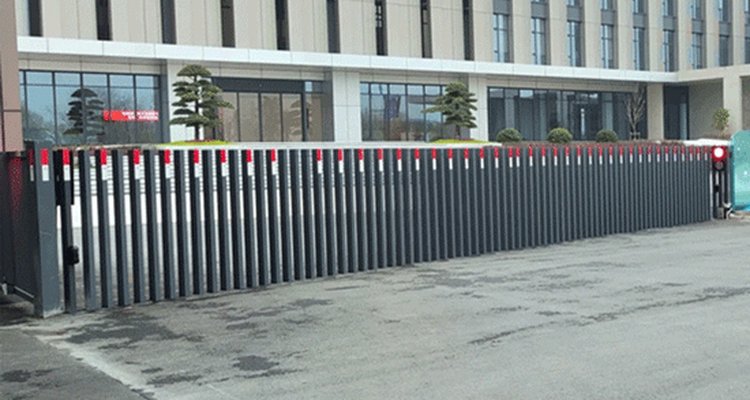
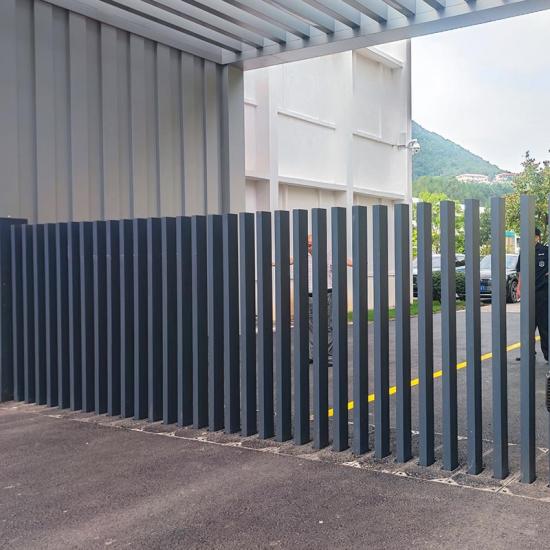
A recessed retractable gate runs on a mechanism below the driveway surface and leaves nothing on the ground to fill with water. There is no track to ice over, no rail to deform, and nothing for a wheel or a foot to catch. The leaf rises out of the ground when it closes and sinks back flush when it opens.
For a driveway that ices every winter, that removes three of the four failures above in one design decision. Details are on the automatic retractable fence gate page.

The anti-pinch setting was tuned in summer
Obstruction sensing works on force. A child in a padded winter coat presents a softer, thicker surface than the same child in a t-shirt, so the force the gate actually measures arrives later than it should.
Re-test the sensitivity in cold weather, with the coat on. It is a five-minute adjustment that most installations never get.
Quiet in July, audible in January
Grease thickens as temperature falls. A drive that was inaudible in summer transmits more noise through the leaf in winter, and on a residential street that is a complaint with a date on it.
Use a low-temperature grease rated below the coldest night on the site, and re-grease before the cold arrives rather than after the neighbour calls.
Six checks before the first cold rain
Cycle the manual release with the power off. Now, not during an outage.
Clear the track or recess and confirm the drain runs.
Inspect the bottom seal for cracking and for contact with the ground.
Re-test obstruction sensitivity in winter conditions, wearing a coat.
Change to low-temperature grease.
Put the salt and the hammer away, and get a plastic scraper and a mat instead.
An automatic gate is a machine that lives outdoors at ground level, in the exact place where water collects and freezes. That is not a design fault. It is a reminder that winter maintenance is about the ground, not the motor.
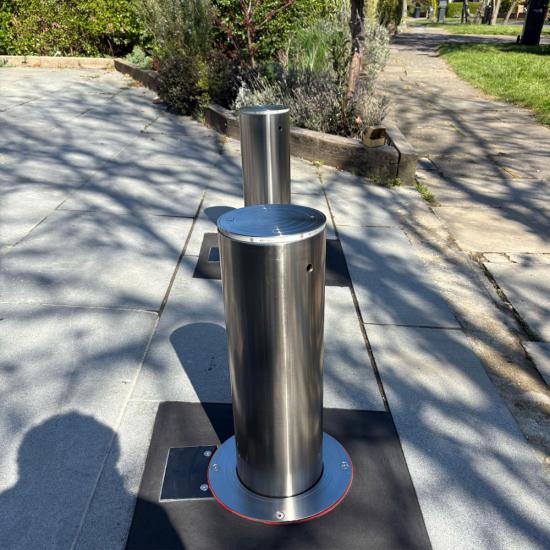
UPARK builds recessed automatic fence gates and the automatic bollards that secure the rest of the frontage, specified for wet and freezing climates rather than for a showroom.
call us :
+86 18206096507 e-mail : [email protected]




 ipv6 network supported