Automatic vs Manual Bollards: Why the Price Gap Is Closing in 2026
For years the buying rule for access-control bollards was simple: manual units cost a few hundred dollars, and if you wanted them to move on their own you paid ten times more. That assumption is now out of date. In 2026 the gap between manual and automatic is collapsing, and the reason is a shift in how automatic bollards are built.
The old price map
Market data for 2026 puts a manual telescopic or removable bollards at roughly $400 to $900 per unit before installation. A traditional automatic hydraulic bollard lands between $3,000 and $15,000 per unit, a gap of four to thirty times. Most buyers stopped comparing there and chose manual by default for any cost-sensitive site.
What actually drove the cost

The expensive part of a classic automatic bollard was never the steel. It was the hydraulic power unit, the separate control cabinet, and the 230V or 120V high-voltage wiring that had to be run by a licensed electrician inside metal conduit. Those three items, not the bollard itself, created the price wall.

How the gap closed
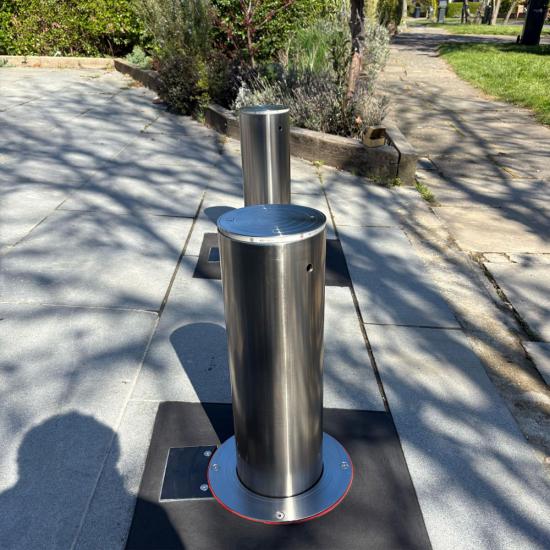
Electromechanical bollards that run on 36V DC remove the hydraulic power unit entirely. Each post has a self-contained low-voltage motor, so there is no cabinet to bury and no high-voltage run to certify. Installation shifts from a licensed-electrician job to a low-voltage crew task, and the no-drainage foundation design cuts civil works. The result: automatic bollards now sit in the same price bracket as many manual units. UPARK's 36V automatic bollards line is built on exactly this principle.
What you get for the manual price
Automatic control: open and close by button, key fob, or access system, with no one lifting anything.
Throughput: vehicles move in seconds instead of waiting for someone to unlock and retract a post.
Central management: schedules, interlocks, and audit trails across a row of bollards.
Safety: 36V is a low-risk voltage class, far safer than 230V field wiring in wet ground.
When manual still makes sense
To be clear, manual and removable bollards keep a real place: seasonal access that changes a few times a year, heritage or protected sites where nothing may be powered, and very small budgets with no need to open and close at all. The point is not that manual is wrong, it is that price is no longer the reason to rule out automatic. Where a site must move access regularly, automatic at a manual-class price simply does the job better.
Questions to ask any supplier
What voltage does the drive run on, and who is qualified to install it: a low-voltage crew or a licensed high-voltage electrician?
Is there a separate hydraulic power unit or control cabinet to bury, or is the motor self-contained in the post?
What does the foundation require: a drained pit, or a no-drainage poured base?
What is the total installed cost, not just the unit price?
The takeaway
If your only reason for choosing manual was price, that reason just disappeared. The smart 2026 specification is to compare automatic and manual on total installed cost and ongoing labor, and on those terms the automatic bollard increasingly wins. automatic bollards cover both battery-backup and control-cabinet configurations; read our engineering approach on the About Us page.
call us :
+86 18206096507 e-mail : [email protected]




 ipv6 network supported