Specifying bollards usually starts with the crash rating and the layout. The power question tends to arrive later, once someone notices the nearest conduit is fifty meters away. That is the wrong order. The power decision shapes install cost, permits, and whether the perimeter stays lit during an outage. Here is how a battery bollard with a solar-charging controller stacks up against a grid-tied unit.
Install cost and permits
A grid-powered bollard line needs conduit, trenching, electrical permits, and a connection to the building system. On a finished plaza that is disruptive and expensive. A battery bollard with solar charging is self-contained: the panel feeds the wall-mounted controller, the controller feeds the battery, and the bollard runs. No trench, no permit pile, no coordination with the facilities electrician. For long or scattered perimeters, the saving is significant.
There is also the lifecycle view. With the battery in a wall-mounted box, a worn cell is a quick swap rather than a dig. Grid runs, by contrast, fail inside conduit where they are slow and costly to reach. Over a ten-year horizon the off-grid unit often costs less to own, not just to install.
Behavior during a power outage
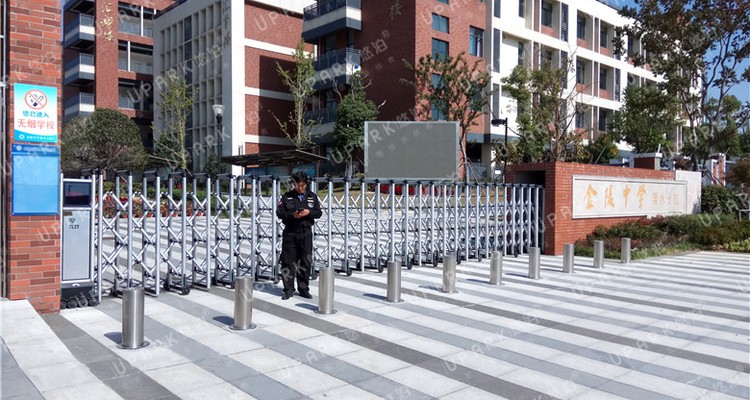
This is the part specifiers underestimate. A grid-tied illuminated bollard is dark the instant the block loses power: the barrier stays, but the lighting and visual deterrence are gone at the worst possible moment. A solar-charged battery bollard does not care what the grid is doing. Its stored energy keeps the perimeter illuminated and any automatic function running. For transit hubs, emergency campuses, and government sites, that independence is the whole point.
Which to choose
Pick a battery bollard with solar charging when the site is open to the sky, far from existing power, or simply where trenching would be a nuisance. Pick a grid-tied unit when you already have clean conduit in place and predictable sun is not guaranteed. When sun hours dip seasonally, go hybrid: solar primary, mains backup. The wall-mounted controller on UPARK's battery models handles both, switching without operator intervention.
Keep in mind that solar can power lighting on its own even when the bollard is fixed and needs no drive power at all. That split is useful for sites that want visibility and passive deterrence without any automatic operation. Solar lighting plus a fixed barrier is the simplest off-grid combination there is.
Foundation and cable notes
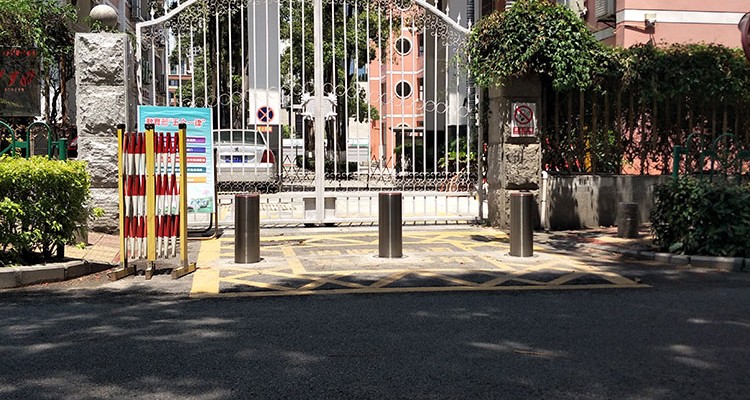
Battery and solar do not change the foundation math: a shallow or deep foundation still depends on the rated impact and the ground. What they change is the cable plan. With no high-voltage run to the bollard, there is less to protect and less to fail near a public walkway. The sealed housing keeps grit out of the works, which matters more when the unit is working off stored energy year-round.
One more practical point: off-grid bollards are easier to relocate. Because there is no conduit to abandon, a line that no longer fits the site can be pulled and reset with far less waste. Grid runs lock the layout in place for the life of the cable, which is a constraint few specifiers enjoy explaining later.
UPARK's automatic bollards include battery-driven variants whose controllers accept solar input. Our fixed bollards and removable bollards cover the sites that need a permanent or occasional barrier without any power at all. The About UPARK page lays out the 36V low-voltage engineering behind the whole range.
The right answer is not that solar is always better. It is matching the power source to the site before the drawings are locked. Get that right and the perimeter is cheaper to build and harder to disable.
call us :
+86 18206096507 e-mail : [email protected]




 ipv6 network supported