When procurement teams evaluate automatic bollard systems, the unit price of the bollard itself is only one line item in a much larger cost picture. The real decision lives in total cost of ownership — what you will spend from initial site preparation through a decade of operation. Here is how battery-powered and wired bollards compare across every meaningful cost dimension.
Installation: The Deciding Factor
Wired bollard installation requires trenching, conduit laying, cable pulling, backfilling, surface restoration, and electrical connection to mains power. For a typical 4-unit entrance, this civil work alone can range from $8,000 to $25,000 depending on ground conditions, distance to the nearest power source, and local labor rates. Permitting and traffic management during construction add further costs and delays.
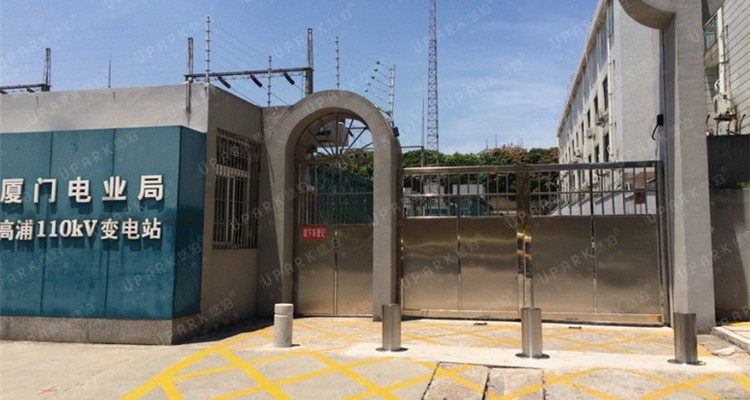
Battery bollard installation eliminates all of this. Each unit is anchored into a shallow foundation — no trenches, no cables, no electrical tie-in. The same 4-unit entrance installs in one day instead of two weeks, with civil work costs reduced by 70-85%. For organizations that need security now rather than next quarter, the speed advantage alone often justifies the battery option. Visit our About UPARK page to understand the engineering philosophy behind this modular design approach.
Ongoing Costs: Energy and Maintenance
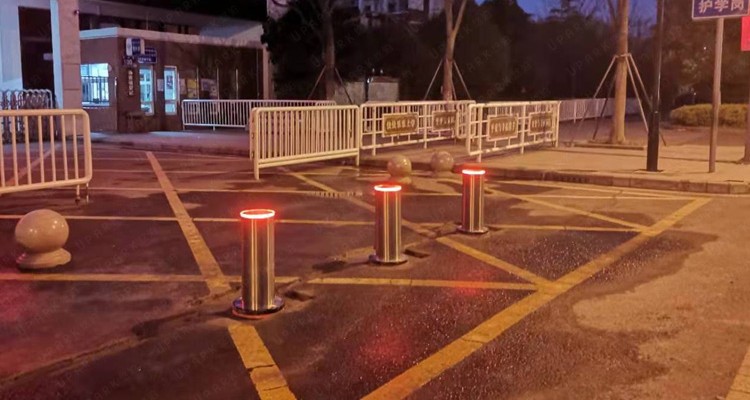
Wired bollards consume grid electricity continuously, with annual energy costs of $50-150 per unit depending on local rates and cycle frequency. Battery bollards, especially when paired with solar panels, have near-zero energy costs. The trade-off is battery replacement every 3-5 years, typically $200-400 per unit — an expense that is predictable and budgetable, unlike the variable cost of repairing underground cable faults, which can run into thousands when excavation is required.
Both systems share the same proven hydraulic mechanism, so mechanical maintenance costs are identical. The key differentiator in maintenance is infrastructure risk: underground cables are vulnerable to accidental strikes during unrelated construction work, rodent damage, and water ingress at junction boxes. Battery bollards have no underground infrastructure to fail. For a full overview of our product range including automatic bollards and parking barriers options, browse our website.
The 10-Year Bottom Line
Over a 10-year lifecycle, a typical 4-unit battery bollard installation saves $15,000-35,000 compared to an equivalent wired system — mostly from avoided civil works and eliminated cable maintenance. Even accounting for two battery replacements within that period, the total cost of ownership strongly favors battery power for most greenfield installations.
The exception is retrofit scenarios where existing power infrastructure is already in place at the bollard locations. In those cases, wired units may offer a lower incremental cost. Either way, UPARK provides both options on the same core platform, ensuring performance consistency regardless of power source. Contact us to discuss which configuration makes sense for your specific site conditions and budget constraints.
call us :
+86 18206096507 e-mail : [email protected]




 ipv6 network supported