Introduction: The Heat Problem in Bollard Engineering
Automatic bollards are increasingly deployed across the Middle East, South Asia, Southeast Asia, sub-Saharan Africa, and the southern United States — regions where summer temperatures routinely reach 40–50 °C and pavement surface temperatures can exceed 70 °C. Yet the dominant technology in the bollard market — hydraulic actuation — was engineered primarily for temperate European climates. The result is a growing mismatch between product specifications and real-world operating conditions.
This guide provides a systematic framework for engineers, facilities managers, and procurement teams selecting automatic bollards for hot climate environments. It covers the physics of heat-induced failure, a technology comparison, site-specific design considerations, installation requirements, and a 10-year total cost of ownership analysis.
Understanding Heat Failure Modes in Hydraulic Bollards
To make an informed selection decision, it's essential to understand precisely how and why heat degrades hydraulic bollard performance. There are four distinct failure mechanisms:
**Viscosity Breakdown**
Hydraulic oil follows a viscosity-temperature relationship described by the Walther equation. For typical ISO VG 46 oil, viscosity at 20 °C is approximately 90 cSt; at 60 °C it falls to 18 cSt; at 80 °C it reaches 9 cSt. Below approximately 15 cSt, internal leakage across valve spools and cylinder seals becomes significant enough to impair lifting force. A bollard designed to lift a 70 kg post at 40 °C may completely fail to operate at 80 °C.
**Thermal Expansion and Pressure Surges**
Hydraulic oil has a thermal expansion coefficient of approximately 0.0007 per °C. A hydraulic circuit sealed at 25 °C and heated to 75 °C in a sun-exposed above-ground unit will see a volumetric expansion of 3.5%. In a sealed circuit, this translates to pressure increases that can exceed 100 bar — triggering pressure relief valves, causing unintended bollard extension, or damaging seals and fittings.
**Elastomer Seal Degradation**
Nitrile rubber (NBR), the most common seal material in hydraulic bollards, has a rated maximum continuous service temperature of 100 °C and a recommended working maximum of 80 °C. Above-ground hydraulic units in direct sun in desert climates routinely exceed these temperatures. Heat causes NBR to lose plasticizer content, resulting in hardening, micro-cracking, and loss of elastic memory. A seal that was properly compressed at installation no longer maintains an adequate sealing force — oil weeping begins, pressure drops, and cycle reliability decreases.
**Additive Package Depletion**
Modern hydraulic oils contain anti-wear additives, oxidation inhibitors, and viscosity improvers. High temperature accelerates oxidation: for every 10 °C increase above the oil's rated temperature, service life is approximately halved (Arrhenius rule of thumb). Oil that should be changed every 24 months at 40 °C operating temperature needs changing every 6 months at 70 °C. Most operators are unaware of this and operate with severely degraded oil.
Electromechanical Bollards: Heat-Resistant by Design
Electromechanical bollards eliminate every one of the four failure modes described above. The operating principle is straightforward: a DC gear motor drives a precision leadscrew, which extends and retracts the bollard post. The system contains no hydraulic fluid, no pressurized seals, and no components whose performance depends on maintaining a specific fluid viscosity.
**Motor Performance at High Temperature**
Copper windings in a DC motor experience resistance increase with temperature at a coefficient of approximately 0.393% per °C. A motor rated at 70 °C nominal temperature will have approximately 20% higher winding resistance than at 20 °C, resulting in roughly 20% lower no-load speed and modestly reduced torque. This is predictable, compensable through slight overrating, and does not result in sudden failure — only a gradual, fully reversible performance reduction that returns to normal as the motor cools.
**Leadscrew Mechanism Reliability**
The ball screw or ACME leadscrew used in electromechanical bollards is lubricated with high-temperature grease (typically rated to 150 °C or higher). Unlike hydraulic oil, grease does not flow, does not leak, and does not lose its lubrication properties within the bollard's operating temperature range. The mechanism is maintenance-free between annual inspections.
**Thermal Management and Housing Design**
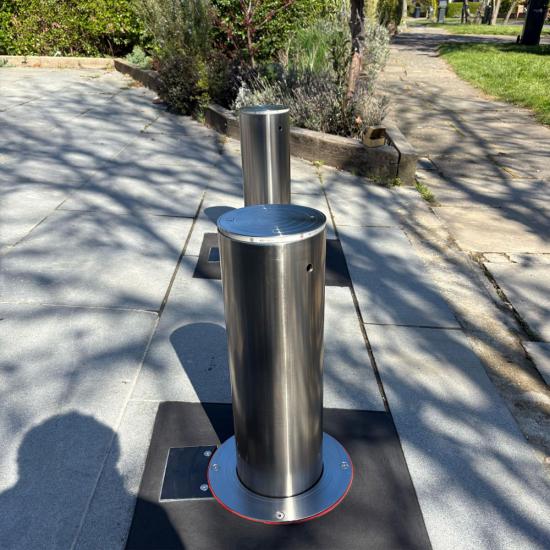
A quality electromechanical bollard uses a steel housing (typically 304 or 316 stainless) that acts as a passive heatsink. The motor's thermal mass absorbs heat from individual short-duration cycles; between cycles, the housing radiates heat to the surrounding soil or air. No active cooling is required. UPARK's 120 mm electromechanical bollard, with its 3 mm wall thickness housing, has more than adequate thermal mass for high-cycle operation in desert conditions.
Site Design Considerations for Hot Climates
Selecting the right technology is only the first step. Hot climate installations require specific attention to site design:
**Installation Depth and Ground Temperature**
Soil temperature at depth is significantly lower than surface temperature. At 600 mm depth, ground temperature in desert regions rarely exceeds 30–35 °C even when surface temperatures are above 60 °C. Bollards with below-grade motor compartments benefit from this natural thermal buffering. Above-grade hydraulic power packs — common in retrofit installations — have no such protection and are directly exposed to solar radiation.
**Solar Heat Gain on the Bollard Post**
The post of a bollard (typically polished or powder-coated steel) can absorb significant solar radiation. Dark powder-coat finishes reach 80–90 °C in direct sun. This is not problematic for the mechanical function of the bollard — the post is structural steel and tolerates these temperatures — but it affects thermal comfort for users and the longevity of decorative coatings. Specifying light-colored or reflective finishes in hot climate environments is recommended.
**Control Cabinet Placement**
Electromechanical bollards require a control cabinet housing the power supply, control board, and communication module. In hot climates, this cabinet must be either shaded, actively ventilated, or rated for the expected ambient temperature. Solar irradiance on an unshaded metal cabinet can raise internal temperature 20–30 °C above ambient. Specify cabinets with IP55 or IP65 rating and internal temperature rated to 70 °C.
**Remote Management and Diagnostics**
Hot climate installations often experience temperature-related anomalies that benefit from remote monitoring. Modern electromechanical bollard controllers can log motor temperature, cycle count, and fault codes. Remote access allows facilities managers to identify thermal stress events before they cause failure. This is particularly valuable for unattended installations in desert or tropical locations.
IP and Ingress Protection Requirements
Hot climate regions often combine high temperatures with sand, dust, or high humidity (coastal tropical zones). IP rating requirements differ by environment:
| Environment | Recommended IP Rating | Notes |
|---|---|---|
| Desert/arid (dry heat) | IP65 minimum | Fine dust ingress is the primary threat |
| Coastal tropical (humid heat) | IP67 | Moisture + salt air; full submersion protection recommended |
| Monsoon/wet tropical | IP67–IP68 | Seasonal flooding; check submersion depth and duration |
| Urban hot climate (standard) | IP65 | Rain + road wash; IP67 preferred for below-grade |
UPARK's 120 mm bollard carries IP67 certification — appropriate for all hot climate environments including coastal and monsoon zones.
10-Year Total Cost of Ownership: Hot Climate Comparison
The following analysis compares a 10-unit bollard installation in a hot climate environment (average summer temperature 42 °C, 80 cycles/day):
| Cost Item | Hydraulic (per unit) | Electromechanical (per unit) |
|---|---|---|
| Initial equipment cost | $1,800 | $2,100 |
| Installation | $600 | $500 |
| Oil changes (every 6 months) | $1,400 | $0 |
| Seal replacements (every 18 months) | $2,200 | $0 |
| Unplanned failures (avg. 1.5 per unit) | $3,500 | $400 |
| Bearing/motor service (10 years) | $0 | $600 |
| Control system maintenance | $500 | $400 |
| **10-year TCO** | **$10,000–$12,000** | **$4,000–$4,500** |
The electromechanical bollard delivers a 60–65% reduction in 10-year total cost of ownership in hot climate conditions — significantly higher than the 55% advantage seen in temperate climate comparisons. Heat amplifies every hydraulic maintenance cost line item.
Selection Decision Framework
Use this six-step framework when specifying bollards for a hot climate installation:
**Step 1: Determine Peak Ambient Temperature**
If peak summer ambient exceeds 38 °C, or pavement temperature exceeds 55 °C, eliminate hydraulic bollards from consideration.
**Step 2: Assess Daily Cycle Count**
For installations with >50 cycles/day in high ambient temperature, hydraulic thermal buildup becomes a serious concern. Electromechanical is strongly preferred.
**Step 3: Evaluate Maintenance Capability**
Does the site have qualified hydraulic maintenance technicians within 100 km? If not, the inability to service seals and oil in a timely manner makes hydraulic bollards a maintenance liability.
**Step 4: Review IP Requirements**
Map the site environment (dust, humidity, flooding) to required IP ratings. Confirm the selected bollard meets those ratings.
**Step 5: Calculate 10-Year TCO**
Use site-specific maintenance cost data to build a full TCO model. In virtually all hot climate scenarios, electromechanical wins by a substantial margin.
**Step 6: Verify Voltage Compatibility**
Electromechanical bollards require a stable low-voltage DC supply (36 V typical) from a compliant power supply. Confirm the site has or can provision appropriate electrical infrastructure. UPARK bollards are designed for standard 220–240 V AC input with integrated 36 V DC converter.
Conclusion
For hot climate environments — the Arabian Peninsula, the Indian subcontinent, Southeast Asia, sub-Saharan Africa, the US Sun Belt, and similar regions — electromechanical bollards are the correct engineering specification. They are not merely "better" than hydraulic bollards in these conditions; they are fundamentally more appropriate technology. The physics of hydraulic systems imposes hard limits that cannot be overcome through improved oil grades or better seal materials — the fundamental incompatibility between high-viscosity requirements and high-temperature operation remains.
UPARK's 120 mm electromechanical automatic bollard — with its 36 V low-voltage architecture, IP67 rating, 3 mm wall thickness, and −30 °C to +70 °C operating range — is designed to be deployed anywhere in the world, including the most demanding thermal environments. It replaces both traditional manual pull-up posts and hydraulic automatic bollards with a system that is reliable, low-maintenance, and cost-effective over its full service life.
call us :
+86 18206096507 e-mail : [email protected]




 ipv6 network supported