Hydraulic vs Electromechanical Bollards in Cold Weather: A Technical Comparison
Two Technologies, One Critical Difference
Automatic bollards are powered by one of two drive systems: hydraulic or electromechanical. Both can raise and lower a steel bollard reliably in temperate conditions. But in cold climates — where temperatures regularly fall below -15°C — the two technologies behave very differently, and that difference has direct consequences for security reliability.
This comparison examines both technologies across five dimensions critical to cold-climate installations: cold-weather performance, failure modes, maintenance burden, installation complexity, and long-term total cost of ownership.
1. Cold-Weather Performance
Hydraulic Bollards
Hydraulic bollards use pressurized oil to drive a cylinder that raises and lowers the bollard shaft. This is the same fundamental principle as a hydraulic car lift or industrial press. At room temperature, hydraulic oil is highly efficient — it transmits force with minimal energy loss.
At low temperatures, the same oil thickens. Viscosity index (VI) describes how a fluid's viscosity changes with temperature. Standard mineral hydraulic oil (ISO VG 46) at 20°C has a viscosity of around 46 cSt. At -20°C, that same oil can exceed 1,000 cSt — more than 20 times thicker. The pump must work harder, operation slows, pressure builds unevenly, and seals designed for flexible operation at low temperatures begin to harden and crack.
Manufacturers address this with low-temperature hydraulic fluids and tank heaters, but these add cost, complexity, and energy consumption. And when the heater fails — which happens — the bollard fails with it.
Electromechanical Bollards

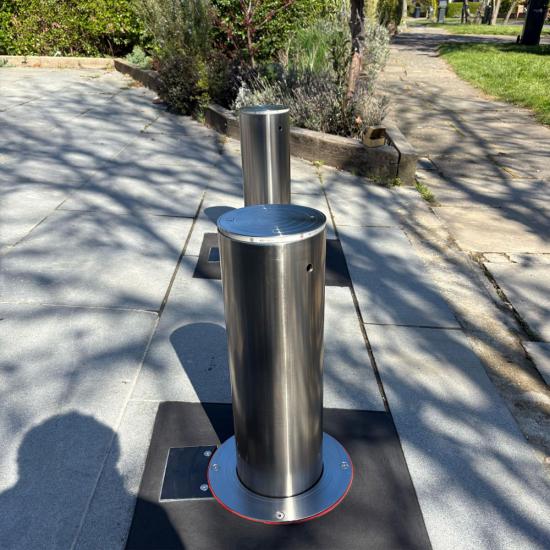
Electromechanical bollards use a DC motor to drive a mechanical transmission (lead screw, ball screw, or rack-and-pinion). There is no fluid in the drive circuit. Motor operation is governed by electrical resistance in the windings, which increases by roughly 0.4% per degree Celsius of temperature drop — an entirely manageable variation.
A bollard motor rated at 36V that draws 3A at 20°C will draw approximately 3.2A at -30°C — well within the design envelope. Operating speed and torque are essentially unchanged. The mechanical transmission may require cold-rated synthetic grease (rated to -40°C or lower), but this is a one-time specification choice during manufacturing, not an ongoing operational concern.
In practice, a well-specified electromechanical bollard operates identically at -30°C and +40°C. No preheating, no fluid top-up, no cold-start procedure.
2. Failure Modes in Winter
Understanding failure modes is more important than understanding nominal performance. A bollard that works at -10°C but fails at -20°C does not protect your facility on the coldest days — precisely when the perimeter is most likely to be challenged.
Hydraulic Failure Modes
The most common hydraulic cold-weather failures are: (1) viscosity-induced slow operation or non-operation; (2) seal cracking due to thermal cycling causing oil leakage; (3) pump cavitation when cold thick oil cannot flow fast enough to prime the pump; and (4) freezing of water contamination in the oil, which is nearly unavoidable in any real-world installation over several years.
Each of these can cause partial or complete loss of bollard function. Recovery typically requires draining and replacing the hydraulic fluid, replacing seals, or calling a specialized hydraulic technician — tasks that are neither quick nor cheap at -20°C in a remote location.
Electromechanical Failure Modes
Electromechanical cold-weather failures are primarily limited to: (1) bearing grease hardening if non-cold-rated grease was used; (2) battery or power supply performance degradation if the power source is not thermally managed; and (3) control board condensation issues if the housing is not properly sealed.
Items (1) and (3) are design-time choices. Specifying a bollard with cold-rated synthetic grease (e.g., Mobil SHC 460 rated to -40°C) and IP67-sealed housing eliminates both risks at the manufacturing stage. There is no ongoing maintenance intervention required — the bollard simply works.
3. Maintenance Requirements in Cold Climates
Hydraulic bollards in cold climates require: annual hydraulic fluid change (with cold-rated fluid); seal inspection twice yearly (thermal cycling accelerates aging); heater element check before each winter; and contamination testing of the fluid. Each service event requires a trained hydraulic technician.
Electromechanical bollards require: annual visual inspection and function test; bearing lubrication check every 3-5 years; and no fluid-related maintenance. Qualified HVAC or electrical technicians can handle routine checks — no hydraulic specialist needed.
In remote high-altitude or high-latitude locations — a mountain ski resort, a border crossing station in the Russian far east, a mining site in northern Canada — the ability to maintain bollards without specialist hydraulic knowledge is a significant operational advantage.
4. Installation Complexity
Hydraulic bollards require a hydraulic power unit (HPU) that must be installed in a weather-protected enclosure. The oil tank, pump, motor, pressure relief valve, and control manifold all need to be accessible for maintenance. In cold climates, the HPU enclosure must also be heated. Buried hydraulic lines must accommodate thermal expansion and use cold-rated flexible hose with appropriate compression fittings.
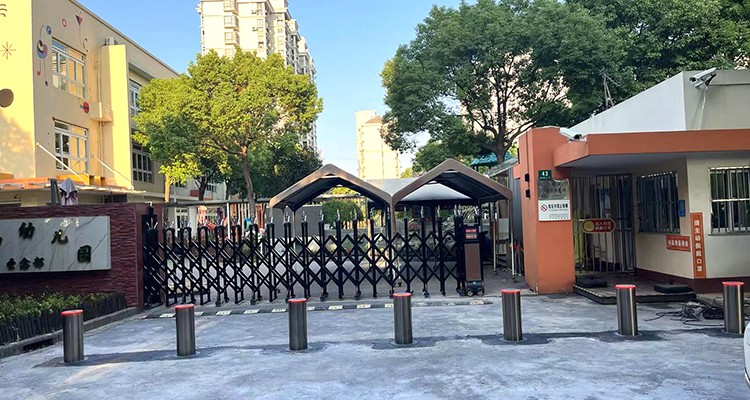
Electromechanical bollards need only a power cable and control wiring. Using 36V DC architecture, a single cable run can serve multiple bollards in series using RVV 3x4.0mm² cable for runs up to 80 meters. The absence of pressurized fluid lines dramatically simplifies the underground works — particularly important when digging in frozen ground.
5. 10-Year Total Cost of Ownership in Cold Climate
The 10-year cost difference per unit is approximately $10,000 — and this does not include the productivity loss when a hydraulic bollard fails in the middle of winter and the access point becomes a security liability until a technician can be dispatched.
Conclusion: Cold Climate Means Electromechanical
For any bollard installation where winter temperatures regularly fall below -15°C, the specification choice is clear: electromechanical bollards with IP67 sealing, cold-rated synthetic bearing lubrication, and 36V low-voltage drive architecture. The hydraulic alternative introduces avoidable failure modes, elevated maintenance costs, and operational dependency on specialist technicians — none of which belong in a robust security perimeter.
The total cost of ownership data confirms what the engineering analysis predicts: in cold climates, the electromechanical bollard is not just the more reliable option — it is also the more economical one over the project lifecycle.
call us :
+86 18206096507 e-mail : [email protected]




 ipv6 network supported