Bollard Selection Guide for High-Altitude and High-Latitude Cold Climate Installations
Introduction: Why Cold Climate Is a Distinct Engineering Challenge
A bollard that performs flawlessly in Singapore may fail catastrophically in Harbin. A system certified to -10°C may be completely non-functional at -25°C. Cold-climate bollard selection is a specialized engineering exercise — and the consequences of getting it wrong extend beyond inconvenience to genuine security failure.
High-altitude installations face compounding challenges: extreme temperature swings (day-to-night differentials of 30°C+ are common above 3,500 meters), reduced air pressure affecting sealed enclosures, UV exposure accelerating polymer degradation, and logistical challenges that make field repairs extremely costly.
High-latitude installations in Siberia, northern Canada, Scandinavia, or Alaska face sustained extreme cold, ground frost penetration affecting foundations, and the operational reality that a maintenance technician may be four hours away when a system fails at -35°C on a Sunday night.
This guide addresses both environments comprehensively — covering drive system selection, sealing standards, lubrication specifications, power infrastructure, foundation engineering, control systems, and maintenance protocols specifically calibrated for cold-climate conditions.
Step 1: Classify Your Cold-Climate Environment
The first step in cold-climate bollard specification is accurate temperature characterization. The relevant variables are:
Note that at 'Mild Cold' (-10°C to -15°C), hydraulic bollards can still function reliably with low-temperature fluid and heated HPU enclosures — but the added cost and complexity rarely justify the choice over electromechanical alternatives. From -15°C downward, electromechanical is the only engineering-defensible option.
Step 2: Drive System Selection
Electromechanical Drive Architecture
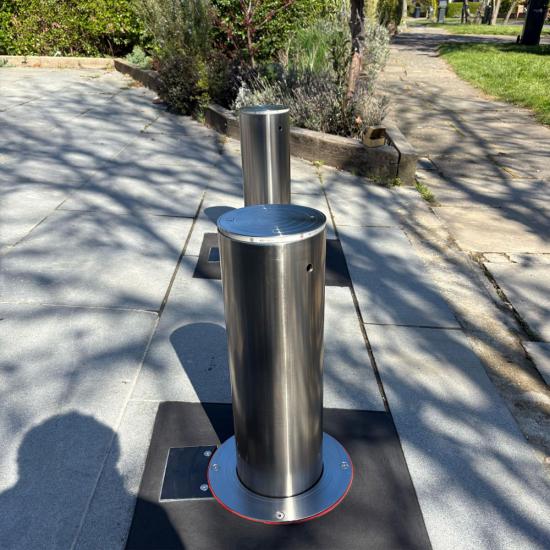
For cold-climate installations, the recommended drive system is a DC electromechanical unit with the following specifications:
Motor: Brushless DC, rated for continuous operation at -40°C to +85°C
Transmission: ball screw or lead screw (not rack-and-pinion, which has greater backlash sensitivity to thermal expansion)
Bearings: sealed deep-groove ball bearings, pre-greased with synthetic lubricant rated to -50°C (e.g., Kluber Isoflex NBU 15 or equivalent)
Motor housing: IP67 minimum, IP68 preferred for high-altitude installations with pressure differentials
Capacitors and PCB: extended temperature range components rated to -40°C; conformal coating on PCBs to prevent condensation damage
Why Not Hydraulic?
The core problem is hydraulic fluid viscosity. Mineral-based ISO VG 46 oil (the most common hydraulic fluid) has a pour point around -30°C — below which it will not flow at all. Even above the pour point, at -20°C its viscosity is 15-25x higher than at operating temperature, causing: slow cycle times (3-5 seconds becomes 15-30 seconds), overload of the hydraulic pump motor, uneven pressure distribution, and premature seal failure.
Synthetic polyalphaolefin (PAO) hydraulic fluids extend reliable operation to -40°C, but they cost 3-5x more than mineral oil, require complete system flushing when switching, and are not universally available in remote locations. Hydraulic tank heaters address cold-start viscosity but add failure points — a heater that fails on the coldest night of the year represents a total security system failure.
The engineering conclusion: electromechanical systems do not require these compensating measures because they do not have a fluid viscosity problem. This is a categorical advantage, not a marginal one.
Step 3: Sealing and Environmental Protection
Cold-climate bollards face two distinct moisture challenges: liquid water ingress during thaw cycles, and condensation from temperature differentials. The IP67 rating (1-meter immersion, 30 minutes) addresses the first. Condensation requires additional design measures.
IP Rating Requirements
IP67 is the minimum for any outdoor installation. IP68 (continuous immersion) is recommended for installations where flooding is possible during spring thaw — particularly in valleys, low-lying parking areas, and locations with poor drainage.
Verify that the IP rating applies to the complete bollard assembly including: the housing-to-base-plate seal, the cable entry glands, the top cap seal, and any sensor ports. Partial IP ratings (housing only, not entry points) are a common source of cold-weather failures.
Condensation Management
In high-altitude installations, rapid temperature changes — a warm day by a cold night — create significant condensation pressure inside imperfectly sealed enclosures. Silica gel desiccant packs within the control housing extend the effectiveness of the IP seal. Some manufacturers incorporate Gore-Tex membrane vents that equalize pressure without allowing liquid ingress — this is the recommended solution for installations with temperature swings exceeding 40°C.
External Surface Treatment
High-altitude UV radiation is significantly more intense than at sea level — roughly 10-12% per 1,000 meters of altitude gain. Powder coating formulations rated for low-UV environments will fade and chalk within 2-3 years above 3,000 meters. Specify polyester or PVDF-based powder coating with a UV resistance rating appropriate for the installation altitude. Alternatively, 316L stainless steel housings with a brushed finish eliminate the coating degradation issue entirely.
Step 4: Foundation Engineering for Frozen Ground
Standard bollard foundation design (300-500mm concrete base) is insufficient for high-frost environments. Frost heave — the expansion of soil water as it freezes — generates uplift forces that can displace a standard foundation by 20-50mm over a single winter, gradually destroying the bollard's alignment and operation.
Frost-Heave Mitigation Strategies
Extend foundation depth below the local frost line: in regions with 1.2m+ frost depth, the concrete base must extend at least 200mm below the maximum frost penetration depth. This may require a foundation 1.5-2.0m deep — four times a standard installation.
Use tapered or belled foundation forms: a wider base below the frost line creates an anchor that resists upward heave forces from the frozen soil column above.
Insulating foam collar: wrap the upper 500mm of the foundation with closed-cell foam insulation to reduce the temperature differential at the frost boundary, limiting heave forces.
Granular backfill: replace native soil around the foundation with clean granular fill (coarse gravel or crusher run), which has lower water retention and significantly reduced frost heave potential.
Ground Sleeve Selection
Standard galvanized steel ground sleeves corrode rapidly in cold-climate environments where road salt is used. Specify hot-dip galvanized sleeves with a minimum zinc thickness of 85 microns, or use 304 stainless steel sleeves for installations in coastal or heavily salted environments. The ground sleeve is the most expensive component to replace post-installation — do not economize here.
Step 5: Power Infrastructure for Cold Climate
Cold temperatures affect power infrastructure as directly as they affect the bollard itself. Key considerations:
Cable Selection
Standard PVC-insulated cable (RVV) becomes brittle below -15°C and can crack during installation or if disturbed by ground movement. Specify cold-rated flexible cable (RVVP or cables with PE or rubber insulation rated to -40°C) for any installation where maintenance staff may need to disconnect or reroute cables in winter conditions.
36V Low-Voltage Architecture
36V DC bollard systems offer a specific advantage in cold climates: the low voltage reduces the risk of arc flash during cold-weather electrical work and allows general maintenance staff to perform inspections without specialized high-voltage safety protocols. For remote locations where trained electricians are difficult to source, this is a meaningful operational benefit.
A central 36V power supply and control panel, installed in a heated interior space if available (or a weatherproof heated outdoor enclosure), feeds multiple bollard positions via RVV 3x4.0mm² cable. This topology centralizes the sensitive power electronics in a controlled thermal environment, leaving only the proven-robust electromechanical drive in the field.
Battery Backup
In cold climates, power outages are more common and last longer than in temperate regions — ice storms, wind damage, and utility failures all occur more frequently. A UPS or battery backup system maintaining bollard operation for 48 hours of outage is strongly recommended. Specify LiFePO4 battery chemistry, which maintains 85%+ capacity at -20°C (compared to 30-40% for standard lithium-ion and near-zero for lead-acid at -30°C).
Step 6: Maintenance Protocol for Cold-Climate Installations
Even the best-specified cold-climate bollard requires a structured maintenance protocol. The following schedule is appropriate for installations with minimum temperatures below -25°C:
For remote installations, the remote function test is particularly valuable — it confirms basic system operation without requiring a site visit. Consider integrating bollard status monitoring (open/closed, fault codes) into the facility's existing building management or security system for real-time visibility without manual inspection.
Case Reference: Cold-Climate Bollard Specifications That Work
Based on field experience in high-altitude and high-latitude installations, the following specification set consistently delivers reliable performance:
Drive: 36V DC electromechanical with brushless motor
Wall thickness: 3mm+ structural steel housing
Sealing: IP67 full assembly (including base seal and cable glands)
Bearing lubrication: synthetic grease rated to -50°C, factory-filled
Surface treatment: PVDF powder coat (UV-stable) or 316L stainless steel for coastal/high-UV
Foundation depth: below local frost line minimum + 200mm; granular backfill
Power cable: cold-rated flexible PE/rubber insulation, rated to -40°C
Battery backup: LiFePO4, 48hr capacity at design load
Control board: conformal-coated PCB, Gore-Tex vent or desiccant, -40°C rated components
This specification set has supported reliable operation in installations across northern China (Harbin, Inner Mongolia), high-altitude environments in the Tibetan Plateau (above 4,000m), Scandinavian winters, and similar extreme-cold contexts. The key insight across all of these: every engineering decision that removes fluid from the drive system, keeps electronics sealed and dry, and anchors the foundation below the frost line is a decision that pays dividends every winter for the life of the installation.
Conclusion
High-altitude and high-latitude bollard installations are not simply standard installations in cold weather. They are a distinct engineering challenge requiring deliberate specification choices across the drive system, sealing, lubrication, foundation, and power infrastructure.
The central specification decision — electromechanical over hydraulic — is not a preference but an engineering necessity at sustained temperatures below -15°C. Every other specification in this guide builds on that foundation: once the fluid problem is eliminated, the remaining challenges of cold-climate bollard deployment become manageable with established, well-understood engineering solutions.
For facilities in extreme cold environments, insisting on the specification set outlined here is not over-engineering — it is the minimum acceptable standard for a security system that must work when the weather is at its worst.
call us :
+86 18206096507 e-mail : [email protected]




 ipv6 network supported