Data centres and critical infrastructure — power stations, water treatment plants, telecoms exchanges, financial clearing centres — have something in common: the fallout from a successful attack is wildly disproportionate to the effort required. A single vehicle breach that takes out a hyperscale data centre can knock millions of servers offline. The physical security perimeter is not a compliance checkbox; it is a core part of the facility's risk profile.
Bollards are one piece of that perimeter. Properly specified and installed, they keep vehicle-borne threats away from the building. Poorly specified, they are security theatre — they look the part, but they would not stop anyone who was actually trying.
Physical security specifications for data centres and critical infrastructure typically start with a threat assessment. For vehicle threats, the relevant scenarios are: an accidental vehicle impact from adjacent road traffic, a deliberate low-speed ram attempt to gain vehicle access, and a high-speed hostile vehicle attack intended to cause maximum structural damage or casualties.
Most commercial data centres in urban environments face the first two threats as genuine risks and treat the third as a design contingency. Government facilities, military sites, and tier-1 financial infrastructure treat all three as live threats and specify accordingly.
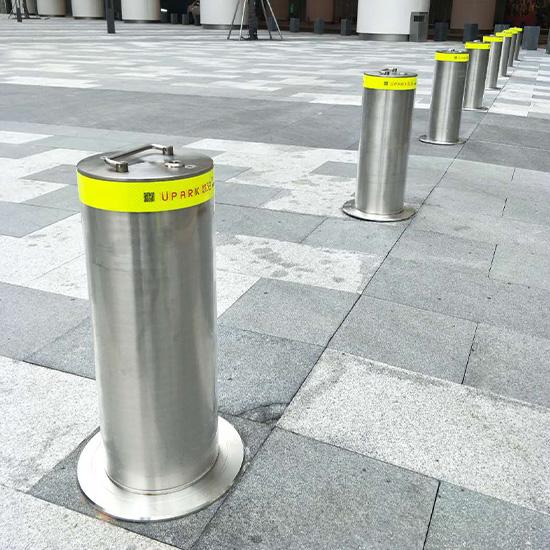
The bollard specification should match the threat level. For the majority of commercial data centres, IWA 14-1 M40/P1 or M50/P1 certified bollards at the main access point and along exposed building faces provide protection against deliberate vehicle attack up to and including large truck scenarios. For higher-threat government and defence installations, the specification may go further — K12 (ASTM F2656) or custom engineering to specific vehicle and speed parameters.
A data centre is designed around uptime. The power systems, cooling systems, and network connectivity are all N+1 or higher redundant. The physical security systems should follow the same logic.
For automatic bollards at a data centre, this means several things. Fail-safe design: if a bollard fails or power is cut, the default state should not create a security vulnerability. For the main access gate, fail-secure (remains raised on power failure) is usually the right choice. Battery backup power keeps the system operational during brief power interruptions. Dual-motor or mechanical redundancy in the bollard actuator means a component failure does not put the bollard out of service.
Spare parts availability is another redundancy consideration. A bollard that cannot be repaired within hours because the manufacturer does not stock spare parts is a liability. When evaluating bollard suppliers, ask about local spare parts inventory and maximum response time for emergency service.
Enterprise data centres run sophisticated physical access control systems (PACS) covering doors, turnstiles, cameras, and perimeter intrusion detection. Vehicle access bollards should integrate with this system rather than operating as an isolated point control.
Standard integration interfaces for bollards are: dry contact relay (simple open/close signal), RS485 Modbus (digital communication with status feedback), and Wiegand (integration with card reader and access control panels). UPARK bollards support all three, making integration with platforms from Lenel, CCURE, Genetec, Honeywell, and other enterprise PACS providers straightforward.
Integration allows the security operations center to see real-time bollard status, log every activation, set up alarm rules (bollard held open longer than X minutes, unauthorized operation attempt), and control bollards remotely in response to security events — all from the same interface used to manage the rest of the physical security system.
Data centres often have challenging site geometries: irregular plot shapes, limited frontage on public roads, existing buildings that constrain where bollards can be positioned. A few design principles that apply across most sites:
The vehicle exclusion zone around the building should match the standoff distance in the threat model. For IWA 14-1 M50/P1 level protection, the bollard line should be at least 10 metres from the building facade to allow the vehicle to decelerate and come to rest without reaching the structure. Closer spacing is possible with custom engineering solutions.
At vehicle access points, the bollard approach lane should be designed to prevent a straight high-speed run at the bollard. A gentle curve in the approach lane, or a speed control feature (speed humps, chicane), reduces the kinetic energy a vehicle can build up before impact. This significantly reduces the load on the bollard and foundation.
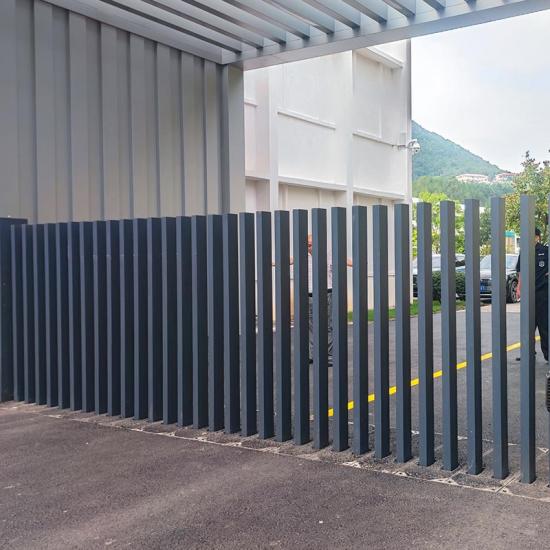
Fence gates and bollards are typically used together at data centre perimeters: the fence gate provides the primary vehicle and personnel access control function, while bollards provide the crash resistance. The gate does the access management; the bollards do the stopping.
Critical infrastructure sites have formal maintenance programs. Bollards at these sites should be included in the preventive maintenance schedule with documented inspection intervals, test procedures, and acceptance criteria. For automatic bollards, this means testing rise and lower function, checking seal integrity, verifying actuator force (via the control system diagnostics), and inspecting the foundation for cracks or settlement.
UPARK provides maintenance manuals and recommended inspection checklists for all automatic bollard products. We also offer service contracts for facilities that require documented maintenance records as part of their physical security compliance program.
UPARK supplies bollard systems for data centres and critical infrastructure sites worldwide. We offer IWA 14-1 certified automatic bollards and fixed bollards with full documentation packages and integration support. Contact us for a technical consultation on your facility's perimeter security requirements.
call us :
+86 18206096507 e-mail : [email protected]




 ipv6 network supported