Storm season is predictable in the calendar and unpredictable in the details. You know roughly when the typhoons, hurricanes or monsoon rains will arrive. You never know which week will deliver 300 mm, which drain will block, or which piece of ground-level equipment will spend two days underwater.
For site managers, the useful question is not whether it will rain. It is which parts of the site change behaviour when it does, and whether the perimeter equipment installed there was chosen with water in mind.
This guide covers three things: what rain does to drivers, where floodwater defeats physical security equipment, and how to specify bollards that keep operating through a wet season.
1. What heavy rain does to a driver
Rain degrades driving in four separate ways, and they compound each other.
Sight lines shorten. Wipers clear a limited arc, side windows fog or bead up, and spray from the vehicle ahead cuts forward visibility to a few metres. Mirrors become nearly useless in heavy spray.
Braking distance grows. On a wet surface at 50 km/h, stopping distance is roughly double the dry figure. On a worn surface with standing water, it is worse. Drivers rarely adjust by enough, because the feedback they rely on, tyre noise and steering weight, is muted by the water film.
Aquaplaning removes control entirely. It does not require high speed. A few millimetres of standing water over a smooth or polished surface is enough at urban speeds, and once it starts there is no steering or braking input until grip returns.
Judgement of position fails. This is the one that matters most for perimeter design. Drivers judge where the vehicle is relative to kerbs, posts and walls using visual cues. Standing water removes those cues, and at night wet asphalt turns reflective, so a dark low object against a bright wet ground simply disappears.
None of this produces fast crashes. It produces slow, expensive ones: vehicles mounting kerbs, rolling into entrances, hitting shutters, and striking pedestrians in areas where vehicles and people share space.
2. Standing water hides the things that stop cars
The perimeter devices most commonly used to stop vehicles are also the ones water hides first.
Wheel stops sit 100 to 150 mm above the ground. In 100 mm of standing water they are invisible, and a slow-moving vehicle will climb them rather than stop. Painted hatching loses all contrast when submerged. Low fixed posts, the 600 mm decorative type, fall below the waterline in a serious pool and become an obstacle the driver meets rather than avoids.
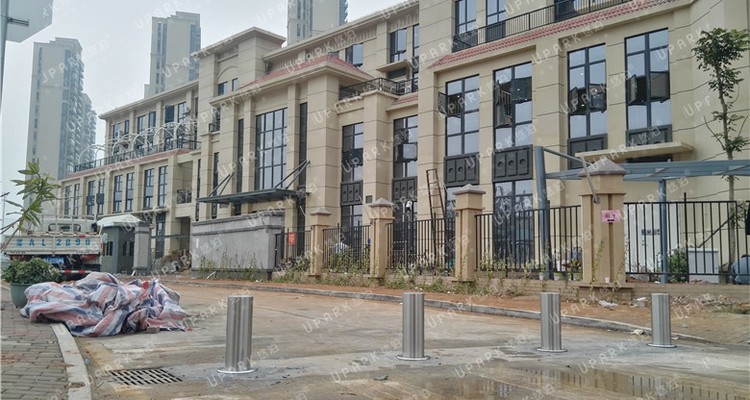
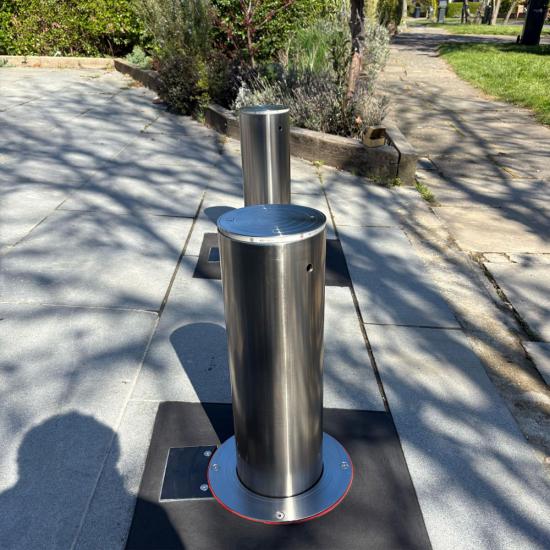
A rising bollard behaves differently. At full height it stands 600 to 900 mm above the surface, well clear of typical flooding, and it occupies the driver's eyeline rather than the ground plane. That height difference is the whole point. Under conditions where everything at ground level has been erased by water, the only devices that still register are the ones standing above it.
Height alone is not enough. The unit needs contrast: a reflective band for night, an LED collar for spray and fog, and a colour that separates from wet asphalt. This is why the same bollard performs very differently on a dry industrial estate and on a coastal forecourt in monsoon season.
3. The low-speed impact problem
Perimeter equipment is usually specified against a crash rating: PAS 68, IWA 14, or ASTM F2656. Those standards test at speed, typically 48 km/h and above. Storm incidents do not look like that.
A typical wet-weather incident involves a vehicle at 10 to 25 km/h with reduced grip and an inattentive driver. The energy is far lower, but so is the equipment's ability to absorb it if the unit was chosen for appearance rather than structure.
This creates a mismatch worth thinking about during specification. A light decorative post may survive a storm impact and may not. A properly engineered rising bollard with a deep foundation and a rated sleeve will take the hit, protect whatever sits behind it, and in most cases remain operational afterwards.
If your site has plant rooms, glazed frontages, fuel dispensers, or pedestrian routes within a few metres of vehicle movement, spec for the low-speed case. It is the one that will actually happen.
4. Basement car parks and sunken driveways
Underground and semi-basement parking is where storm water does the most expensive damage, and it deserves separate attention.
The geometry works against you. A ramped access is a channel that collects everything flowing downhill. Once water depth at the bottom exceeds the ramp invert, the space below becomes a tank. Vehicles get submerged, and buoyancy starts moving things that weigh two tonnes.
Bollards at the head of a basement ramp serve two purposes. They prevent unauthorised access, and they stop a vehicle that has lost control on a wet ramp from descending into the space. The second function matters most precisely when the ramp is slick and the driver cannot see the bottom.
Water that gets in has to go somewhere. Pumped drainage is standard in basement design, and the failure mode is always the same: the pump loses power, or the intake blocks with debris, or the inflow simply exceeds capacity. If perimeter equipment at the ramp head depends on a dry pit, it fails at the same moment the drainage does. Specifying equipment that operates while submerged removes that shared failure point.
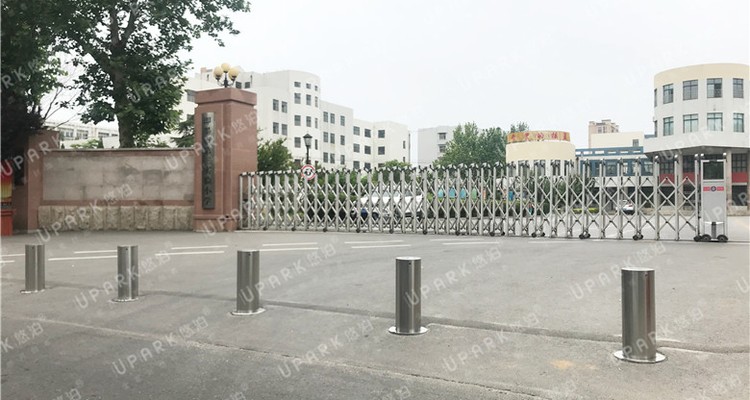
Consider removable bollards for the ramp-head position where occasional vehicle access is needed, and fixed automatic units where access control has to stay enforced.
5. Power cuts during a storm
Storms and power outages arrive together, which is why emergency behaviour belongs in the specification rather than in the manual.
There are three behaviours to choose between, and the right one depends on what the bollard is protecting.
Fail-raised keeps the site secured when power drops. This suits a high-risk perimeter where the asset behind the bollard is worth more than the inconvenience of blocked access.
Fail-lowered opens the route. This suits fire lanes, ambulance access, and any position where a blocked vehicle route creates a life-safety problem.
Battery-backed controlled operation keeps both options available, giving a defined number of cycles after mains loss so an operator can make the call. It costs more and needs periodic testing.
Write the requirement into the specification. "Automatic lowering on power failure" is a purchase-order line, not an afterthought. And test it before the season: a backup battery that has never been cycled will not deliver its rating, and the first real test should not happen during a blackout.
Our automatic bollards support configurable fail-state behaviour with battery backup, so the same unit can be set to suit a fire lane or a secured perimeter.
6. Specifying bollards for a wet climate
Four specification lines decide whether a bollard survives storm season.
Ingress protection. Ask for IP68 on the below-ground housing and the drive unit, and confirm whether the rating covers operation or only survival during immersion. The distinction determines whether a flooded pit is a service call or an outage.
Drive voltage. Water and mains voltage are a bad combination in a pit that pedestrians walk past. A 36 V electromechanical drive keeps the consequence of water ingress manageable and puts the power conversion above ground. This is the specification detail most often skipped, and the one that matters most in a flood.
Drainage requirement. Conventional installations need a soakaway, sump or pump. Each adds cost, a failure point, and a dependency on ground conditions that stop holding during a storm. A drainage-free unit is sealed and rated to operate submerged, so there is nothing to pump and nothing to block.
Material. Coastal and tropical sites add salt and constant humidity to the equation. 304 stainless steel pits in a coastal environment; 316 is worth the premium where salt spray is regular. Ask about the finish on below-ground components as well, since that is where corrosion starts and where nobody sees it until the unit seizes.
7. Drainage-free installation, explained
The idea is simple enough that it is worth stating plainly.
A conventional bollard pit is a hole in the ground. Water enters it. So the design has to include a way to get water out, and that means a soakaway into permeable ground, a sump with a pump, or a connection to the site's stormwater system. Each of those works on a dry site and each becomes unreliable when the surrounding ground is saturated.
A drainage-free design removes the requirement instead of solving it. The drive unit is a sealed assembly rated for continuous immersion. The pit does not need to be dry for the bollard to work, so there is no pump to fail, no soakaway to silt up, and no excavation beyond the unit itself.
The practical benefits show up in three places. Installation is faster and does not disturb existing drainage. Sites on clay, on a high water table, or above a basement slab become viable without expensive civil work. And the maintenance schedule loses its single most common callout.
It is not the right answer everywhere. Sites with genuinely aggressive groundwater chemistry should still be assessed individually. But for the majority of car parks, forecourts and coastal sites, removing the drainage dependency is the difference between equipment that works through storm season and equipment that works until the first serious flood.
8. Before and after the storm
Before the season, walk the site in actual rain. Pooling only appears when water is moving, and a dry-day inspection will not show you where the problems are. Check cable gland torque, confirm the backup battery cycles, clean reflective bands, and time a full raise-and-lower stroke against the specification. A unit that has slowed down is telling you something.
After a significant storm, open the housings before re-energising anything. Look for silt, water marks above the cable entry, and rust staining at the base. Cycle each unit and listen. Grinding, hesitation, or a stroke that is slower than the unit next to it all warrant attention before the next event.
Keep a short log. Date, water depth observed, units affected, action taken. Two seasons of that log will tell you exactly which positions need better specification, which is far more useful than a generalised maintenance contract.
For sites reviewing their perimeter before the wet season, the range covers automatic bollards, fixed bollards, removable bollards and parking barriers, all built around a sealed 36 V electromechanical drive with drainage-free installation. Company background and engineering approach are on the about us page.
Storm season arrives on schedule every year. Whether your perimeter is ready for it is a specification decision made months earlier.
call us :
+86 18206096507 e-mail : [email protected]




 ipv6 network supported