Three drive technologies dominate the automatic bollard market: electromechanical, hydraulic, and pneumatic. Each has its place, but most facility managers who have operated all three eventually settle on electromechanical for day-to-day usability, maintenance cost, and installation flexibility. This guide explains the tradeoffs, and helps you work out when the other technologies genuinely make sense.
UPARK has manufactured electromechanical rising bollards for over 10 years across schools, government compounds, shopping centers, energy infrastructure, and industrial facilities.
How each drive type works
Understanding the mechanism makes the tradeoffs obvious.
Hydraulic bollards use a pump to push pressurized oil through a cylinder, which drives the post upward. Lowering releases oil back into a reservoir. The system needs an external hydraulic power unit, oil lines, and seals throughout. It is mature, heavy-duty technology borrowed from industrial machinery.
Pneumatic bollards use compressed air from an onsite compressor rather than oil. The mechanics are similar to hydraulic in principle, but air compressibility gives pneumatic systems their speed advantage. A compressor must be installed nearby and maintained separately.
Electromechanical bollards integrate the electric motor and mechanical drive into a single sealed unit inside the bollard body. There is no external power unit, no hydraulic oil circuit, and no compressor. The motor turns a lead screw or gear mechanism to push the post up and retract it down. Everything is self-contained.
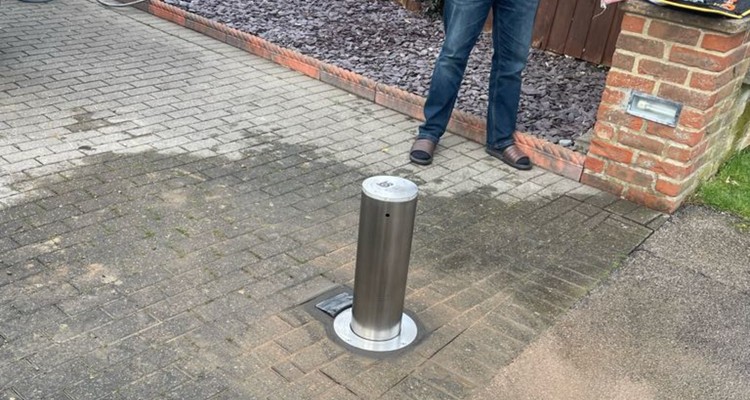
That self-contained design is the main reason electromechanical bollards have become the default for most new installations.
Why electromechanical bollards have the edge
No fluid to leak, no compressor to service
This is the practical daily reality for maintenance teams. Hydraulic systems have oil, and oil eventually leaks. Seals degrade, especially in ground-level installations exposed to thermal cycling. A leaking hydraulic bollard contaminates the surrounding ground and takes the unit out of service until the failed seal is found and replaced. At a busy access control point, that means real downtime.
Pneumatic systems need a compressor running continuously or on demand. Compressors require air filter replacements, oil changes for lubricated models, belt or valve service, and a dry location to operate. If the compressor fails, every bollard on that circuit goes down at once.
Electromechanical bollards have none of these external dependencies. UPARK's electromechanical models use fully sealed drive assemblies where the motor and mechanism are one protected unit. Routine maintenance is minimal: a periodic visual check and, depending on the model, a lubrication check on the drive thread. That is a very different maintenance commitment from managing a hydraulic fluid circuit.
Lower installation cost and simpler civil works
Hydraulic bollards require running oil lines between the power unit and each bollard. For a row of six units, that means excavating a trench for the hydraulic circuit on top of the standard electrical conduit. The hydraulic power unit needs a dry, ventilated housing, typically a below-grade cabinet or plant room, which adds civil engineering cost.
Pneumatic installations have the same problem with the compressor. It needs shelter, condensate drainage, and a dedicated power supply.
Electromechanical bollards only need an electrical supply and control cable. No fluid lines, no external power unit, no plant room. On retrofit projects over existing paving where excavation is expensive and disruptive, this difference can shift the whole cost calculation.
24V operating voltage in wet environments
UPARK's electromechanical bollards operate at 24V. That matters in ground-level installations where moisture is a factor: coastal sites, car parks prone to ponding, locations near water features. A 24V electrical fault in a waterlogged bollard pit is a very different situation from a high-voltage hydraulic power unit in the same condition.
UPARK's UP-C001 achieves IP67/IP68 full-sealed waterproofing on top of the 24V architecture. Both together meaningfully reduce risk in demanding outdoor environments.
Quiet enough for noise-sensitive locations
Electric motors at low load are quiet. A well-engineered electromechanical bollard at a school entrance or hospital drop-off is genuinely unobtrusive. Hydraulic power units emit continuous pump noise. Pneumatic systems exhaust air with each cycle, which is audible. For installations near occupied buildings, residential areas, or healthcare facilities, the noise difference is noticeable.
Cycle speed is now competitive
Slow cycle times were the standard criticism of early electromechanical bollards. 10 seconds per cycle was common. That has changed. UPARK's current electromechanical models operate in the 3-to-6-second range depending on configuration. For school gates, shopping centers, and office car parks, that is fast enough. The gap with pneumatic is much narrower than it was five years ago.
When hydraulic bollards still make sense
Physical security at the highest level. For applications where the bollard must actually stop a vehicle — an anti-ram perimeter around a power plant, a government facility in a high-threat location, a pedestrian zone in a dense urban area — hydraulic bollards can be engineered to achieve recognized crash ratings. The mass and oil circuit of a hydraulic system contribute to its physical resistance in a way that is difficult to replicate in a lighter electromechanical design.
UPARK's UP-M002 hydraulic bollard is specified for these deployments. If the project requires a crash rating under PAS 68, IWA 14, or ASTM F2656, hydraulic is worth a serious look.
For most other sites, the maintenance load of hydraulic is hard to justify.
When pneumatic bollards make sense
High-frequency industrial cycling where sub-2-second cycle time is genuinely needed: a logistics depot gate handling hundreds of vehicles per shift, a factory entrance where throughput directly affects productivity. UPARK's UP-M003 pneumatic bollard covers this use case.
For standard access control at schools, shopping centers, parking facilities, or government offices, pneumatic speed exceeds what the application needs, and the compressor infrastructure adds cost without adding value.
UPARK's electromechanical bollard range
The UP-A001 Enhanced Electromechanical Bollard is the high-traffic option. Stainless steel construction, suited to shopping centers, campuses, and gas stations where daily cycle volumes are high. Dimensions, control integration, and finish are all configurable.
The UP-M001 Full-Automatic Electromechanical Bollard is built for institutional sites. It connects to license plate recognition systems, remote management platforms, smartphone apps, and traffic light controllers. School gates and government facilities where the access control system needs to do meaningful work, not just open and close, are the typical applications.
The UP-C001 offers the most complete environmental protection: IP67/IP68 waterproofing, 24V safety voltage, and availability across electromechanical, hydraulic, and pneumatic drive configurations. The electromechanical variant covers most deployments. Schools, government compounds, and energy infrastructure are the primary users.
The UP-A006 Battery-Powered Bollard removes external power requirements entirely. It runs off an internal rechargeable battery, suited to parks, remote checkpoints, and temporary installations where cable trenching is not practical.
Drive type comparison
Electromechanical — schools, campuses, shopping centers, government, general use — low maintenance, low installation complexity, low noise.
Hydraulic — anti-ram / crash-rated security perimeters — medium to high maintenance, high installation complexity, medium noise.
Pneumatic — high-frequency industrial gates, sub-2-second cycle needed — medium maintenance, high installation complexity, medium to high noise.
Battery electromechanical — off-grid sites, temporary installations — low maintenance, very low installation complexity, low noise.
Working through the selection
Start with the security requirement. If there's a crash rating in the brief, evaluate hydraulic. If not, electromechanical covers the application.
Then look at cycle frequency. If the gate runs hundreds of cycles per day and speed is a hard constraint, check whether electromechanical cycle time meets the requirement. Most sites will find it does. If not, consider pneumatic.
Then check the infrastructure available. No power supply: battery electromechanical. No space for a plant room: electromechanical. Retrofit over existing paving: electromechanical.
Check the environment. Coastal or flood-prone location: 24V electromechanical with IP67/IP68. Noise-sensitive zone: electromechanical.
For most sites, that process leads to electromechanical bollards. UPARK carries 20-plus patents in electromechanical bollard technology and holds over 60 quality certifications. Export-market projects are handled through uparkbollards.com, where the technical team can work through a site-specific recommendation based on vehicle volume, environment, and security requirements.
call us :
+86 18206096507 e-mail : [email protected]




 ipv6 network supported