Hotel entrances handle a complex mix of traffic: guests arriving by private car, taxis and ride-share vehicles, shuttle buses, delivery trucks, emergency vehicles, and pedestrians — often all at the same time. Bollards provide the physical access control layer that lets security staff manage this complexity without creating bottlenecks or compromising the welcoming atmosphere that guests expect.

High-profile hotels have been targeted in vehicle-ramming incidents in multiple countries. Beyond deliberate attacks, hotels also face the mundane but costly problem of vehicles entering restricted areas — the outdoor dining terrace, the porte-cochère when it is not in use, the pathway between the lobby and pool area. Without physical barriers, these incidents happen regularly.
Crash-rated automatic bollards stop a 7.5-tonne vehicle traveling at 30 km/h. This is the standard used by government facilities, embassies, and financial institutions worldwide. Hotels that have adopted the same standard have effectively neutralized the vehicle-as-weapon threat at their main entrances.
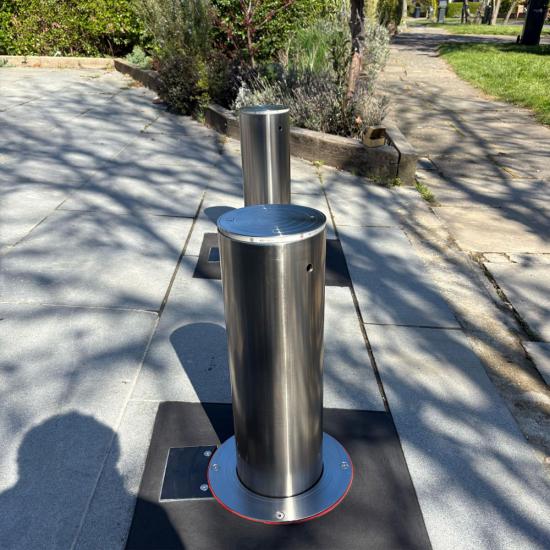
A four-star hotel is not going to install bollards that look like they belong outside a government building. The good news is that modern automatic bollards are designed with architectural integration in mind. Stainless steel housing can be brushed, polished, or powder-coated to match the hotel's exterior palette. Bollard heights are typically 600-900mm, which is low enough that the bollards read as a design element rather than a fortification.
Several luxury hotels have incorporated illuminated bollards — with LED rings at the base or top — into their entrance lighting scheme. During the day the bollards are barely noticeable. At night they contribute to the landscaping and pathway lighting while still providing the same physical barrier function.
A hotel entrance typically has several distinct zones: the main drop-off lane for guests, a separate lane for valet operations, a service entrance for delivery vehicles, and pedestrian paths connecting the entrance to parking areas. Bollards define and enforce these zones without the need for continuous staff supervision.
The main drop-off lane benefits from automatic bollards that can be controlled by the door staff or valet captain. When a delivery truck arrives outside its scheduled window, the service entrance bollard stays raised until the receiving dock is ready. This eliminates the situation where a truck blocks the main entrance because there was nowhere else to go.
Hotels operate property management systems (PMS) that track room assignments, check-in times, and guest services. Automatic bollards can integrate with these systems through the same relay contact interface used in parking management. Guest vehicles registered at check-in can be granted automatic bollard access via a transponder or card reader at the parking entrance. VIP guests can be pre-authorized for direct access to the main building entrance.
For hotels with conference facilities, the bollard schedule can be programmed around event calendars. When a banquet is scheduled from 6-10pm, the event parking lane bollards lower automatically at 5:45pm and raise again at 10:15pm. This eliminates the need for a staff member to manually operate the bollards for every event.
Every hotel access control system must provide rapid, reliable access for fire engines, ambulances, and police vehicles. Automatic bollards address this through two mechanisms: a physical key switch that security staff can use to lower all bollards simultaneously, and a strobe/siren activation input that automatically triggers bollard retraction when emergency vehicle lights are detected.
The 36V DC power supply used in UPARK bollards also includes battery backup, ensuring that bollards can operate even during power outages — which is exactly when emergency access is most critical.
Hotel installations typically require coordination with the facilities management team and sometimes with local planning authorities regarding the appearance of the entrance. The surface-mount installation method avoids the structural disruption that cored installations require, which is important for entrances with heated pavement systems or embedded decorative elements.
Operating costs for electric bollards are minimal. The 36V motor consumes approximately 80W during each raise/lower cycle, which takes under 4 seconds. For a hotel entrance cycling 200 times per day, annual electricity consumption for bollard operation is under 10 kWh — essentially negligible.

call us :
+86 18206096507 e-mail : [email protected]




 ipv6 network supported