A bollard either stops a vehicle or it doesn't. That outcome is mostly decided before the vehicle ever moves.
Wall thickness is the single most important structural variable in a bollard's impact resistance. Most buyers never ask about it. Most product pages don't mention it. That gap is where substandard manufacturers hide.
Standard automatic bollards use steel tubes as the main body. The wall thickness of that tube — typically measured in millimeters — directly determines how much energy the bollard can absorb before deforming or failing. A 4mm wall and a 6mm wall look identical in a photo. They perform very differently when a 2-ton truck hits them at 30km/h.

The math is straightforward. A thicker wall means more steel cross-section resisting the bending load. It also means the weld joints and base flange have more material to bond to. Thin-wall bollards don't just bend more — they tend to fail suddenly at the weakest point, usually the weld.
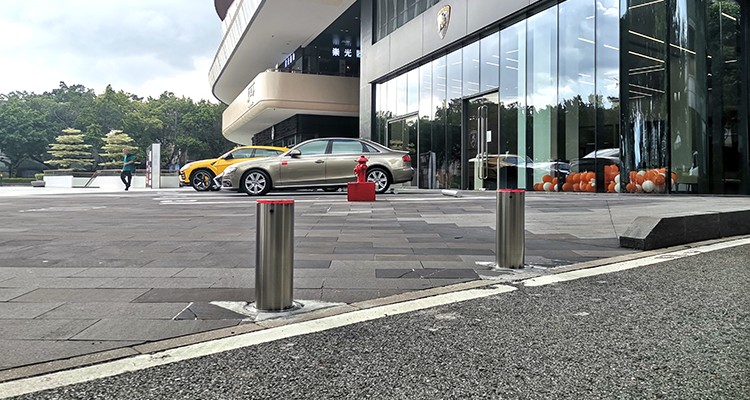
In competitive markets, wall thickness is the first place manufacturers cut costs. Reducing from 6mm to 4mm saves roughly 30% on raw material per unit. The difference is invisible to most buyers at the quote stage. It only shows up after installation — either in a slow deformation under repeated minor impacts, or in a dramatic failure when it matters most.
The same principle applies to the overlap zone — the section where the moving bollard body slides inside the fixed outer sleeve. A longer overlap means more surface contact distributing the lateral load during impact. A short overlap concentrates the stress at one point, accelerating wear and increasing the chance of jamming or collapse on impact.
UPARK bollards are built with a 20cm overlap between the moving inner tube and the outer housing. That's not a marketing figure — it's a structural specification that determines how force transfers through the assembly when the bollard takes a hit. Shorter overlaps, which are common in budget products, leave the inner tube acting more like a lever arm, multiplying stress at the contact edges.
IP67 waterproofing also relates to wall quality. Thin-wall bollards are harder to seal reliably. The deformation tolerance is tighter, and any minor warping during welding creates gaps. A bollard rated IP67 needs consistent geometry across all joints — which requires the dimensional stability that only comes from adequate wall thickness.
When evaluating bollard specifications, ask for the wall thickness in millimeters and the overlap length in centimeters. If a supplier can't answer immediately, that's information too.
A bollard is infrastructure. It sits in the ground for ten or fifteen years. The extra cost of proper wall thickness and overlap is paid once. The consequences of skipping it can be paid much more expensively.
See UPARK automatic bollards for full structural specifications including wall thickness and overlap dimensions.
call us :
+86 18206096507 e-mail : [email protected]




 ipv6 network supported