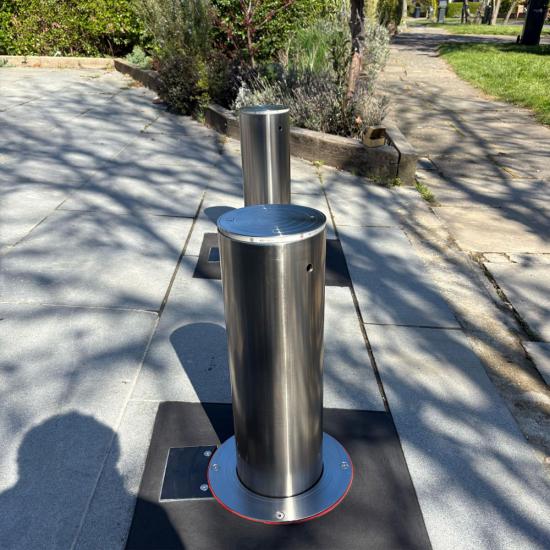
Automatic bollards rely on one of two main drive technologies: hydraulic or electromechanical. Each has distinct characteristics that make it better suited for certain applications. Understanding these differences helps you choose the right system for your project.
Hydraulic systems use fluid pressure to raise and lower the bollard. A motorized pump pushes hydraulic fluid into a cylinder beneath the bollard, forcing it upward. Releasing pressure lets gravity and an internal counterweight return the bollard to ground level. This technology has powered automatic bollards for decades and remains the standard in high-security applications.
The hydraulic approach offers several advantages. Speed stands out first. Hydraulic bollards typically raise in 2 to 4 seconds, making them suitable for high-traffic entrances where waiting matters. The lifting force remains consistent regardless of temperature or weather conditions. Hydraulic systems also handle heavier bollard shafts, which matters for high-security ratings. Most M50-rated bollards use hydraulic drive because the system can reliably push the heavier mass to full height.
Maintenance concerns often get overstated. Early hydraulic systems leaked fluid and required frequent service. Modern sealed systems have largely solved this problem. A properly installed hydraulic bollard needs professional service every 3 to 5 years under normal use. The components are robust and well-understood by technicians worldwide.
Electromechanical bollards use an electric motor to drive a screw mechanism or gear rack. The motor turns a threaded rod that pushes the bollard up or pulls it down. This approach eliminates hydraulic fluid entirely and simplifies installation.

The electromechanical design offers clear benefits. Installation requires no hydraulic lines or pumps, reducing setup complexity and cost. The system uses standard electrical components that most technicians can service. Without fluid to leak, environmental concerns disappear. Initial cost typically runs 15 to 20 percent lower than comparable hydraulic systems.
Speed represents the main limitation. Electromechanical bollards usually require 6 to 10 seconds for a full raise or lower cycle. For most applications this poses no problem. But at busy entrances where vehicles queue frequently, the extra seconds add up across many vehicles daily.
Climate affects each technology differently. Hydraulic systems perform reliably from -40 to 60 degrees Celsius. Extreme cold can thicken hydraulic fluid slightly, though additives address this in northern installations. Electromechanical systems face different challenges. The electric motor works harder in very cold conditions. Gears and threads may need more frequent lubrication in harsh weather. Hot climates generally pose no problem for either technology.

Security ratings work differently across systems. Both hydraulic and electromechanical bollards can achieve crash ratings up to M50. The key is engineering quality, not drive type. A well-designed electromechanical bollard meets the same standards as a hydraulic equivalent. When comparing products, look at the actual test results, not just the drive technology.
Power consumption differs notably. Hydraulic systems run a pump motor only during raising, typically drawing power for 10 to 30 seconds per cycle. Electromechanical motors run continuously during both raising and lowering, which can increase total energy use at high-frequency installations. For most properties this difference amounts to pennies per day.
Emergency operation matters in some contexts. Hydraulic bollards typically include a manual lowering feature using a hand pump or release valve. This works even during power outages. Electromechanical systems usually require battery backup or manual override to lower during electrical failures. Check the specific product features if power reliability concerns you.
Choosing between them often comes down to three factors. First, frequency: very high traffic entrances favor hydraulic speed. Second, budget: electromechanical systems cost less upfront and install simpler. Third, security level: both achieve top ratings, but hydraulic dominates the extreme high-security market. Most commercial applications work perfectly well with either technology.
UPARK offers both hydraulic and electromechanical automatic bollards. Our engineering team can help match the right drive system to your specific traffic patterns, security requirements, and budget constraints.
call us :
+86 18206096507 e-mail : [email protected]




 ipv6 network supported