Manual Pull-Up Post vs Automatic Bollard: The Complete Comparison for Parking Management
Why the Manual Pull-Up Post Is Losing Ground
The manual pull-up parking post has been a fixture in parking lots and residential compounds for decades. Its appeal is straightforward: low purchase cost, simple mechanical design, and no electrical infrastructure required. For a single private parking spot used occasionally, it still makes sense.
But parking management has changed. Modern residential compounds may have hundreds of spots with dozens of daily access events. Commercial facilities face turnover rates that make manual operation impractical. And in all cases, user behavior is the weak link — a manual post left unlocked by a rushed driver is a security post that provides zero security.
This is where the 120mm automatic bollard enters the conversation. It is designed specifically as a direct replacement for the manual pull-up post — same diameter class, same parking-spot footprint, but fully automated operation. Here is the complete comparison across the dimensions that matter.

1. Daily Convenience: The Real Cost of Manual Operation
A manual pull-up post requires the driver to stop, exit the vehicle, unlock the post (often with a key in a low position), lift the post, lock it, return to the vehicle, and drive away. On return, the process reverses. In ideal conditions this takes 20-30 seconds. In rain, snow, or darkness, it takes longer and feels much longer.
An automatic bollard reduces this to a button press on a remote control. The bollard rises or lowers in 3-5 seconds while the driver remains seated. Over 200 days of use per year with two operations per day, that is 400 manual operations avoided — roughly 3-4 hours of cumulative time saved annually per user.
For multi-user facilities, the convenience gap multiplies. Property managers report that manual posts left in the raised position (to avoid the hassle) become trip hazards. Automatic bollards eliminate this entirely — users simply press the remote and drive through.
2. Security: The Weakest Link Is the User
A manual pull-up post is only as secure as the last person who used it. If a resident forgets to lock it, the post can be lowered by anyone. If the lock mechanism corrodes after exposure to rain (which it inevitably does), the post becomes a decorative obstacle at best.
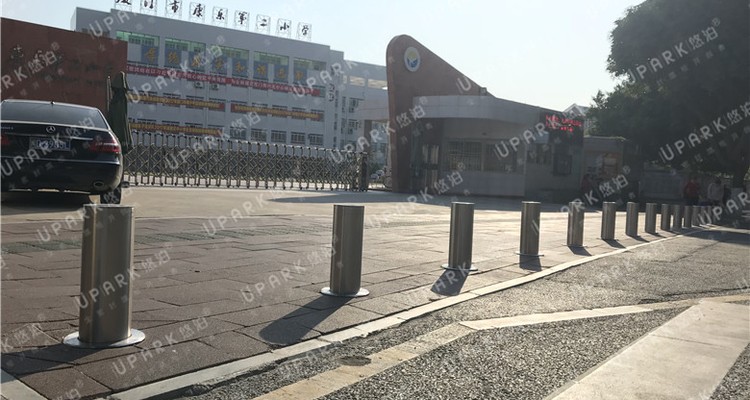
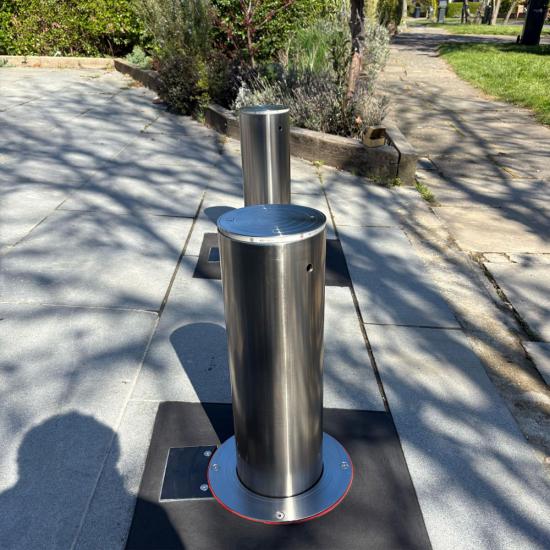
A 120mm automatic bollard addresses these vulnerabilities at the design level. The bollard defaults to the raised (locked) position — it only lowers on authenticated command. There is no exposed lock cylinder to pick, freeze, or corrode. The motorized mechanism is sealed within a 3mm+ wall thickness steel housing, making forced manual lowering extremely difficult.
For facilities where parking spot theft is a real concern — shared residential garages, hospital staff parking, university lots — this default-locked behavior represents a genuine security upgrade.
3. Installation: Electrical Infrastructure Matters
This is the one area where manual posts have an undeniable advantage. They require zero electrical work — just a ground sleeve and concrete foundation. Total installation time is under an hour per post.
Automatic bollards require power. However, 120mm models operating at 36V low voltage significantly reduce the installation burden. In most jurisdictions, 36V circuits do not require licensed electricians or buried conduit at the depth mandated for 220V mains. A single power line can serve multiple bollards in series. The foundation requirements are nearly identical to manual posts — a concrete base with a ground sleeve.
The installation cost premium for an automatic bollard over a manual post is typically $200-$400 per unit when using 36V low-voltage architecture. Over a 10-year lifecycle, this premium is recovered through operational savings and reduced user friction.
4. Durability and Maintenance
Manual pull-up posts have a simple failure mode: the lock mechanism. Exposure to rain, road salt, and dust means locks require regular lubrication and occasional replacement. The lifting mechanism (typically a spring-loaded pin) also wears over time, especially in high-use environments.
Automatic bollards have more components — motor, control board, sensors — but modern electromechanical designs are rated for 500,000+ cycles. With IP67 waterproofing, the internal electronics are fully protected from moisture and dust ingress. The 3mm+ structural wall thickness provides impact resistance that manual posts with 1.5-2mm walls cannot match.
Maintenance on an automatic bollard primarily consists of an annual inspection of seals and a functional test. The sealed design means there is no lock to lubricate, no spring to replace, and no exposed moving parts to protect from weather.
5. Cost Comparison Over 10 Years
A quality manual pull-up post costs $80-$150. A 120mm automatic bollard costs $600-$900. On purchase price alone, the manual post wins. But the total cost picture is different:
The automatic bollard costs roughly 2.3x more over a decade. For a single private spot used occasionally, the manual post remains the budget-friendly choice. For any multi-user, high-frequency application, the convenience and security benefits of the automatic bollard justify the premium many times over — the avoided user frustration alone typically drives full resident or staff satisfaction within the first month.
Conclusion: When to Upgrade
If your parking facility has more than 5 daily access events, operates in a shared or commercial setting, or has experienced security incidents related to unlocked posts, the 120mm automatic bollard is not an upgrade — it is the correct baseline specification. The manual pull-up post, for all its simplicity, belongs in single-user, low-frequency applications. For everything else, automation pays for itself in convenience and reliability.
call us :
+86 18206096507 e-mail : [email protected]




 ipv6 network supported