Parking lots face a unique combination of challenges: high vehicle turnover, pedestrian traffic, and the constant risk of unauthorized access. Automatic bollards have become the go-to solution for parking facility managers who need reliable, low-maintenance access control.

Unlike traditional barriers or gates, automatic bollards rise and retract in seconds, keeping traffic moving without compromising security. A standard electric bollard like the UPARK model can cycle from fully raised to fully retracted in under 4 seconds — fast enough to serve one vehicle per lane per minute during peak entry periods.
The core problem in parking access is this: you need to let authorized vehicles in quickly while blocking unauthorized ones completely. Swing gates and boom barriers accomplish the first goal reasonably well, but they fail at the second — a determined driver can simply drive around or through them. A bollard rated at 7.5 tonnes of impact resistance cannot be pushed aside.
Beyond access control, bollards protect pedestrian zones within parking facilities. Placing bollards at the entrance to covered walkways, near elevator lobbies, and at crosswalk boundaries keeps foot traffic physically separated from vehicle lanes, even when drivers are distracted.
The most important decision is between fixed, removable, and automatic bollards. Fixed bollards work well for permanent pedestrian zones inside the lot. Removable bollards serve loading zones or event-day closures. Automatic bollards handle the main entry and exit lanes where regular vehicle movement is required.
For parking lots specifically, consider these factors:
Cycle frequency matters. A busy urban parking lot might process 500 vehicles per day per lane. Over a 10-year lifespan, that is 1.8 million cycles. UPARK bollards are tested to 1 million+ cycles with standard maintenance, making them appropriate for high-traffic facilities.
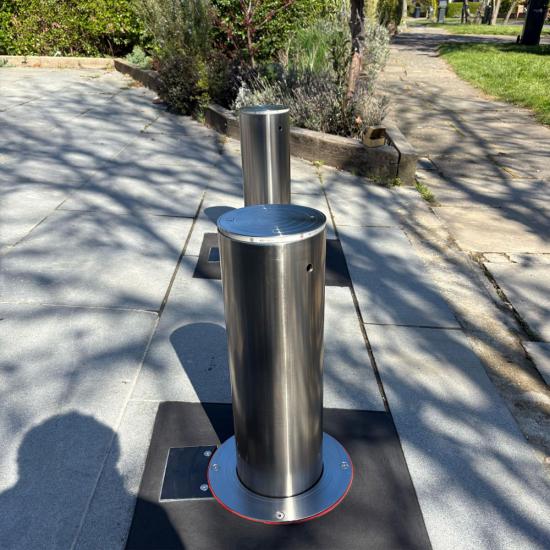
Power supply type affects installation cost. Surface-mounted electric bollards (36V DC) can be installed without cutting into the existing concrete, which matters when the parking structure is built over a basement or has limited slab depth. The 36V low-voltage system also eliminates the need for separate electrical permits in most jurisdictions.
Height and diameter selection depends on the vehicle types you need to stop. Standard passenger vehicles are controlled by a 600mm-height bollard. For facilities that need to keep out trucks or delivery vehicles, 900mm-height bollards provide a more visible deterrent.
Modern parking facilities use license plate recognition (LPR) cameras, loop detectors, and ticketing machines to manage flow. Automatic bollards integrate cleanly with all of these systems through dry contact inputs. When the LPR system reads a valid plate, it sends a signal to lower the bollard. When the ticketing machine dispenses a paid ticket, the same signal triggers the exit bollard. No custom programming is required — standard relay outputs work with every major parking management platform.
Remote control options add another layer of flexibility. A security guard at a central booth can override individual bollards for delivery vehicles, emergency access, or VIP entry without leaving their station.
Most parking lots are asphalt or concrete surfaces that are relatively straightforward to core-drill for bollard installation. The main variable is underground utility depth. Before installation, always request utility locating services to map any conduit, plumbing, or structural rebar that might interfere with the core hole.
For multi-level parking structures, verify the slab load rating before selecting bollard models. Standard surface-mount bollards distribute forces across the base plate; cored models concentrate load at the foundation point. Your structural engineer should review the specific bollard load specifications against the slab design.
Parking lots are harsh environments for mechanical equipment. Oil drips, road salt in winter climates, and constant vibration from vehicle traffic all accelerate wear. The IP67 rating on UPARK bollards means the internal motor and electronics are fully sealed against dust and water ingress. The stainless steel housing resists the minor chemical exposure from automotive fluids.
Scheduled maintenance consists of lubricating the lifting mechanism every 6 months and inspecting the impact sensors annually. Most facilities build this into their regular parking equipment service rounds. The expected service life before major component replacement is 10 years under typical parking lot conditions.

call us :
+86 18206096507 e-mail : [email protected]




 ipv6 network supported