Logistics parks and distribution centers combine the highest vehicle traffic volumes of any commercial environment with the constant presence of pedestrians doing time-sensitive work. Forklifts, heavy trucks, and delivery vehicles operate in close proximity to staff on foot, often in spaces with limited sight lines and under time pressure. Bollards play a critical protective role in this environment — not primarily as perimeter security, but as internal traffic management and impact protection.

Forklift collisions with building infrastructure are one of the most costly recurring maintenance issues in logistics facilities. A standard counterbalance forklift weighs 3-5 tonnes and can reach speeds of 20 km/h in internal aisles. At typical aisle speeds, a collision with a column, wall, or racking system can cause structural damage costing tens of thousands to repair. More importantly, these incidents injure workers — either directly from the forklift or from displaced racking and product.
Fixed bollards positioned at column bases, wall corners, and racking ends absorb the kinetic energy of forklift glancing blows before they reach the protected structure. The bollard deforms or is damaged, but the column or wall remains intact. Bollard replacement costs USD 500-2,000; column repair can cost USD 50,000 or more.
Loading docks present specific hazards because large trucks are reversing into position in a space also occupied by dock workers, pallet movers, and sometimes forklifts driving onto trucks. Bollards at dock corners define the truck lane boundaries and protect dock levellers, door frames, and building corners from being struck during the backing manoeuvre.
Guide bollards — spaced at regular intervals along the truck approach lane — help truck drivers align their reversing approach without requiring a spotter. Reflective banding on these bollards makes them visible in the poor lighting conditions common at night-shift loading operations.
The most critical safety application in logistics facilities is physically separating pedestrian walkways from vehicle traffic routes. Painted lines alone are insufficient in high-traffic, fast-moving environments — studies consistently show that physical barriers reduce pedestrian incident rates by 70-80% compared to marked-only separation.
Bollard lines along pedestrian corridors within warehouse floors and between the warehouse and the truck yard create hard separation that both pedestrians and vehicle operators can rely on. When a forklift driver knows the bollard line is there, they stop at it. When pedestrians know the bollard line is there, they stay behind it.
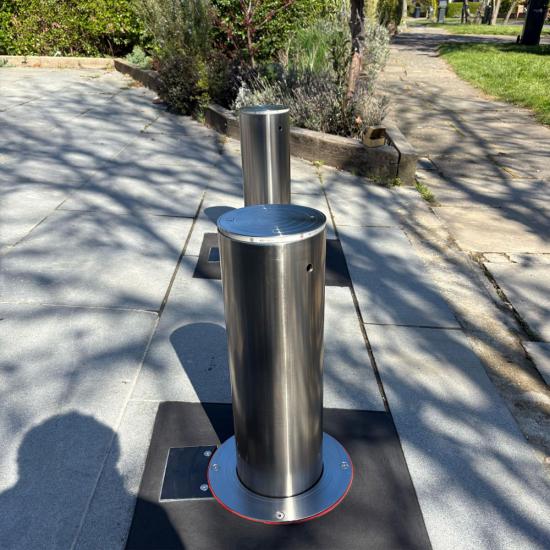
Logistics facilities face specific security threats: cargo theft at the perimeter, vehicle-borne intrusion for rapid loading of stolen goods, and the sabotage risk present at facilities handling high-value or sensitive cargo. Automatic bollards at vehicle entrances provide the access control layer that verifies authorized vehicles before allowing entry.
Integration with truck scheduling systems means the bollard lowers when a scheduled delivery vehicle presents its booking reference, and remains raised at all other times. This eliminates the gate supervision cost while maintaining secure perimeter control 24 hours a day.
Large logistics parks with multiple buildings and internal road networks use bollards to manage internal traffic routing. Restricting certain internal roads to specific vehicle categories — for example, keeping heavy articulated trucks off internal pedestrian paths — requires physical enforcement that signs alone cannot provide.
Removable bollards are well-suited to this application: they physically block unauthorized vehicle access while being quickly removable when equipment access is genuinely needed (maintenance vehicles, emergency services). The key-operated lock on removable bollards means only authorized staff can remove them.
Health and safety regulations in most jurisdictions require logistics facilities to demonstrate that they have addressed vehicle-pedestrian conflict risks through a hierarchy of controls. Physical separation — using bollards and barriers — is rated higher in the control hierarchy than administrative controls (rules and training) or personal protective equipment. Documented bollard installation records contribute to compliance evidence and reduce liability exposure in the event of an incident.
Regular inspection of bollard condition is part of a compliant safety management system. Bollards that have been struck and deformed should be replaced promptly — a damaged bollard provides reduced protection. Schedule visual inspections as part of the weekly walkthrough routine and maintain a replacement log.

call us :
+86 18206096507 e-mail : [email protected]




 ipv6 network supported