When you start comparing automatic bollards, one spec gets buried under impact ratings and finish options: the drive system. Two technologies dominate the market. Pneumatic bollards run on compressed air delivered through a power unit with a compressor, air lines, and valves. Electromechanical bollards carry their own self-contained drive in the cabinet. The difference shapes everything about the install, the maintenance, and the long-term cost.
What a pneumatic setup actually requires

A pneumatic bollard system needs a power unit: an air compressor, air-treatment components, valves, and the control logic that ties them together. That unit is often installed indoors or in a weather-resistant enclosure, then connected to each bollard by air lines. On a multi-bollard entrance, those lines run under the pavement between the power unit and every unit. It works, and it is quiet at the bollard itself, but the infrastructure behind the scenes is substantial. There is a compressor that draws power, air lines that can develop leaks, and a treatment system that needs attention.
The self-contained alternative
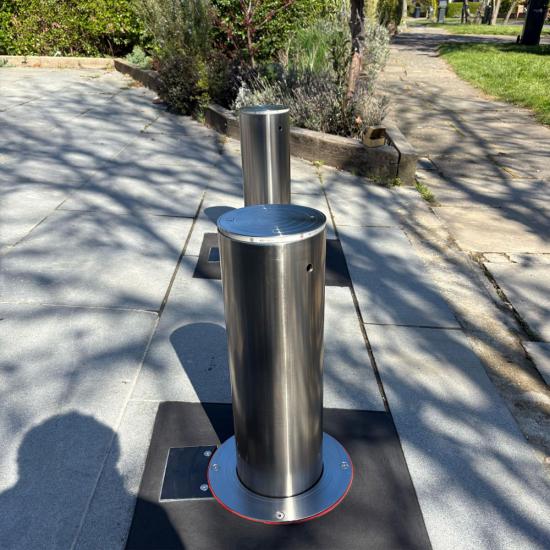
An electromechanical bollard puts the motor, gear, and control inside the bollard housing. There is no shared air plant, no web of air lines under the slab, and no compressor to maintain. Each unit is independent. If one needs service, the rest keep working. For a site manager, that means fewer trades on site, fewer scheduled maintenance visits, and far fewer single points of failure. The drive is also compact, which helps when space behind a curb is tight or the bollard sits far from any plant room.
Install and foundation
Pneumatic and heavy electromechanical systems both need a solid foundation to transfer load, but a self-contained design keeps the surrounding work simpler. With a drainage-free foundation there is no drainage pipe, no gravel seepage bed, and no deep excavation chasing a buried air manifold. A two-person crew sets a line of bollards without coordinating a compressor plant and a trenching crew. On tight urban curbs or historic streets where you cannot dig a deep trench, that independence matters.
Power and safety
Pneumatic compressors are electrical loads in their own right, and the air-side complexity does not change the voltage question at the bollard. A low-voltage electromechanical drive runs at 36V. That is touch-safe for installers and facilities teams, and it connects to a standard low-voltage circuit rather than demanding a three-phase supply. For older civic buildings or sites with weak grid supply, low voltage removes a whole layer of electrical upgrade cost.

Where each fits
Pneumatic still earns its place on very large, high-cycle sites that already run compressed-air infrastructure and have plant rooms to spare. For most civic, commercial, and institutional entrances, a self-contained electromechanical drive is the lower-friction choice: simpler install, fewer failure points, easier service, and safer voltage. Pair it with battery backup and the bollard keeps operating through a power outage without anyone touching a manual valve. Browse our Automatic Bollards to see the full specification, combine wider openings with Fence Gates, or read About Us for how we build for safety first.
call us :
+86 18206096507 e-mail : [email protected]




 ipv6 network supported