Stadium & Arena Security: How Bollards Protect Sports Venues and Entertainment Complexes
A modern stadium holds more people than many small towns. On event days, 50,000 to 100,000 fans converge on a single location within a two-hour window, creating one of the most attractive targets for vehicle ramming attacks. The threat is not hypothetical. Security agencies worldwide have identified sports venues and entertainment complexes as high-priority targets for hostile vehicle mitigation (HVM) planning.
The solution is not a single barrier. It is a layered system that starts with bollards at the perimeter and extends through turnstiles, ticketing, and crowd management. Companies like Alvarado have been building integrated stadium entry systems for over 25 years, with installations at NBA arenas, MLB ballparks, NASCAR tracks, and 80% of the largest stadiums in Australia and New Zealand. The lessons from these installations are directly applicable to any large-venue security project.
The Stadium Threat Profile
Stadiums face a unique combination of risks. First, massive crowd density at entry points — thousands of fans queueing at gates create a slow-moving, tightly packed target. Second, predictable timing — event schedules are public, giving attackers the ability to plan precisely. Third, vehicle access for logistics — delivery trucks, broadcast vehicles, and team buses require legitimate entry, creating potential for a vehicle-borne threat to blend in.
The 2017 attack on a concert venue in Manchester and the 2021 Waukesha parade attack demonstrated that crowds outside the venue are as vulnerable as crowds inside. The perimeter must extend well beyond the stadium walls to include parking approaches, drop-off zones, and pedestrian queuing areas.
Layer 1: The Vehicle Perimeter
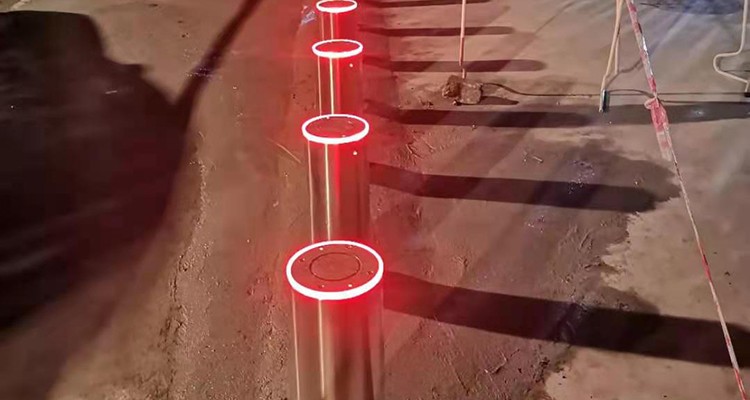
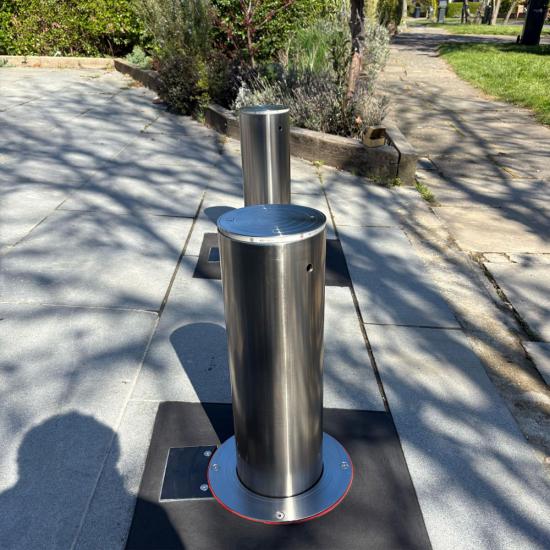
The outermost security ring uses crash-rated bollards to create a vehicle exclusion zone around the stadium. No unauthorized vehicle should be able to approach within striking distance of a crowd gathering area. This typically means bollards at every point where a roadway meets a pedestrian zone: parking lot exits, drop-off zones, service entrances, and perimeter roads that run adjacent to queueing areas.
For stadiums, the bollard specification should match the highest credible threat. A 7.5-tonne truck at 80 km/h is the baseline used by PAS 68 and IWA 14-1 standards. Stadiums in major markets should specify bollards rated to this level at minimum. For lower-risk approaches (parking lot exits with speed bumps), M30 equivalent bollards may suffice.
The key operational requirement is that authorized vehicles — team buses, broadcast trucks, emergency vehicles — can pass through quickly. This means automatic bollards with fast cycle times (under 5 seconds) and integration with vehicle identification systems (license plate recognition, RFID windshield tags).
Layer 2: The Pedestrian Entry
Once vehicles are stopped at the perimeter, the next layer controls pedestrian flow. This is where turnstiles and ticketing systems come into play. Modern stadium entries use optical turnstiles that process one person per second per lane, with barcode or NFC ticket verification. During peak arrival (the 90 minutes before kickoff), a stadium with 10 turnstile lanes can process approximately 36,000 entries — adequate for most venues.
The critical integration point is between the vehicle and pedestrian layers. If a vehicle is authorized to enter the perimeter (for example, a team bus), the turnstile system should be aware of this event and adjust its operation accordingly — perhaps opening a wider gate for bus passengers or alerting security staff to screen the vehicle's occupants.
Layer 3: Crowd Management Inside the Perimeter
Inside the stadium, the security focus shifts from anti-ram protection to crowd flow management. Modular railing systems, like those provided by Alvarado's crowd control product line, direct pedestrian traffic away from hazardous areas (loading docks, vehicle paths) and toward ticketing and entry points. These systems are not crash-rated, but they serve a critical function: preventing crowd crush incidents and keeping pedestrians away from areas where vehicles operate.
The integration between crowd management and security is often overlooked. If a crowd management barrier is repositioned (for example, to open an additional entry lane), the bollard system should be aware of the change. A new pedestrian path may cross a vehicle route that was previously separated, requiring temporary bollard deployment or vehicle traffic restriction.
Case Study: Integrated Stadium Entry in Practice
Alvarado's GateLink10 system, installed in over 200 venues globally, illustrates what integrated stadium security looks like in practice. The system manages ticket validation, turnstile operation, crowd flow monitoring, and entry point status from a single platform. Security staff see real-time dashboards showing gate-by-gate throughput, congestion alerts, and anomaly detection (for example, a spike in denied entries at one gate might indicate a ticketing fraud attempt).
In an integrated setup, this same platform would interface with the bollard control system. A lockdown command — triggered by a security incident — would simultaneously raise all perimeter bollards, lock all turnstiles, and display evacuation instructions on entry screens. This is the power of integration: one decision, system-wide response.
Beyond Game Day: Multi-Use Venue Security
Modern stadiums are not single-purpose facilities. They host concerts, conventions, political rallies, and community events, each with different crowd profiles and security requirements. A bollard system that is permanently installed provides baseline protection for every event without reconfiguration. The same bollards that protect a football game on Sunday protect a concert on Saturday and a trade show on Wednesday.
For events with elevated risk profiles — major political events, high-profile concerts — the permanent bollard system can be supplemented with mobile barriers for temporary perimeter expansion. This is the layered approach: permanent bollards as the always-on baseline, portable barriers for event-specific risk amplification.
Lessons for Venue Operators
If you are responsible for venue security, three principles should guide your bollard strategy. First, extend the perimeter beyond the building — protect crowds in queuing areas, drop-off zones, and parking approaches, not just at the stadium doors. Second, integrate — your bollards should communicate with your turnstiles, ticketing, and monitoring systems. Third, plan for multi-use — specify permanent bollards that provide baseline protection for every event type, supplemented by mobile barriers only when threat levels require temporary expansion.
The cost of a comprehensive stadium bollard system is significant — easily USD 200,000 to USD 500,000 for a major venue. But the cost of a single successful vehicle attack at a crowded stadium entrance is measured in lives, liability, and the permanent reputational damage to the venue and its operators. Security is not where stadiums should optimize for cost.
call us :
+86 18206096507 e-mail : [email protected]




 ipv6 network supported