Strategic Perimeter Security for Government Facilities: Automatic Bollards Guide
Government facilities—from federal buildings and embassies to military bases and courthouses—face complex security challenges that extend far beyond private sector requirements. Threats include not just opportunistic vehicle-ramming attacks, but coordinated terrorist operations, espionage activities, and civil unrest. Perimeter security, therefore, is not just about physical protection—it's about national security, public safety, and continuity of government operations.
This strategic guide provides government security professionals with a framework for evaluating, procuring, and implementing automatic bollard systems. We examine threat landscapes, regulatory requirements, procurement best practices, and real-world case studies from government installations worldwide.
Understanding the Threat Landscape for Government Facilities
# Vehicle-Borne Threats: Statistics and Trends
According to the US Department of Homeland Security (DHS):
• **60% of terrorist attacks** on government facilities worldwide involve vehicle-borne improvised explosive devices (VBIED) or vehicle-ramming tactics.
• **Intentional vehicle-ramming attacks** on Western government targets increased 400% between 2015-2020.
• **Accidental vehicle crashes** into government buildings occur at similar rates to commercial properties (~60/day in US), but with higher stakes due to symbolic value and public safety impact.
# Beyond Vehicles: Multi-Dimensional Perimeter Security
Modern perimeter security must address:
1. **Vehicle threats** (primary focus of bollards)
2. **Pedestrian threats** (requiring integrated access control)
3. **Cyber-physical threats** (hacking of security systems)
4. **Insider threats** (requiring audit trails and access logging)
Automatic bollards, when integrated with comprehensive security systems, address vehicle threats while supporting broader perimeter defense strategies.
Regulatory and Standards Landscape
Government facilities must comply with a complex web of security standards and regulations.
# US Federal Standards
**ASTM F2656-20**: Standard Test Method for Crash Testing of Vehicle Security Barriers. Defines K-ratings (K4, K8, K12) based on vehicle weight and speed.
**DHS Buffer Zone Protection Plan (BZPP)**: Guidance for state and local government facilities on perimeter security design.
**GSA PBS-21**: GSA Public Buildings Service guidance on security design for federal buildings.
**UFC 4-022-02 (Unified Facilities Criteria)**: Department of Defense standards for building design to resist progressive collapse.
# International Standards
**UK**: Physical Security Standards (PED) for government buildings.
**Canada**: Canadian Aviation Security (CAC) standards for airports and government facilities.
**Australia**: AS/NZS 1170 for structural design, including impact loads from vehicle barriers.
Procurement Process for Government Bollard Projects
Government procurement follows structured processes designed to ensure fairness, transparency, and best value.
# Phase 1: Requirements Definition (Months 1-2)
**Stakeholders involved**: Security team, facilities management, procurement office, legal counsel.
**Key activities**:
• Conduct threat assessment (DHS BZPP methodology or equivalent)
• Define performance requirements (crash rating, operational modes, integration needs)
• Establish budget and funding source (capital budget, grant, etc.)
• Develop statement of work (SOW) with clear specifications
# Phase 2: Market Research (Months 3-4)
**Activities**:
• Research available solutions (GSA Schedule, state contracts, open market)
• Request information (RFI) from potential vendors
• Evaluate vendor capabilities (past performance, certifications, financial stability)
• Develop source selection criteria (technical, price, past performance weights)
# Phase 3: Solicitation and Award (Months 5-8)
**For US federal projects**:
• Publish Request for Proposal (RFP) on SAM.gov
• Conduct pre-proposal conference (optional but recommended)
• Evaluate proposals using pre-defined criteria
• Conduct discussions with offerors (if using tradeoff process)
• Award contract (typically to best value, not lowest price)
**For state/local projects**:
• May use alternative procurement methods (cooperative contracts, piggybacking)
• Check state-specific requirements (competitive bidding thresholds, etc.)
# Phase 4: Implementation and Oversight (Months 9-18)
**Key activities**:
• Kickoff meeting with awarded vendor
• Review and approve project plans (installation, testing, training)
• Conduct site preparation (utility coordination, permitting)
• Oversee installation (government quality assurance representative on-site)
• Test and accept system (functional testing, documentation review)
Vendor Evaluation Criteria: Beyond Price
Government procurement should evaluate vendors on multiple dimensions.
# 1. Technical Capability
**Crash certification**: Require third-party test reports, not just manufacturer claims. Verify:
• Test was conducted by certified laboratory (e.g., CSTI, Calspan)
• Test conditions match your requirements (vehicle weight, speed, angle)
• Barrier performance meets specified penetration limit (L1, L2, L3)
**Integration capability**: Government facilities often have existing security systems. Ensure bollards can integrate with:
• Access control systems (CCTV, badging, biometric)
• Command and control centers (SCADA, PSIM)
• Emergency response systems (fire, police, EMS)
# 2. Past Performance
Request and verify past performance references:
• Similar facility types (courthouses, embassies, federal buildings)
• Similar project scale (single building vs. campus-wide)
• Client satisfaction (contact references directly)
**Red flags**:
• Unable or unwilling to provide references
• Multiple past performance issues (delayed delivery, poor quality)
• Financial instability (check Dun & Bradstreet rating)
# 3. Lifecycle Cost Analysis
Evaluate total cost of ownership over expected life (typically 15-20 years):
Compare this to cheaper upfront options that may have higher lifecycle costs due to maintenance, energy, or shorter lifespan.
Installation Best Practices for Government Facilities
Government installations have unique considerations.
# Security Clearances for Installers
For sensitive facilities, installation personnel may need security clearances. Plan for:
• Background investigations (can take 3-6 months)
• Escort requirements (uncleared personnel must be escorted at all times)
• Document handling (sensitive plans/drawings must be stored securely)
# Coordination with Multiple Stakeholders
Government projects often involve multiple agencies:
• **Security**: Define operational requirements
• **Facilities**: Manage installation logistics
• **Procurement**: Oversee contract compliance
• **Legal**: Review contract terms and certifications
• **Public Affairs**: Manage public communications about construction
Establish a project management office (PMO) or integrated project team (IPT) to coordinate.
# Testing and Acceptance
Government acceptance testing should be rigorous:
• **Factory acceptance testing (FAT)**: Witness testing at manufacturer's facility (optional but recommended for large projects)
• **Site acceptance testing (SAT)**: Test all functions after installation:
- Raise/lower cycles (minimum 50 consecutive cycles)
- Emergency override functions
- Integration with other systems (access control, CCTV)
- Fail-safe behavior (power loss, system fault)
Measuring Security Effectiveness
How do you know your bollard investment is effective? Track these metrics:
# 1. Deterrence Metrics
• **Incident rate**: Compare pre- and post-installation vehicle encroachment attempts
• **Security audit results**: Track improvements in perimeter security ratings (e.g., DHS BZPP assessment scores)
# 2. Operational Metrics
• **System availability**: % of time system is operational (target: 99.5%+)
• **Mean time to repair (MTTR)**: How quickly faults are corrected (target: <4 hours for critical faults)
• **False alarm rate**: Nuisance activations that disrupt operations
# 3. Cost Metrics
• **Cost per incident prevented**: Compare security investment to cost of potential incidents
• **Lifecycle cost variance**: Actual vs. budgeted costs over system lifespan
Case Study: US Courthouse Perimeter Upgrade
**Facility**: US District Courthouse, medium-sized city
**Challenge**: Aging fixed bollards prevented authorized vehicle access (judges, deliveries), creating operational inefficiencies. Also, existing bollards not crash-certified to current standards.
**Solution**: Replace 12 fixed bollards with UPARK 120mm automatic bollards, integrated with court's access control system.
**Results (2 years post-installation)**:
• Zero vehicle encroachment incidents
• Authorized vehicle access time reduced by 80% (no manual removal of portable barriers)
• Security audit rating improved from 'Adequate' to 'Excellent'
• No increase in security incidents despite rising local crime rates
**ROI**: Upfront cost $85,000. Annual savings from operational efficiency: $12,000. Simple payback: 7.1 years. Enhanced security: Priceless.
Conclusion: Security as National Defense
For government facilities, automatic bollards are not just a local security upgrade—they're part of the national defense infrastructure. The procurement and implementation process is necessarily rigorous, but the payoff is substantial: enhanced protection for government operations, public safety, and symbolic targets.
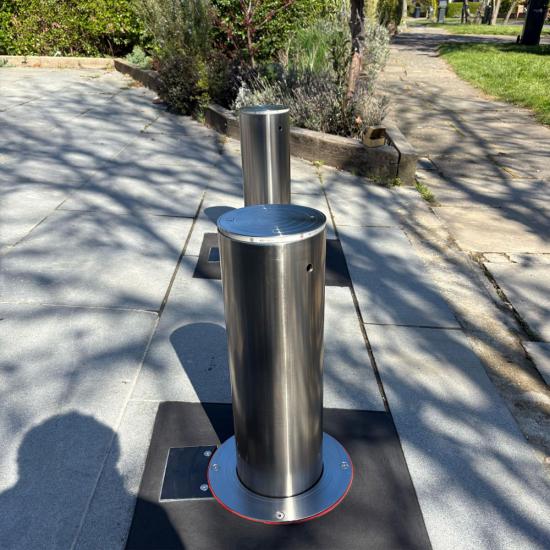
UPARK's government-grade automatic bollards are designed specifically for the demanding requirements of government facilities. With K12/L3 crash certification, 36V safe operation, and proven performance at federal, state, and local government installations, our solutions deliver the security and compliance that government professionals demand.
Invest in perimeter security that meets the highest standards. Contact UPARK Government Security Division for a consultation tailored to your facility's unique requirements.
call us :
+86 18206096507 e-mail : [email protected]




 ipv6 network supported