The Complete Guide to Selecting a 120mm Automatic Bollard for Parking Management
The 120mm Diameter: Why Size Matters in Parking Applications
Bollard diameters range from 60mm (slim decorative posts) to 275mm+ (heavy-duty anti-ram barriers). For parking spot protection, the 120mm diameter occupies a specific sweet spot that deserves attention.
At 60-80mm, bollards are too slim to provide meaningful impact resistance. They serve as visual deterrents only — a determined vehicle can push through them with minimal damage. At 168-220mm, bollards are built for crash-rated perimeter security (K4, K8, K12 ratings), but their larger footprint reduces usable lane width and their cost ($2,000-$5,000 per unit) is disproportionate for parking spot applications.
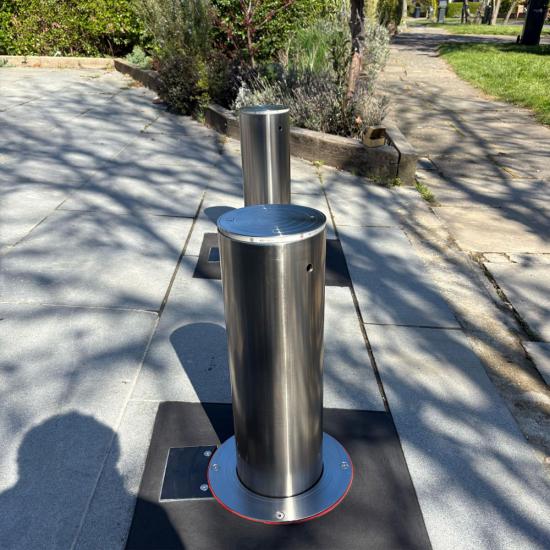
The 120mm diameter — roughly the width of a standard traffic cone — provides enough structural cross-section for a 3mm+ wall thickness steel housing while maintaining a compact footprint. It is visibly authoritative enough to deter casual parking encroachment, yet slim enough that two bollards can be installed at a standard 3-meter lane entrance without reducing effective passage width below 2.5 meters.
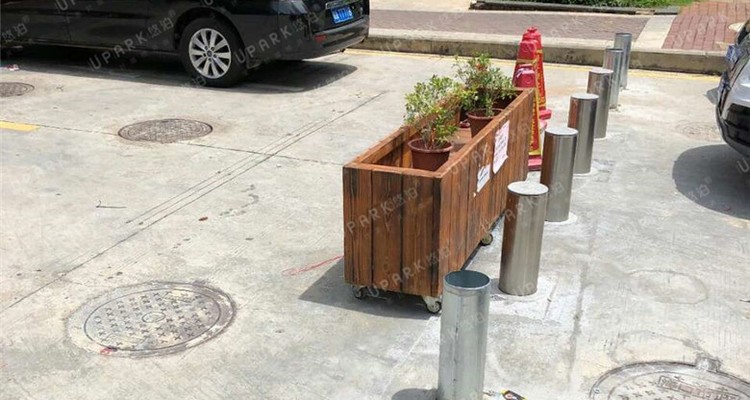
For facilities upgrading from manual pull-up posts, the 120mm diameter is also the closest match to the existing ground sleeve dimensions of most pull-up post models, minimizing civil works when retrofitting.
Voltage Selection: Why 36V Low-Voltage Architecture Is the Standard
Automatic bollards require an electric motor to drive the lifting mechanism. The operating voltage of that motor has significant downstream effects on installation cost, regulatory compliance, and long-term safety.
220V Mains-Powered Bollards
Traditional automatic bollards use 220V AC motors. While this provides high torque, it creates several complications: installation requires a licensed electrician in most jurisdictions; buried conduit must meet mains-voltage depth and protection standards; and any water ingress into the electrical housing creates a serious shock hazard. In pedestrian-accessible areas — parking lots, sidewalks, residential compounds — 220V bollards face increasing regulatory restrictions.
36V Low-Voltage Electromechanical Bollards
A 36V DC electromechanical bollard addresses all of these issues. The voltage is below the threshold that most electrical codes classify as 'low voltage,' meaning installation can often be performed by general contractors without specialized electrical licensing. The reduced shock risk makes 36V units suitable for all pedestrian-adjacent applications without additional safety barriers. Modern 36V motors deliver sufficient torque for a 120mm bollard to raise and lower reliably through 500,000+ rated cycles.
The power supply architecture also supports daisy-chaining: multiple 120mm bollards can be powered from a single 36V line using RVV 3x2.5mm² or 3x4.0mm² cable, dramatically simplifying the electrical infrastructure compared to running individual 220V circuits to each bollard position.
When evaluating 120mm automatic bollards, confirm that the manufacturer uses a genuine 36V low-voltage architecture — not a 220V motor with a step-down transformer added as an afterthought. The entire drive train should be designed around 36V operation.
Wall Thickness: The Difference Between 2mm and 3mm+
The structural wall thickness of a bollard's steel housing directly determines its resistance to bending, impact deformation, and long-term corrosion. This is the single most important specification to check — and the one most commonly compromised by budget manufacturers.
A bollard with 2mm wall thickness may look identical to a 3mm unit from the outside. The difference becomes apparent after 2-3 years of service: the thinner wall develops stress fractures at the base weld point from repeated minor impacts (shopping carts, low-speed bumps, wind load on signage attachments). In coastal or high-humidity environments, corrosion penetrates a 2mm wall to the point of structural compromise 2-3x faster than a 3mm wall.
For 120mm diameter bollards, the minimum acceptable wall thickness for parking applications is 3mm. This provides a service life of 10+ years under normal conditions and maintains structural integrity through incidental vehicle contact. Units with 4mm+ walls are available for high-abuse environments (loading docks, delivery zones) but add cost and weight without proportional benefit for standard parking applications.
A practical verification method: request the manufacturer's cutaway or cross-section drawing showing the wall thickness measurement. Reputable manufacturers publish this specification openly; if a supplier cannot or will not confirm wall thickness, assume it is below 3mm.
IP Rating: Waterproofing That Determines Reliability
Parking bollards live outdoors. They face rain, snow, pressure washing, and in some installations, standing water from poor drainage. The IP (Ingress Protection) rating tells you exactly how well the bollard's internal electronics are protected.
IP67 is the benchmark for automatic bollards in outdoor parking applications. The first digit (6) means complete dust protection — no particulate ingress. The second digit (7) means protection against immersion in water up to 1 meter depth for 30 minutes. This covers everything from heavy rain to temporary flooding.
Bollards rated IP65 or lower should be avoided for outdoor use. IP65 protects against water jets but not immersion — a flooded ground sleeve can destroy the motor and control board in a single event. The cost of one IP65 failure (bollard replacement + civil works to access the foundation) typically exceeds the price difference between an IP65 and IP67 unit by 3-5x.
An additional consideration: the IP rating should apply to the complete bollard assembly, not just the above-ground portion. The ground sleeve, cable entry points, and base seal must all achieve the same protection level. Ask the manufacturer whether their IP rating covers the full assembly or only the visible housing.
Control Options: Matching Access Control to User Profiles
A 120mm automatic bollard's value is realized through its control interface. The right control option depends entirely on who will operate the bollard and how frequently:
Remote Control (RF 433MHz)
The most common and cost-effective option. Each authorized user carries a key-fob remote. Range is typically 30-50 meters. Best for: residential compounds, small business parking lots, staff parking areas with fewer than 50 authorized users.
RFID Card/Token Reader
Users tap a proximity card or token on a reader post near the bollard. Cards are inexpensive to issue and easy to deactivate if lost. Best for: medium-to-large facilities, mixed-use developments, any scenario where managing individual remotes becomes impractical.
License Plate Recognition (LPR) Integration
The bollard system integrates with a camera-based LPR system. Authorized plates are whitelisted; the bollard lowers automatically as an authorized vehicle approaches. No user action required. Best for: high-traffic commercial facilities, logistics centers, premium residential developments.
Push-Button / Key Switch
A simple manual override mounted on a nearby post or wall. Typically used as a backup control method or for facilities where electronic access control is unnecessary. Best for: single-user private parking, service vehicle access points.
Most 120mm automatic bollard systems support multiple control methods simultaneously — for example, RFID for residents plus a push-button override for maintenance staff. When specifying a system, confirm the control board's input capacity and whether adding control methods later requires hardware replacement or just configuration changes.
Installation Planning: What to Prepare Before Ordering

A successful 120mm automatic bollard installation requires coordination across civil works, electrical, and access control disciplines. Here is a pre-installation checklist:
Confirm ground sleeve diameter: 120mm bollards typically require a 160-180mm ground sleeve. Verify compatibility with existing sleeves if retrofitting.
Foundation depth: standard recommendation is 400-500mm concrete base with drainage gravel below. Adjust for local frost line requirements.
Cable routing: plan the path from the power supply to each bollard position. 36V systems can use RVV 3x2.5mm² for runs up to 30 meters; use RVV 3x4.0mm² for longer runs or multiple bollards on one line.
Drainage: even IP67-rated bollards benefit from a gravel drainage layer at the base of the ground sleeve. Standing water accelerates corrosion of external surfaces even if internals are protected.
Control panel location: centralize the power supply and control board in a weatherproof enclosure within 50 meters of the furthest bollard. Include surge protection on the power input.
Access for maintenance: ensure the bollard can be fully extracted from the ground sleeve for servicing. Avoid installing under low overhangs or in positions that would block a maintenance vehicle.
Comparing 120mm Automatic Bollard Specifications: A Decision Matrix
Use this framework to evaluate and compare 120mm automatic bollard options from different manufacturers:
Conclusion: The 120mm Automatic Bollard Is the New Standard
The parking management industry is undergoing a quiet but decisive shift. Manual pull-up posts, once the default, are increasingly viewed as a legacy solution — adequate for single-user private parking but unsuitable for any facility where convenience, security, and user satisfaction matter.
The 120mm automatic bollard, built to the specifications outlined in this guide — 36V low-voltage, 3mm+ wall thickness, IP67 waterproofing, multi-method control — represents the new baseline for professional parking management. It costs more upfront than a manual post, but the gap narrows to insignificance when measured against a decade of reliable, hassle-free operation.
For facility managers, property developers, and parking operators evaluating an upgrade, the question is not whether to move to automatic bollards, but which specifications to require and which manufacturer to trust. Use the decision matrix in this guide as your evaluation framework — and insist on published specifications, not marketing claims.
call us :
+86 18206096507 e-mail : [email protected]




 ipv6 network supported