Bollard ROI Calculator: How to Justify Your Automatic Bollard Security Investment
Why Finance Teams Demand a Bollard ROI
Security budgets face scrutiny in every organization. Whether you are proposing bollards for a government campus, a shopping center, or a logistics park, procurement committees now ask the same question: what is the return on this investment?
Automatic bollards are not cheap. A quality electromechanical unit — such as a 36V low-voltage bollard with IP67 waterproofing and a 3mm+ wall thickness — typically costs $1,200–$2,500 per unit installed. For a ten-bollard installation, that is $12,000–$25,000 in capital expenditure. Without a credible ROI argument, that budget is hard to approve.
This guide provides a step-by-step framework for calculating bollard ROI, with real-world numbers, a risk quantification model, and a one-page justification template you can adapt for any project.
Step 1: Quantify the Threat — What Is the Annual Expected Loss Without Bollards?
ROI starts with risk quantification. You need to estimate what a successful vehicle intrusion event would cost your organization.
The ALE Formula
Annual Loss Expectancy (ALE) = Single Loss Expectancy (SLE) × Annual Rate of Occurrence (ARO)
Note: ARO values above are illustrative benchmarks. You should consult local crime statistics, your insurer, and site-specific risk assessments to calibrate your own figures.
In the example above, the site faces an estimated $17,600 per year in expected losses from vehicle-related incidents. This is the baseline threat value your bollard system must offset.
Step 2: Estimate the Bollard System Cost (Total Cost of Ownership)
A complete TCO (Total Cost of Ownership) analysis over a 10-year lifecycle includes:
When you divide the 10-year TCO ($32,500 midpoint) by 10 years, the annualized cost is approximately $3,250/year.
Step 3: Calculate Bollard ROI
Now you have the two numbers you need:
Annual risk avoided (ALE) = $17,600
Annualized total cost = $3,250
ROI = (Annual Risk Avoided − Annual Cost) ÷ Annual Cost × 100
ROI = ($17,600 − $3,250) ÷ $3,250 × 100 = 441%
Payback Period = Capital Expenditure ÷ Annual Net Benefit
Payback Period = $26,000 ÷ ($17,600 − $800 maintenance) = $26,000 ÷ $16,800 ≈ 1.55 years
In this scenario, the bollard installation pays for itself in under 18 months and delivers a 441% return over the 10-year lifecycle. Even with conservative ALE estimates at 50% of the above figures, ROI remains above 170% — still a compelling case.
Step 4: Layer in the 'Soft' Benefits
The quantitative ROI calculation above only captures avoided financial losses. In reality, bollards deliver several additional value streams that are harder to quantify but equally important:
1. Insurance Premium Reduction
Many commercial property insurers will reduce premises liability premiums by 5–15% when certified anti-ram barriers are installed. On a $50,000 annual premium, that is $2,500–$7,500 per year in cash savings — potentially covering the entire annualized bollard cost.
2. Regulatory Compliance Avoidance Costs
Facilities handling government contracts, critical infrastructure, or public events may face mandatory perimeter protection requirements (e.g., CPNI guidelines in the UK, GSA standards in the US, or GB50348 in China). Non-compliance can result in contract cancellation or fines exceeding $50,000. Bollards that satisfy these standards eliminate this exposure.
3. Operational Continuity
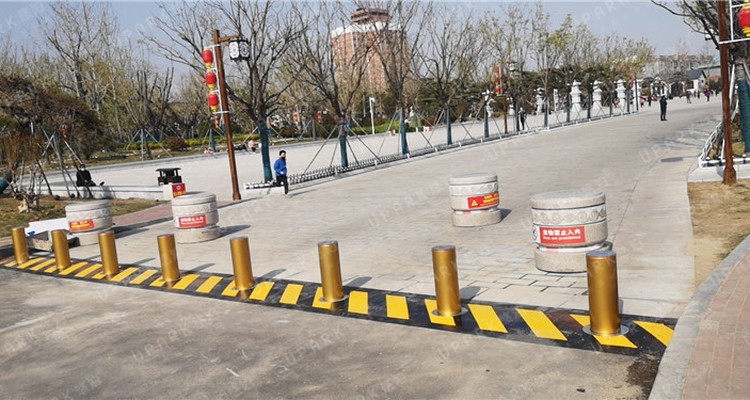
A single major vehicle intrusion can close a facility for 1–5 days for cleanup, investigation, and repairs. For a retail store generating $8,000/day in revenue, a 3-day closure means $24,000 in direct lost revenue — not counting the indirect brand damage. Bollards eliminate this operational discontinuity.
4. Increased Footfall and Tenant Confidence
Research from the British Property Federation shows that visible perimeter security measures — including bollards — increase tenant satisfaction scores by an average of 12% in mixed-use developments. In retail, perceived safety directly correlates with dwell time and spend.
Step 5: Choose the Right Bollard to Maximize ROI
Not all bollards deliver the same ROI. Here is how specification choices affect your return:
36V Low-Voltage Electromechanical Bollards
Bollards operating at 36V (vs. conventional 220V mains) offer two specific ROI advantages: First, they do not require licensed electricians for installation in most jurisdictions, reducing civil works cost by 15–25%. Second, in markets with strict low-voltage safety regulations (especially pedestrian zones, schools, and public spaces), 36V units avoid the permitting delays that 220V installations face — meaning the system is operational weeks earlier.
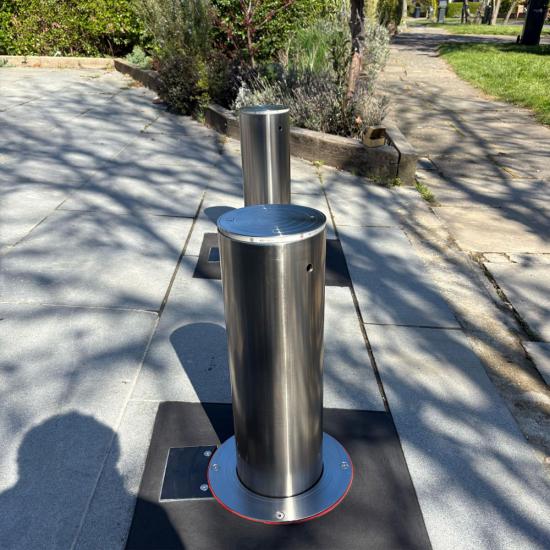
UPARK's 36V electromechanical bollards, with a 20cm depth overlap and minimum 3mm structural wall thickness, are designed to deliver full crash-resistance performance at low-voltage operating parameters — no safety compromise, just lower installation and running costs.
IP67 Waterproofing and Drainage-Free Design
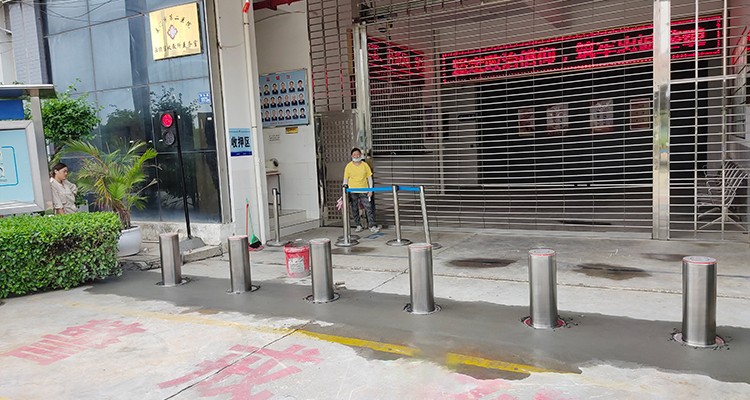
Bollards requiring drainage sump systems add $400–$800 per unit in civil works costs. Over an 8-unit installation, that is $3,200–$6,400 extra. IP67-rated sealed bollard housings eliminate this cost entirely — improving ROI at the point of installation.
3mm+ Wall Thickness
A bollard with sub-2mm wall thickness may pass initial QA but typically requires structural replacement within 3–5 years after impact events or corrosion. A 3mm+ structural wall thickness doubles the expected service life, halving the amortized hardware cost in your TCO model.
The One-Page Bollard ROI Justification Template
Use this structure to build your internal approval document:
Common ROI Calculation Mistakes to Avoid
Conclusion: The Numbers Support the Investment
For most commercial, institutional, and public-space applications, a well-specified automatic bollard installation will deliver a positive ROI within 12–24 months and continue generating value for 10+ years. The key is running the numbers — not relying on intuition.
The ROI framework in this guide gives you a structured, defensible methodology for quantifying that value. Combine it with specifications from a quality manufacturer — one whose products minimize TCO through low-voltage design, sealed housings, and structural integrity — and the business case essentially writes itself.
For ROI modeling support or product specifications for your next bollard project, contact the UPARK technical team. We provide system-level consultation, specification sheets, and reference installation data to support your procurement process.
call us :
+86 18206096507 e-mail : [email protected]




 ipv6 network supported