Buying automatic bollards is not a casual purchase. The wrong choice can cost you thousands in repairs, fail an inspection, or leave a gap in your perimeter security. We have compiled the 20 questions we hear most often from contractors, architects, facility managers, and security consultants, and answered each one directly.
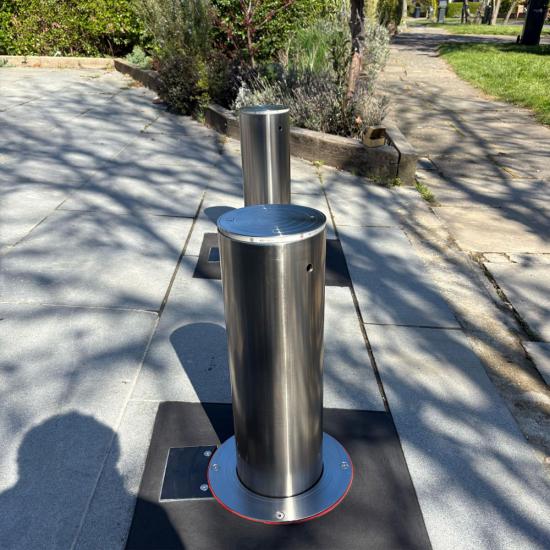
An automatic bollard is a retractable steel post that rises from and descends into the ground under motorized control. When raised, it blocks vehicle access. When lowered, the top sits flush with the road surface, allowing authorized vehicles to pass. It differs from a fixed bollard, which stays in place permanently, and from a removable bollard, which requires manual lifting.
Three drive mechanisms dominate the market. Electromechanical bollards use an electric motor and worm gear to push the post up and pull it down. Hydraulic bollards use pressurized oil driven by a central pump unit. Pneumatic bollards use compressed air. Each mechanism has trade-offs in speed, noise, maintenance, and temperature tolerance that we cover in later questions.
Normal operating speed ranges from 3 to 6 seconds for a full rise cycle. Hydraulic models can reach 2 seconds in emergency fast-operation (EFO) mode. Electromechanical models typically achieve 3 seconds in normal mode and around 1.5 seconds in emergency mode. Speed matters for high-traffic entrances where vehicles queue.
Equipment-only pricing: electromechanical bollards run $1,500 to $3,500 per unit. Hydraulic bollards run $2,300 to $6,000 per unit. Crash-rated automatic bollards (IWA 14-1 / PAS 68 certified) start at $5,999 and can exceed $15,000 per unit. Installation, civil works, and control systems add 30% to 100% on top of equipment cost.
Hydraulic bollards use a central pump station connected by hoses to multiple bollards. They deliver the highest lifting force and are the default for crash-rated anti-terror applications. The trade-off is complexity: more infrastructure, more maintenance, and hydraulic oil management.
Electromechanical bollards are self-contained. Each unit has its own motor and gear assembly, needing only a power cable. They are quieter, simpler to install, and cheaper to maintain. UPARK electromechanical models operate on 36V safety voltage, which reduces electrical compliance burden on site.
Crash ratings certify that a bollard stopped a specific vehicle at a specific speed in a physical test. The three main standards are IWA 14-1 (international), PAS 68 (UK), and ASTM F2656 (US). M50 means the bollard stopped a 7,500 kg vehicle at 80 km/h. M30 means the same vehicle at 50 km/h. If your project involves a government building, airport, or critical infrastructure, you will likely need crash-rated bollards. For commercial and residential applications, non-rated bollards are sufficient.
Standard foundation depth for automatic bollards is 1.0 to 1.5 meters. Shallow-mount designs reduce this to 400 to 600 mm, which matters when you cannot dig deep due to underground utilities or structural slabs. Shallow-mount bollards are available with crash ratings, though they carry a price premium.
Most automatic bollard installations require a drainage system. The below-ground cylinder collects rainwater and debris over time. Without drainage, standing water corrodes internal components and can freeze in cold climates, jamming the mechanism. UPARK bollards carry IP67 waterproof ratings, which protects the electronics, but drainage is still recommended for the foundation cavity.
Yes, with the right preparation. Electromechanical bollards typically operate from -15 to +50 degrees C without special measures. Hydraulic bollards need anti-freeze hydraulic oil or a built-in heating element below -10 degrees C. Pneumatic bollards handle the widest range, down to -25 degrees C, because compressed air does not thicken. If your site sees sustained sub-zero temperatures, specify a heater option during ordering.
This varies by manufacturer. Many hydraulic and older electromechanical bollards run on 220V-240V. UPARK electromechanical bollards operate on 36V DC, which is classified as a safety extra-low voltage. This means simpler wiring, reduced shock risk for installers and maintenance personnel, and easier compliance with electrical codes on commercial sites.
Common control methods include remote controls (RF), key switches, RFID card readers, license plate recognition (LPR) cameras, smartphone apps via Bluetooth or Wi-Fi, and integration with building management systems (BMS). Most projects combine two or more methods: for example, an RFID reader for daily access plus a key switch for emergency override.
It depends on the drive type and design. Most electromechanical bollards are fail-safe: they lower automatically when power is cut, allowing emergency vehicle access. Hydraulic bollards typically hold their position via a check valve, with a manual release for controlled lowering. Some systems include a battery backup or UPS that keeps the bollard operational for a limited number of cycles during an outage.
For a single-lane entrance (3 to 4 meters wide), one bollard is sufficient. For a two-lane entrance (6 to 8 meters), two bollards spaced 1.5 to 2 meters apart on center will cover the width. For hostile vehicle mitigation, the maximum gap between raised bollards should not exceed 1.2 meters, otherwise a determined driver could steer between them.
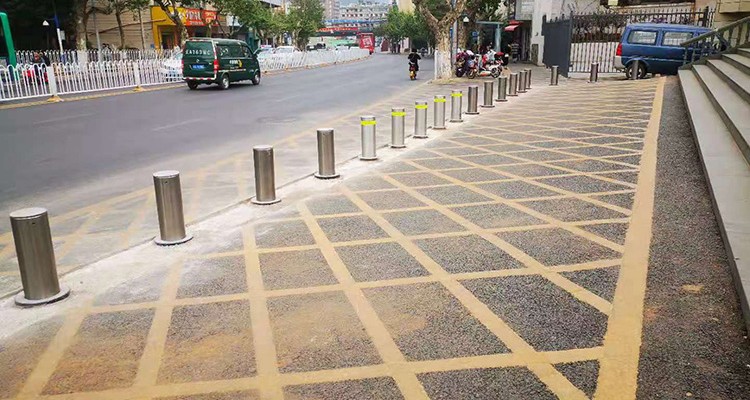
Yes, when fully retracted, the top of the bollard sits flush with or slightly below the road surface. Vehicles can drive over it without issue. The flush design is what makes automatic bollards preferable to speed bumps or barrier arms in applications where aesthetics and uninterrupted traffic flow matter.
Electromechanical bollards need the least attention: an annual inspection of the drive mechanism, cleaning of the internal cylinder, and a check of electrical connections. Budget $100 to $300 per unit per year. Hydraulic bollards need additional hydraulic oil checks and changes ($150 to $400 per service). For all types, keep the top cover clear of debris and test the safety sensors regularly.
A well-maintained automatic bollard lasts 10 to 15 years in normal commercial use. The below-ground steel cylinder can last 20+ years if drainage is adequate. Wear items that need periodic replacement include seals, drive belts (on some electromechanical models), and hydraulic hoses. UPARK uses 304 or 316 stainless steel for the exposed post, which resists corrosion in coastal and industrial environments.
Yes, but it requires excavation. You need to cut through the existing surface, dig the foundation pit, pour concrete, install the bollard cylinder, connect power and control wiring, and restore the surface. Retrofit projects typically take 2 to 3 days per bollard position. Plan the installation for a time when the entrance can be closed, and have a temporary barrier ready.
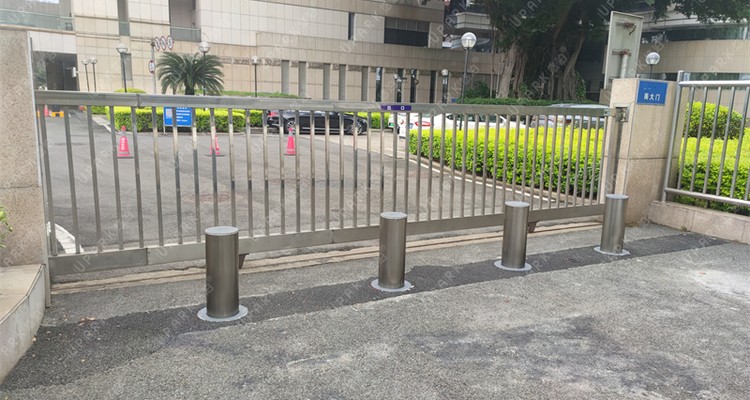
Electromechanical bollards are the quietest option, producing around 55 to 65 dB during operation. That is roughly the volume of a normal conversation. Hydraulic bollards are louder at 65 to 75 dB due to the pump motor. If the bollard is near residential bedrooms or a hospital entrance, electromechanical is the better choice. Pneumatic bollards can be loud on the exhaust stroke unless a silencer is fitted.
Automatic bollards rise and lower under full motorized control. You press a button or swipe a card, and the bollard moves on its own. Semi-automatic bollards use a gas spring or pneumatic assist: you unlock the bollard with a key, and the spring helps you lift it manually. Semi-automatic bollards cost less (typically $500 to $1,200 per unit) but require a person on site to operate them. They are a good fit for locations that only need occasional access control.
Start with three questions. First, what threat level are you addressing? Non-rated bollards handle traffic guidance and casual deterrence. Crash-rated bollards stop deliberate vehicle attacks. Second, what is the traffic frequency? High-traffic sites need fast, durable electromechanical or hydraulic units. Low-traffic sites can use semi-automatic or even removable bollards. Third, what are your site constraints? Limited dig depth points to shallow-mount models. No drainage available points to self-contained electromechanical units with high IP ratings. Cold climate points to pneumatic or heated hydraulic options.
If you need a recommendation tailored to your site conditions, contact UPARK. We manufacture electromechanical, hydraulic, and pneumatic automatic bollards, along with fixed bollards, fence gates, and parking barriers, and we ship to projects worldwide.
call us :
+86 18206096507 e-mail : [email protected]




 ipv6 network supported