The bollard market has a transparency problem. What's written on a spec sheet and what arrives on a pallet are not always the same thing. Three specific practices are common enough that any serious buyer should know about them before signing a purchase order.
The first is composite construction — specifically, an outer layer of stainless steel bonded over an inner core of carbon steel or ordinary iron.
The logic is straightforward: stainless steel is expensive. A bollard with a 304-grade stainless exterior looks identical to a solid stainless unit. In photos, in a showroom, even up close in a parking lot, the surface finish is the same. The price can be 40–60% lower because the cost of material dropped dramatically.
The problem surfaces over time, literally. The bond between dissimilar metals is not permanent under cycling thermal loads and vibration. Moisture finds its way into micro-gaps at cut edges, welds, and mounting points. Once water reaches the carbon steel core, galvanic corrosion accelerates — the two metals in contact with an electrolyte form a battery. The outer stainless shell can look fine while the structural core corrodes from inside.
A simple field test: a strong magnet. Solid 304 stainless steel is non-magnetic or very weakly magnetic. A composite shell over carbon steel will have a noticeably stronger magnetic pull, especially near edges where the stainless layer is thinner. It's not a certified test, but it's informative.
The second practice is more straightforward: stating a wall thickness that the delivered product does not meet.
Wall thickness in hollow steel tube is measured in millimeters. The difference between a 5mm wall and a 3.5mm wall is not visible without tools. A caliper or ultrasonic thickness gauge will show it immediately, but most buyers don't bring measurement equipment to goods inspection.
The structural consequence is significant. Bending stiffness of a tube scales with the cube of its wall thickness relative to the outer diameter. Cutting from 5mm to 3.5mm doesn't reduce strength by 30% — it reduces it by more than half, depending on geometry. A bollard specified to stop a 2,500 kg vehicle at 20 km/h based on 5mm walls will not meet that rating with 3.5mm walls. The physics doesn't adjust for what the paperwork says.
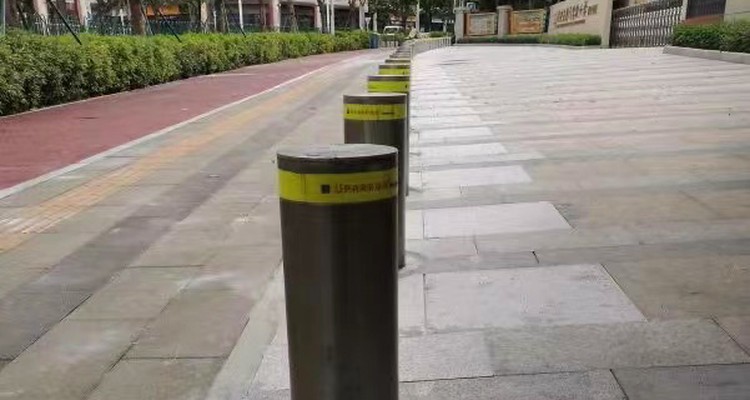
For buyers ordering in quantity, third-party inspection before shipment should include physical measurement of wall thickness on a sample of units. This is standard practice in industrial procurement and is often overlooked in security hardware purchasing.
The third problem is below ground and invisible after installation: the outer fixed sleeve.
In a retractable bollard system, the outer sleeve is buried in concrete. It's a cylinder of steel — sometimes 400mm to 600mm deep — that the moving inner tube slides through. The sleeve sees groundwater, soil chemistry, and in some regions, road salt runoff. It is not designed to be replaced easily. In most installations, replacing a corroded sleeve means breaking concrete.
Budget manufacturers use thin-gauge steel for this component — sometimes as thin as 1.5mm to 2mm — because it's buried and buyers can't see it. The surface treatment is minimal. In the first year, everything looks fine. By year three or four in a wet climate, the sleeve is rusting from outside in. The inner tube starts binding. The bollard rises slowly, then erratically, then stops.
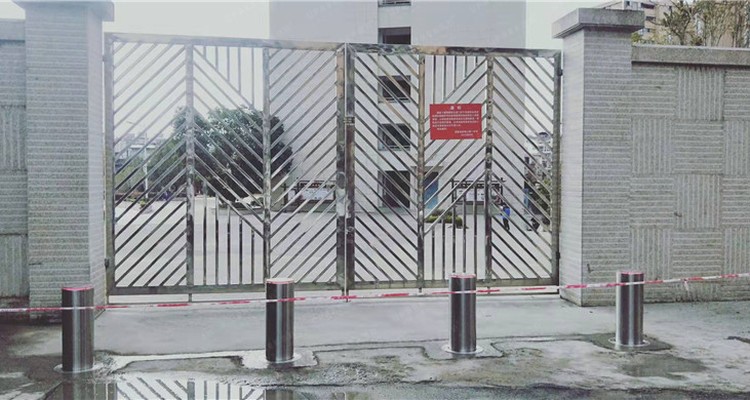
Water ingress is the accelerant. Many budget bollards are rated IP54 or claim IP67 without the drainage engineering to back it up. When water enters the cavity — through a failed seal, through the cable gland, through groundwater pressure — it sits at the bottom of the sleeve. That standing water corrodes the sleeve floor first, then the motor housing, then the electrical connections.
A properly engineered bollard addresses this in two ways: thicker sleeve wall material that can sustain years of corrosion before losing structural function, and genuine IP67 sealing with drainage provisions so water doesn't accumulate in the first place.
UPARK's outer sleeve specification uses heavier-gauge steel than the industry norm for buried components. The reasoning is simple: a component you can't inspect or replace easily should be over-engineered, not under-engineered. The IP67 rating is backed by sealed motor cavities and tested cable gland installations — not just a declared figure.
The moving inner tube runs with a 20cm overlap inside the outer sleeve. That overlap length matters for corrosion resistance as well as impact performance: a longer contact surface means water has more path to travel before reaching the motor assembly, and the load is distributed across more metal surface area so any localized corrosion doesn't immediately compromise the structural fit.
The questions worth asking any bollard supplier before purchasing: What is the wall thickness of the main tube, measured — not specified? Is the outer sleeve the same material and thickness as the above-ground body? What is the sleeve wall thickness? How was the IP67 rating verified, and what is the drainage specification?
Suppliers who can answer those questions with specific numbers have probably built a product worth buying. Suppliers who deflect to brochure language probably haven't.
Full material specifications for UPARK automatic bollards are available on request, including outer sleeve gauge and IP67 test documentation.
call us :
+86 18206096507 e-mail : [email protected]




 ipv6 network supported