Most automatic bollards on the market run on 220V or 380V AC power. This has been the standard for decades. It works. But it also creates three problems that nobody talks about until something goes wrong: electric shock risk, drainage requirements, and installation complexity.
There is an alternative. 36V DC low-voltage bollards solve all three problems at once. Here is how they work and why they are worth a serious look.
The electric shock problem nobody wants to think about
220V automatic bollards are installed in the ground. They sit in pits that collect water. They are surrounded by soil that conducts electricity. They operate in rain, snow, and flood conditions. And they have moving parts — motors, pumps, hydraulic lines — that wear out and expose wiring over time.
A 220V circuit that shorts to the bollard casing can energize the entire installation. Anyone touching the bollard — a pedestrian leaning against it, a security guard doing a maintenance check, a child playing nearby — is at risk. This is not theoretical. Ground fault incidents happen, especially at older installations where seals have degraded.
A 36V DC system eliminates this risk. 36 volts is below the threshold where electricity can push through human skin resistance under normal conditions. International safety standards, including IEC 60364 and SELV (Safety Extra Low Voltage) classifications, treat 36V DC as a low-risk voltage for human contact. If a 36V bollard develops a fault, the worst-case scenario is a component failure — not a fatal shock.
Drainage: the hidden cost of 220V bollards

Every 220V automatic bollard installation needs a drainage system. Water in the foundation pit will eventually reach the electrical components. So you dig a pit, install the bollard foundation, add a sump pump or gravity drain, run drainage pipes to a discharge point, and hope it all works during heavy rain.
This is expensive. It adds days to the installation schedule. It requires civil works beyond simple excavation. And it becomes a maintenance liability — drains clog, pumps fail, and water finds its way in eventually.
36V DC bollards with IP68 waterproof ratings change the equation. IP68 means the bollard can be fully submerged in water and continue operating. With 36V power and IP68 sealing, there is no electrical safety reason to drain the foundation pit. Water can sit in the pit indefinitely. The bollard does not care. This eliminates the drainage system entirely — no pipes, no pumps, no ongoing drain maintenance.
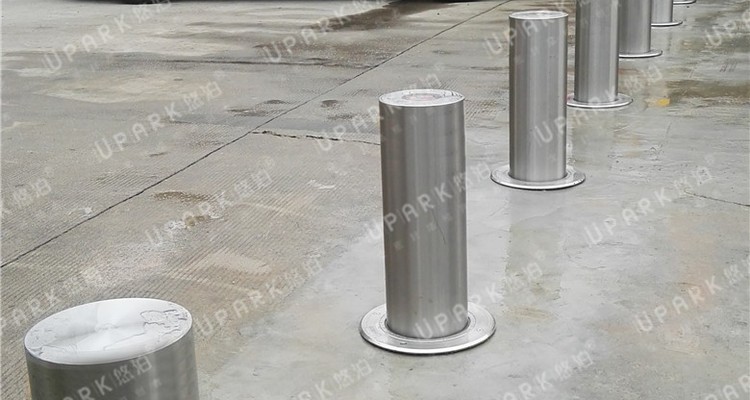
For sites with high water tables, near coastlines, or in regions with monsoon seasons, this is not a nice-to-have. It is the difference between a bollard that works for 10 years and one that shorts out after the first heavy rain.
Installation: shallow foundations, less disruption
220V automatic bollards need foundations that are deep, reinforced, and drained. A typical installation might require 800 mm to 1,200 mm of excavation — more for crash-rated models. In urban areas with underground utilities, this gets complicated fast. You hit pipes. You hit cables. You need permits. The project timeline stretches.
36V systems, especially electromechanical models with integrated drive units, can work with shallower foundations. Some models need as little as 600 mm of depth. Less excavation means faster installation, lower cost, and fewer surprises underground. For retrofit projects where you are adding bollards to an existing streetscape, this matters a lot.
Power integration and backup
A 36V DC bollard system runs on low-voltage DC power. This integrates naturally with solar panel arrays and battery backup systems. If your site already has a DC power infrastructure — common at remote facilities, military installations, and off-grid locations — 36V bollards can plug directly in without voltage conversion.
Backup power is also simpler. A standard battery bank can keep 36V bollards operational during a grid outage. A 220V system needs a generator or UPS with inverter. The 36V approach is more efficient and costs less to back up.
Maintenance: what breaks and when
Both 220V hydraulic and 36V electromechanical bollards have moving parts that need maintenance. The difference is what happens when things go wrong.
A hydraulic system has pumps, hoses, fluid reservoirs, and seals. A hydraulic leak means lost performance and possible environmental contamination. Repairs often require a specialist. A 36V electromechanical system uses a motor-driven screw or chain mechanism. Fewer fluid-related failure modes. Easier to service. No hydraulic oil to dispose of.
That said, electromechanical systems are not magic. They have their own wear points — gears, bearings, limit switches. The key advantage is that when an electromechanical bollard fails, it typically fails safe (stays down or stays up, depending on configuration) and the 36V power means any exposed wiring during service is not a shock hazard. Maintenance crews can work on 36V systems without specialized high-voltage training.
What to check before choosing 36V
36V bollards are not the right answer for every project. A few things to verify:
Rising and lowering speed. Some 36V electromechanical bollards are slower than their 220V hydraulic counterparts. If your site has high traffic volume and needs sub-3-second cycle times, check the speed spec carefully.
Crash rating availability. Not all crash-rated bollard models are available in 36V. If you need K12 or M50 certification, confirm that the 36V version carries the same rating as the 220V equivalent.
Local electrical codes. Some jurisdictions still require certain safety measures for any in-ground electrical installation regardless of voltage. Check local requirements before assuming 36V means no permits.
For most commercial, residential, and light industrial applications, 36V DC automatic bollards offer a simpler, safer, and often cheaper alternative to traditional high-voltage systems. The technology has matured over the past decade. It is no longer experimental. It is just not yet the default — which means taking the extra step to ask for it.
Learn more about UPARK low-voltage automatic bollards at Automatic Bollards or explore our full product range at UPARK.
call us :
+86 18206096507 e-mail : [email protected]




 ipv6 network supported