If you have spent any time researching perimeter security, you have probably seen the term HVM. It stands for Hostile Vehicle Mitigation — and it is the industry-standard way of describing barriers built to stop a vehicle that someone is using as a weapon. Not a stray delivery truck. Not a lost tourist in a rental car. A vehicle driven with intent to cause harm.
HVM bollards are not the same thing as the decorative posts you see outside a coffee shop. Those are there to keep shopping carts off the patio. HVM bollards are engineered to stop a multi-ton vehicle moving at speed. The difference is the difference between a speed bump and a concrete wall.
Where the term HVM comes from
HVM became a standard term after a series of vehicle-ramming attacks in Europe and the Middle East during the 2010s. Governments and security agencies needed a way to talk about protective barriers that went beyond "bollard" or "fence." The UK Centre for the Protection of National Infrastructure (CPNI) was one of the early drivers, publishing guidance on vehicle-borne threats and the barriers that could stop them.
Today, HVM is used across the security industry. You see it in tender documents, in government procurement specs, and on product pages from manufacturers like Automatic Systems. If a bollard is described as HVM-rated, it means it has been tested and certified to stop a specific vehicle weight at a specific speed — and the results are backed by an independent lab, not the manufacturer's marketing department.
Crash test standards: the alphabet soup explained
HVM bollards are rated under several testing standards. The three most common are:
PAS 68 (UK): This is the British standard for impact-tested vehicle security barriers. A PAS 68 rating tells you the vehicle type, weight, speed, and penetration distance. For example, "PAS 68:2013 V/7500(N3)/80/90" means the barrier stopped a 7,500 kg N3-class vehicle at 80 km/h, with the cargo bed penetrating no further than 90 cm past the barrier line.
IWA 14-1 (International): Based on PAS 68, this is the international version. The format is similar: vehicle class, impact speed, and penetration. You will see it on products sold outside the UK.
ASTM F2656 (US): The American standard uses M-ratings and P-ratings. An M30 rating means the barrier stopped a 6,800 kg truck at 50 km/h. An M50 rating means it stopped the same truck at 80 km/h. A P1 rating is the lowest penetration (under 1 meter). A P4 rating means the vehicle went through. The most common high-security rating is ASTM M50/P1.
DOS K-ratings (US State Department): K4, K8, and K12 are older ratings from the US Department of State. K12 is the highest, stopping a 6,800 kg vehicle at 80 km/h. These were largely replaced by ASTM F2656 in 2007, but you still see K12 referenced in procurement documents, especially for US government facilities.
Fixed vs automatic vs removable: three ways to deploy HVM bollards
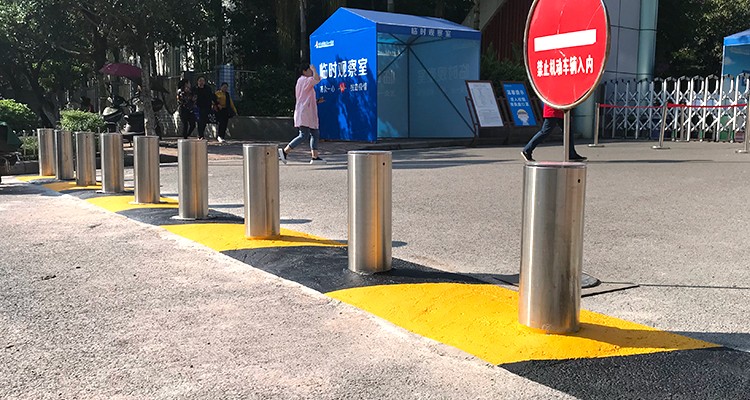
HVM bollards come in three basic configurations. Each has a different use case.
Fixed bollards (also called passive bollards) are permanently installed in the ground. They cannot be raised or lowered. They provide the highest level of security because there are no moving parts to fail. The Automatic Systems FB M50, for example, is a fixed bollard rated to stop a 7,500 kg vehicle at 80 km/h. Fixed bollards work best at sites where vehicle access is never needed — think pedestrian plazas, stadium perimeters, and embassy compound edges.
Automatic bollards (also called active bollards or rising bollards) can be raised and lowered on command. When raised, they provide full HVM protection. When lowered, authorized vehicles can pass. These are the most common type for sites that need both high security and controlled vehicle access — government buildings, airports, corporate campuses, data centers. The trade-off is that automatic bollards have moving parts (hydraulic or electromechanical), and those parts need maintenance.
Removable bollards can be taken out of the ground when access is needed and locked back in place afterward. They are a middle ground: stronger than automatic bollards (fewer failure points) but less convenient for frequent access. They are often used at emergency access routes and maintenance gates that open only a few times per year.
For more details on choosing between types, see our guides on Fixed Bollards and Automatic Bollards.
What to look for when buying HVM bollards
Not all HVM bollards are equal. Here are the things that actually matter when you are comparing products:
Certification is real. A manufacturer can claim their bollard "can stop a truck." Unless that claim is backed by a PAS 68, IWA 14-1, or ASTM test certificate from an accredited lab, it is marketing. Ask for the test report number. If they cannot produce one, walk away.
Foundation depth affects cost. The FB M50 requires a 600 mm foundation. Some HVM bollards need foundations over 2 meters deep. The deeper the foundation, the more excavation and concrete you need — and the higher the installation cost. Ask about foundation requirements early in the planning process.
Operation speed matters for automatic bollards. Some rise in 5 seconds. Others take 15. At a busy entrance with 500 vehicles per day, that difference adds up to real operational impact. Also check the daily cycle rating — can the bollard handle 2,000 cycles per day, or is it rated for 300? Get the wrong one and you will be replacing motors every year.
Power and drainage are often overlooked. Most automatic HVM bollards run on 220V or 380V mains power. They need proper drainage at the foundation to prevent water damage. Some newer models run on 36V DC, which eliminates the need for drainage and reduces the electrocution risk — worth asking about if your site has high water tables or frequent flooding.
Finishing is not just cosmetic. Stainless steel holds up better in coastal environments. Painted steel with ribs provides a visual deterrent — people see the bollards and slow down before they even get close. Some manufacturers offer custom color matching for architectural integration. These details matter when the bollards are in front of a luxury hotel lobby, not a loading dock.
The bottom line
HVM bollards are not a commodity. The right choice depends on your threat level, your access patterns, your site conditions, and your maintenance budget. A certified M50/P1 automatic bollard with a shallow foundation and low-voltage power is a very different proposition from a fixed K12 bollard buried in 2 meters of concrete. Both do the job. The question is which job you actually have.
If you are specifying HVM bollards for a project, start with the threat assessment. Then match the test standard, the deployment type, and the site constraints. The rest is details — important ones, but details.

Learn more about UPARK crash-rated bollards at Automatic Bollards or About UPARK.
call us :
+86 18206096507 e-mail : [email protected]




 ipv6 network supported