Crash ratings for bollards can feel like alphabet soup. K4. K8. K12. M30. M50. P1. P3. If you are writing a security specification or evaluating supplier quotes, you need to know what these numbers mean — and more importantly, what they do not mean.
Here is a practical breakdown. No marketing fluff. Just the standards, the test conditions, and the decisions that come out of them.
Where these ratings come from
There are two rating systems you will encounter most often:
The DOS K-rating system came from the US Department of State. It was originally created for embassy and consulate security. K-ratings are straightforward: the number tells you the vehicle speed the barrier can stop. K4 = 30 mph (48 km/h). K8 = 40 mph (64 km/h). K12 = 50 mph (80 km/h). All three are tested with a 15,000 lb (6,800 kg) medium-duty truck. The rating is just about speed — same vehicle, different impact energy.
The ASTM F2656 system replaced K-ratings in 2007. It uses M-ratings for the vehicle type and speed, and P-ratings for how far the vehicle penetrates past the barrier. An M30/P1 rating means the barrier stopped a 6,800 kg truck at 50 km/h with less than 1 meter of penetration. An M50/P3 means the barrier stopped the same truck at 80 km/h, but the truck bed pushed through up to 3 meters. Higher M-number = higher speed stopped. Lower P-number = less penetration = better performance.
K4 bollards: the entry-level crash rating
K4 is the lowest vehicle-impact rating you will see on a security bollard. It means the bollard was tested against a 6,800 kg truck moving at 30 mph (48 km/h). In ASTM terms, this is roughly equivalent to M30.
K4 bollards are used at sites where the threat is a slow-moving vehicle — think a truck pulling up to a checkpoint and accelerating from a short distance. They are common at corporate office parks, retail distribution centers, and low-risk government facilities. They cost less and usually require shallower foundations than K8 or K12 bollards.
The limitation: K4 does not stop a determined high-speed attack. A truck hitting K4 bollards at 50 mph will likely get through. If your site faces a credible vehicle-ramming threat, K4 is not enough.
K8 bollards: the mid-range workhorse
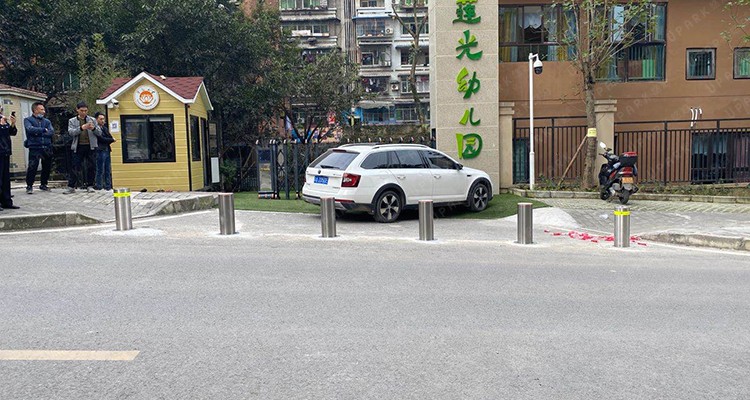
K8 bollards are tested at 40 mph (64 km/h) with the same 6,800 kg truck. In ASTM terms, this sits between M30 and M50 — there is no exact ASTM equivalent, but you will often see K8-rated products certified under ASTM M30 with low penetration (P1).
K8 is a common choice for airports, seaports, stadiums, and critical infrastructure. It stops a realistic vehicle-ramming scenario — a truck accelerating across a parking lot or access road — while keeping foundation depths and costs manageable. Many European manufacturers rate their bollards under PAS 68 or IWA 14-1 instead, but the performance level is comparable. A PAS 68 V/7500(N3)/80/90 rating is in the same ballpark as K8.
K12 bollards: the highest crash rating
K12 is the top of the DOS rating scale. It stops a 6,800 kg truck at 50 mph (80 km/h). In ASTM terms, this is M50. Automatic Systems' FB M50 fixed bollard is K12-rated, with an impact resistance of 2,000,000 joules.
K12 bollards are specified for embassies, military bases, nuclear facilities, and other sites where the threat model includes a determined vehicle-borne attack. They are heavier, deeper, and more expensive. Foundation depths can exceed 2 meters. The bollard itself may be 275 mm or more in diameter, with significant reinforcement. Installation is not a weekend job.
The question for specifiers: do you actually need K12? Many projects specify K12 because it sounds safest, but a K8 or M30/P1 barrier would cover the actual threat at half the cost. Match the rating to the assessment, not the marketing.
Understanding P-ratings (penetration distance)
The ASTM F2656 P-rating is often overlooked but matters as much as the M-rating. It tells you how far the vehicle penetrated past the barrier line during the crash test:
P1: Less than 1 meter of penetration. The vehicle was essentially stopped at the barrier line. This is what you want for pedestrian areas and building perimeters where every meter counts.
P2: 1 to 7 meters of penetration. The vehicle was stopped, but it pushed through a car's length past the barrier. This might be acceptable if the bollards are set back from the protected area — for example, at a perimeter fence line with open ground behind it.
P3: 7 to 30 meters. The barrier absorbed the impact but the vehicle traveled a significant distance. The threat was neutralized in the sense that the vehicle lost momentum, but anyone standing within 30 meters of the impact point could still be in danger.
P4: More than 30 meters. The barrier failed to stop the vehicle. This rating means the product did not pass the test at that speed/weight combination.
When comparing products, look for the full ASTM rating, not just the M-number. An M50/P1 bollard is a very different product from an M50/P3, even though both say "M50" on the datasheet.
PAS 68 and IWA 14-1: the European approach
Outside the US, PAS 68 and IWA 14-1 are the dominant standards. They use a different format but test the same thing: vehicle weight, speed, and penetration.
A PAS 68 rating like V/7500(N3)/80/90 breaks down as follows: "V" means vehicle impact test (as opposed to pedestrian or manual test), "7500" is the vehicle weight in kilograms, "N3" is the vehicle class (goods vehicle over 12 tonnes GVW — but the test uses a specific 7,500 kg model), "80" is impact speed in km/h, and "90" means the load bed penetrated less than 90 cm (roughly equivalent to ASTM P1).
IWA 14-1 uses the same format and is recognized internationally. If you are sourcing bollards from European or Asian manufacturers, look for IWA 14-1 or PAS 68 certification. If you need ASTM ratings for a US project, ask the manufacturer whether they have done ASTM testing — many have, even if their primary datasheet shows PAS 68.
How to read a crash rating and spot the red flags
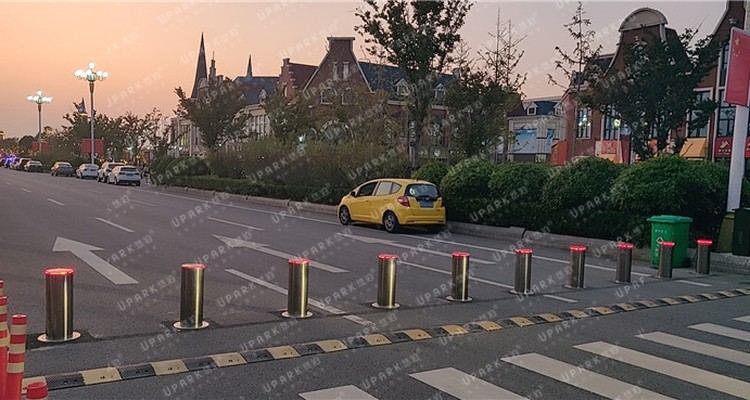
A legitimate crash rating will tell you six things: the testing standard, the vehicle type, the vehicle weight, the impact speed, the penetration distance, and the certifying body. If any of these are missing, ask why.
Red flags to watch for: "Tested to K12 standards" without a certificate number. "Designed to stop a 7.5-ton truck" without mentioning speed. Claims of being "the strongest bollard" without any test data at all. These are not certifications. They are marketing statements dressed up to look like certifications.
One practical note: a bollard that is K12-rated as a fixed installation may not achieve the same rating as an automatic version. The lifting mechanism creates potential failure points under impact. If you need automatic bollards with a specific crash rating, confirm that the rating applies to the automatic model specifically, not just the fixed version from the same product family.
Matching the rating to the project
For most commercial projects — malls, office parks, hotels, event venues — a K4 or M30 rating is sufficient. These stop the most common threat scenario: a vehicle accelerating from a short standoff distance at lower speed.
For critical infrastructure — airports, ports, government buildings, data centers — K8 or M30/P1 is the standard. It provides a safety margin without the extreme cost of K12.
For high-threat sites — embassies, military installations, nuclear facilities — K12 or M50/P1 is required. This is non-negotiable for facilities that follow US Department of State or similar security standards.
Whatever rating you choose, make sure the installation matches the test conditions. A K12 bollard installed in a thinner foundation than the tested configuration is not a K12 bollard anymore. The rating applies to the complete system: bollard, foundation, and surrounding ground conditions.
Browse UPARK crash-rated bollards at Automatic Bollards and Fixed Bollards. For more on perimeter security planning, visit our About page.
call us :
+86 18206096507 e-mail : [email protected]




 ipv6 network supported