A car crashes through a storefront at 3 AM. Not a terrorist attack. Not even an accident. A ram-raid — someone driving a stolen vehicle through a shop window to grab merchandise before the police arrive. It happens more often than most people realize, especially at electronics stores, jewelry shops, and high-end boutiques near highway exits.
Anti-vandalism bollards are the straightforward solution. They are not designed to stop a 7.5-ton truck at 80 km/h. They are designed to stop a car or van moving at low to moderate speed — the kind of impact that happens in a ram-raid, a parking lot collision, or a vehicle that rolls through a pedestrian plaza because the driver confused the brake and the accelerator.
The difference between anti-vandalism and high-security bollards
High-security bollards are certified to PAS 68, IWA 14-1, or ASTM F2656 crash test standards. They stop multi-ton vehicles at highway speeds. They need deep foundations, heavy reinforcement, and significant budgets.
Anti-vandalism bollards operate in a different category. They are typically 500 to 800 mm tall, 114 to 168 mm in diameter, and installed in foundations 300 to 600 mm deep. They will stop a car at city speeds — 20 to 40 km/h is the typical design envelope. They will not stop a truck at 80 km/h, but they are not supposed to. The threat profile is different: nuisance, crime, and accident, not terrorism.
Because anti-vandalism bollards are less demanding structurally, they cost less. A single anti-vandalism automatic bollard might be one-third to one-half the price of a K12-rated equivalent. For a retail chain protecting 50 storefront locations, the savings add up fast.
Where anti-vandalism bollards make sense
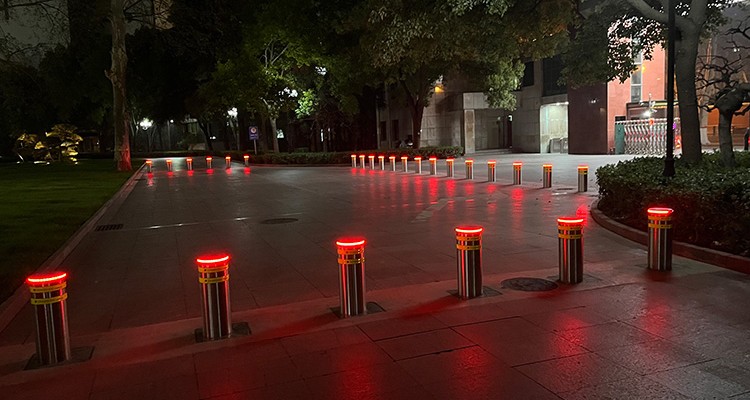
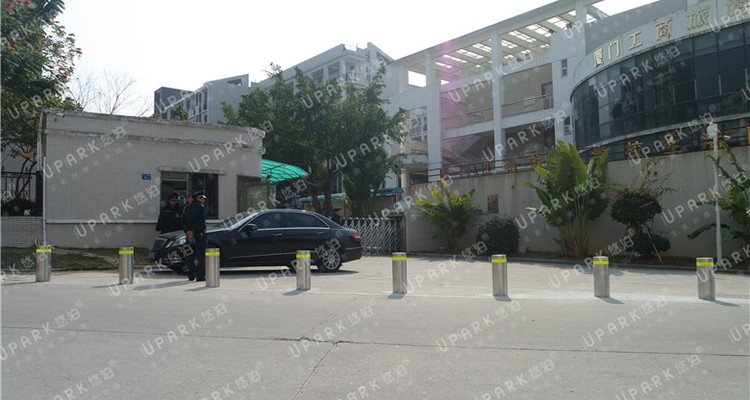
Retail storefronts. This is the classic use case. A row of bollards spaced 1.2 to 1.5 meters apart along a shop front creates a physical barrier that a vehicle cannot drive through. The bollards are close enough together that even a motorcycle cannot squeeze between them, but pedestrians can walk through freely.
Outdoor dining and cafe terraces. Restaurants that expanded outdoor seating during the pandemic kept it after. Tables and chairs on what used to be parking spaces or street lanes sit inches from moving traffic. A line of fixed or removable bollards provides separation without building a permanent wall.
Public plazas and squares. Town squares host markets, festivals, and gatherings. They also attract delivery vehicles looking for shortcuts and drivers who ignore "pedestrian only" signs. Anti-vandalism bollards at plaza entry points create a clear, physical message: vehicles stop here.
School and playground perimeters. A vehicle rolling into a playground area is every parent's nightmare. Fixed bollards around school drop-off zones and playground edges prevent vehicles from entering pedestrian-only spaces, while still being low enough not to obstruct sightlines for supervision.
ATM and bank frontages. Ram-raids targeting ATMs are common enough that some insurers require physical barriers at bank and credit union storefronts. Anti-vandalism bollards satisfy that requirement without the cost of a crash-rated HVM installation.
Fixed, removable, or automatic?
Fixed anti-vandalism bollards are the simplest and cheapest. They are permanently installed in concrete foundations. No moving parts, no maintenance beyond occasional cleaning and repainting. Best for locations that never need vehicle access.
Removable bollards can be taken out when needed — for a delivery truck once a week, a maintenance vehicle once a month, or emergency access that is only used a few times a year. The bollard lifts out of a ground socket and is stored nearby. A padlock or internal locking mechanism prevents unauthorized removal. Removable bollards give you flexibility without the cost of automation. For options, see Removable Bollards.
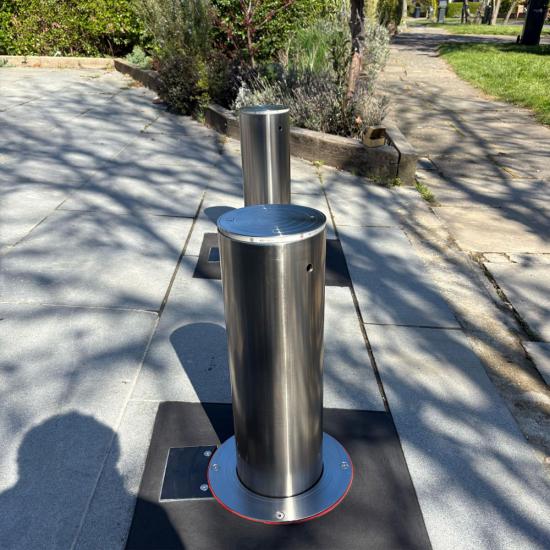
Automatic (retractable) anti-vandalism bollards work like their high-security cousins — they rise and lower on command — but without the crash rating and the associated cost. They make sense at locations that need frequent vehicle access: a hotel entrance that serves as both a pedestrian plaza and a VIP drop-off, or a retail loading zone that becomes a pedestrian walkway during business hours. Learn more at Automatic Bollards.
Installation and maintenance notes
Anti-vandalism bollards are easier to install than their high-security counterparts. Foundation depths are shallower — typically 300 to 600 mm. The bollard diameter is smaller. The concrete volume is less. Some models come as surface-mounted options that bolt directly to existing concrete, eliminating excavation entirely. If your site has existing underground utilities that make deep excavation difficult, look for surface-mount or shallow-foundation models.
Maintenance for fixed bollards is near zero — inspect the foundation once a year for cracks, repaint if the finish is degrading, that is about it. Automatic anti-vandalism bollards need the same routine maintenance as any automatic bollard: check the motor and drive mechanism every 6 to 12 months, keep the foundation sump clear of debris, and verify the control system is functioning. The good news is that lighter-duty automatic bollards often use simpler, more reliable mechanisms than heavy HVM models — fewer hydraulic components to leak, fewer high-stress parts to fatigue.
For most commercial applications, anti-vandalism bollards hit the sweet spot: enough protection to stop real-world threats, without the cost and complexity of a high-security HVM system. They do the job they are designed for. Just make sure you are clear about which job that is before you buy.
Explore UPARK bollard options for commercial and urban security at Fixed Bollards and About UPARK.
call us :
+86 18206096507 e-mail : [email protected]




 ipv6 network supported