Fully automatic bollards are the gold standard for vehicle access control. Press a button, the bollard drops. Press it again, the bollard rises. No physical effort, no waiting, no key. But that convenience comes with a price — the motors, control boards, power supply, and installation costs add up. For a site with 10 bollards, the budget can hit six figures before you even think about maintenance.
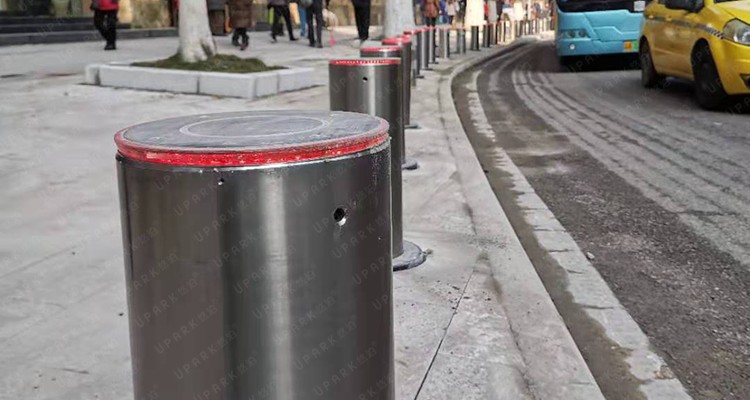
Semi-automatic bollards offer a middle path. They cost roughly half to two-thirds of a fully automatic system. They are simpler, more reliable, and in many use cases, they do exactly the same job. Here is how they work and when they make sense.
How semi-automatic bollards work
A semi-automatic bollard uses a gas spring or mechanical spring mechanism to assist with raising and lowering. The operator unlocks the bollard — usually with a key — and the spring does most of the lifting. To lower it, the operator pushes the bollard down against the spring and locks it in the lowered position. The whole operation takes about 5 to 10 seconds per bollard.
This is different from a manual removable bollard, where the operator physically lifts the entire bollard out of the ground and carries it away. Semi-automatic bollards stay in their foundation. They are permanently installed, just like automatic bollards. The difference is in how they move: motorized vs. spring-assisted.
Because there is no motor, no control board, no wiring, and no power supply, semi-automatic bollards have far fewer things that can break. A gas spring eventually loses pressure and needs replacement — typically after 5 to 10 years of use. That is about it for moving parts. Compare that to a fully automatic bollard with a hydraulic pump, control board, power supply, and wiring harness — all of which can fail and require specialized repair.
Where semi-automatic bollards fit best
Low-to-medium frequency access points. If a bollard needs to go up and down 200 times a day, get an automatic. If it goes up and down 5 times a day — a delivery truck in the morning, an employee coming and going, a service vehicle once a week — semi-automatic is the smarter choice. The cost savings more than compensate for the 10 seconds it takes to unlock and lower the bollard.
Residential and gated communities. Homeowners who want to control vehicle access to a shared driveway or private street do not need a fully automatic system with remote controls and ANPR cameras. A semi-automatic bollard at the entrance, unlocked with a key, provides the same access control at a fraction of the cost. Each resident gets a key. Visitors call ahead and someone comes out to lower the bollard.
Backup and emergency access routes. Many sites have secondary access points that are used a few times a year: a fire access lane, a maintenance gate at the back of a property, an emergency vehicle route through a pedestrian plaza. Installing fully automatic bollards at these locations is overkill. Semi-automatic bollards provide the security when the route is closed and the access when it is needed, with near-zero ongoing cost.
Parking lots and private garages. Small parking facilities — 20 to 50 spaces — often need access control but cannot justify the cost of a boom gate or automatic bollard system. Semi-automatic bollards at entry and exit points give the owner control without the investment in automation.
Cost comparison: semi-automatic vs. fully automatic
The price difference is significant. A single semi-automatic bollard typically costs 40% to 60% less than a fully automatic equivalent. But the real savings are in the supporting infrastructure: no electrical wiring to trench, no control cabinet to install, no power supply to provision. Installation costs for semi-automatic bollards are essentially the same as fixed bollards — foundation excavation and concrete. For fully automatic bollards, add electrical work, control system integration, and commissioning.
Maintenance costs are also lower. Over a 10-year lifecycle, a semi-automatic bollard might need one gas spring replacement and periodic cleaning. A fully automatic bollard needs motor service, hydraulic fluid changes (for hydraulic models), control board inspection, and possibly component replacement if electronics fail. The total cost of ownership gap widens over time.
Limitations to know about
Semi-automatic bollards are not the right choice for every project. Here is where they fall short:
No remote control. You cannot lower a semi-automatic bollard with a phone app or RFID tag. Someone has to walk up to it with a key. For high-traffic access points where waiting for manual operation would cause congestion, this is a deal-breaker.
No integration with access control systems. Semi-automatic bollards are standalone devices. They do not connect to ANPR cameras, intercom systems, or centralized security management platforms. If you need automated, system-integrated access control, go fully automatic.
Physical effort required. The gas spring assists, but the operator still needs to push the bollard down and lock it. For a 168 mm diameter bollard, this is manageable for most adults. For a 275 mm high-security bollard, it may not be practical. Check the specifications for operating force before committing.
Weather exposure. Gas springs perform best in moderate temperatures. Extreme cold reduces gas pressure and makes the bollard harder to operate. If your site sees winter temperatures below -20C, test the bollard in those conditions or consider a fully automatic model with cold-weather modifications.
How to decide
Count your daily cycles. If the number is under 20, semi-automatic is almost always the right economic choice. If it is over 100, automatic is probably worth the cost. Between 20 and 100, look at the specifics: who operates the bollard, what happens if they are delayed, and whether the convenience of remote control justifies the cost difference.
Semi-automatic bollards fill a gap in the market that many buyers do not know exists. They are not a compromise. They are the right tool for a specific set of access control problems — and in those situations, they outperform both fixed bollards (too inflexible) and fully automatic bollards (too expensive).
See UPARK bollard solutions including semi-automatic, fully automatic, and fixed models at Automatic Bollards and Fixed Bollards. Learn more about our company at UPARK.
call us :
+86 18206096507 e-mail : [email protected]




 ipv6 network supported