Greece occupies a distinctive position in the European luxury residential landscape. Athens' Vouliagmeni and Ekali districts house Greece's wealthiest residential concentrations — properties with assessed values that rival comparable real estate in Rome and Madrid. Beyond the mainland, the Cycladic islands — Mykonos, Santorini, Paros — have attracted an international luxury buyer cohort that rivals the French Riviera.
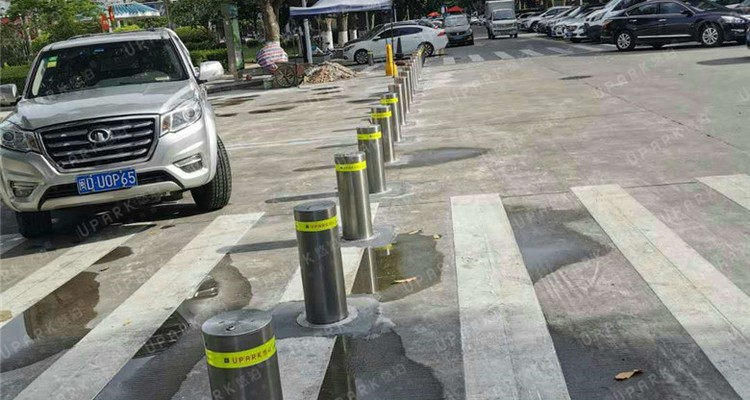
This market, concentrated around high-value properties with significant seasonal occupancy patterns, has a specific security profile. And within that profile, physical vehicle access control is increasingly standard.
Greece's Luxury Residential Security Context
Greece's Golden Visa program, which attracted significant foreign investment in high-value residential property across Athens and the islands, also introduced a pattern familiar to Mediterranean luxury markets: high-value properties with partial occupancy, often owned by non-resident international buyers, and managed through property management firms or caretakers.
These properties share a vulnerability that cameras and alarm systems cannot address. During the off-season — October through April on the islands, during extended absences on the mainland — unoccupied luxury properties become targets for organized intrusion. Vehicle-assisted approaches allow criminal networks to reach a villa's main entrance faster than any alarm response, remove valuables, and depart before police arrival.
For Greek luxury homeowners, the response is physical. An automatic bollard is the only measure that stops the vehicle.
Three Contexts Where Bollards Add Measurable Value
1. Athens hillside estates. Ekali, Kifissia, and the hillside suburbs north of Athens feature large private estates with extended driveways set back from the road. These properties have the geography for a layered security approach — outer gate, then a bollard positioned further up the driveway, creating a second physical barrier that gates alone cannot replicate.
2. Vouliagmeni and Athenian Riviera villas. The coastal strip south of Athens — Glyfada, Voula, Vouliagmeni — features some of the highest property values on the Greek mainland. Sea-facing villas with private driveways are architecturally and aesthetically premium; the security specification must match. Marine-grade bollards with discreet finishes integrate naturally into this environment.
3. Island properties with seasonal occupancy. Mykonos and Santorini villa properties may be occupied for only three to five months per year. An automatic bollard with remote access control allows the property owner or property manager to open and close vehicle access remotely, matching the operational rhythm of a seasonally occupied luxury villa. No physical key, no on-site coordinator, no window of unauthorized access.
Installation Considerations for Greek Luxury Properties
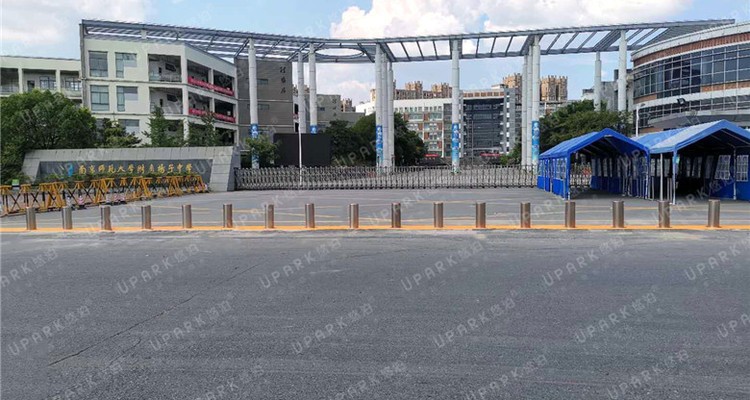
Greek residential properties present two specific installation considerations that differ from Northern European contexts:
- Mediterranean climate and salt air. Properties within proximity to the Aegean or Ionian Sea — which includes virtually all island properties and a significant portion of the mainland's luxury coastal market — require marine-grade 316 stainless steel as the baseline material specification. The combination of high UV exposure, salt air, and summer heat creates a corrosive environment that standard 304 stainless steel does not withstand over a ten-year service life.
- Seismic zone ground conditions. Greece lies in one of Europe's highest seismic activity zones. Bollard foundation specifications must account for potential ground movement — this is a civil engineering detail, not a bollard feature, but it is one that any competent installation contractor in Greece will address in the site preparation phase. The bollard's ground sleeve must be set in adequately reinforced concrete to prevent loosening during seismic events.
The 36V Low-Voltage Advantage in Greece
Greece's electrical installation regulations, governed by the Hellenic Organization for Standardization (ELOT), apply significant compliance requirements to high-voltage residential installations. Approved electrical contractors, documentation, and inspection are required for high-voltage work.
UPARK's 36V DC system bypasses these requirements. Low-voltage installation falls within the scope of standard residential electrical work — the same contractor who manages landscape lighting, pool electrics, or smart home wiring can install the bollard control system. For Greek property owners managing villa renovation projects through property management companies or local contractors, this simplification reduces both cost and timeline.
The 20-centimeter overlap between the rising shaft and the ground sleeve prevents dust, sand, and fine grit — common in Greek island environments — from entering the mechanism. This design feature is the difference between a bollard that performs reliably for ten years and one that requires annual servicing after exposure to Aegean summer conditions.
UPARK Automatic Bollards for Greek Luxury Properties
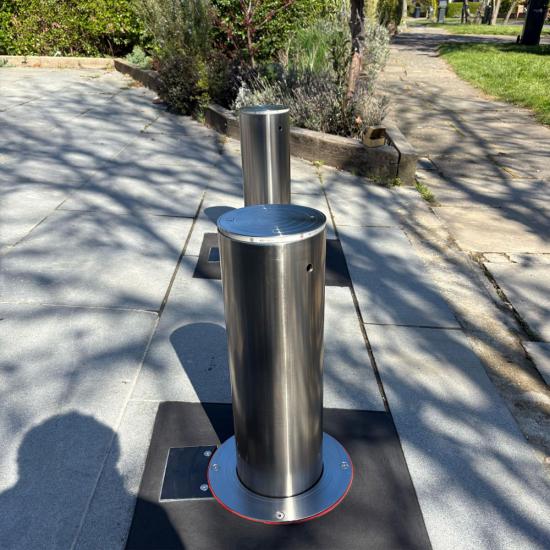
For island and coastal mainland installations, 316 marine-grade stainless steel is the standard specification — brushed or mirror finish depending on the architectural preference. The finish does not corrode in salt-air conditions and requires no special maintenance beyond periodic rinsing.
Remote control is standard for seasonal properties. GSM and IP modules allow property managers to open or lock the bollard from anywhere in the world. Access logs record vehicle entries and exits, providing an audit trail that property management companies can share with absent owners.
The operating temperature range is minus 35 to plus 60 degrees Celsius — the upper limit is particularly relevant for Greek island properties, where summer temperatures in the bollard housing can exceed 50 degrees Celsius in direct sunlight.
Frequently Asked Questions
Do automatic bollards require planning permission in Greece?
Under Greek building regulations, minor installations on private residential land within the property boundary typically do not require a building permit (oikodomiki adeia). Properties in archaeological protection zones, traditional settlement areas (paradosiakoi oikismoi), or coastal setback zones may be subject to additional restrictions. Consult your architect and local Υπηρεσία Δόμησης (Building Service).
What is the installed cost of residential automatic bollards in Greece?
Installed costs typically range from 8,000 to 17,000 euros per bollard, depending on model, finish, and site conditions. Island installations may carry additional logistics costs for material transport.
Can bollards be integrated with property management systems for seasonally occupied villas?
Yes. UPARK bollards with GSM or IP control modules can be programmed for scheduled access windows, integrated with property management software, and set to log entry events for owner reporting. This is particularly relevant for Mykonos and Santorini villa operators.
How do automatic bollards hold up in the Greek summer heat?
UPARK bollards are rated to plus 60 degrees Celsius. Control electronics are in IP67-rated enclosures with UV-stabilized seals. Hydraulic fluid is specified for high-temperature viscosity. No cooling measures are required for Greek climate conditions, including summer installations in direct sunlight.
call us :
+86 18206096507 e-mail : [email protected]




 ipv6 network supported