Norway consistently ranks among the wealthiest nations in Europe on a per-capita basis, with a large concentration of high-net-worth households in Oslo's western districts of Frogner and Holmenkollen, the fjord-side suburbs of Bergen, and the oil industry enclave around Stavanger.
High-value properties require a different level of perimeter security. And in Norway, where winters are long, driveways are extended, and properties are often partially isolated, automatic bollards are becoming a standard specification for luxury residential construction and renovation.
The Norwegian Luxury Residential Market and Physical Security
Norway's property crime statistics present an interesting paradox. Overall crime rates are low by European standards — but residential burglaries targeting high-value properties are disproportionately concentrated in Oslo's wealthiest neighborhoods. Statistics Norway (SSB) data shows that properties with assessed values above 10 million NOK are significantly more likely to be targeted than average-value homes.
The shift in method is what concerns security consultants. Organized networks operating across Scandinavia have moved away from forced entry through doors and windows — both of which trigger alarms almost immediately. Instead, vehicle-assisted approaches allow criminals to bypass perimeter fencing, reach the main residence quickly, and depart before response teams arrive.
For Norwegian luxury homeowners, the response has been to add physical vehicle barriers at the driveway — the one entry point that gates and cameras alone cannot reliably stop.
What Distinguishes Norwegian Residential Installations
Norway's climate and geography create specific installation requirements that differ from Central European residential projects:
1. Cold-weather performance. Oslo averages 30 days per year at or below minus 10 degrees Celsius. Bergen's coastal climate brings heavy rainfall and freeze-thaw cycles. Bollard mechanisms must operate reliably across this range without seasonal adjustment. The hydraulic fluid, the drive mechanism, and the ground sleeve seal must all be cold-rated.
2. Extended driveways with gradient changes. Norwegian luxury estates frequently feature long driveways with elevation changes — ascending toward the property from a public road below. This creates a natural access point where a single well-placed bollard provides maximum security coverage.
3. Remote property access. Many Norwegian luxury properties are occupied seasonally or used as primary residences alongside a city apartment. Owners require remote control capability — the ability to grant or restrict vehicle access from a smartphone when they are not on site.
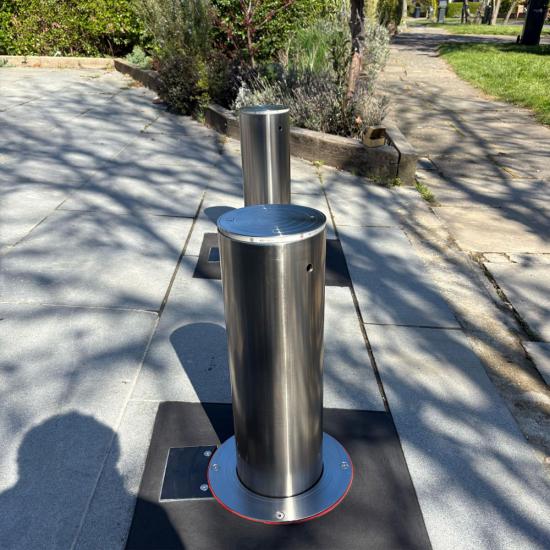
4. Aesthetic integration with natural materials. Norwegian residential architecture favors natural stone, timber, and clean lines. A bollard specification that clashes with the landscape design creates friction during the architect's review process. Stainless steel and custom powder-coat finishes that complement stone driveways and timber fencing are essential.
The 36V Advantage in Norwegian Residential Installations
Norway applies strict regulations to high-voltage electrical work in residential settings, managed by the Directorate for Civil Protection (DSB). High-voltage installations require certified electrical contractors and inspection. This adds both cost and scheduling complexity to any residential security project.
UPARK's 36V DC low-voltage system falls outside the high-voltage classification, simplifying the installation. The same electrical contractor who manages low-voltage landscape lighting can install the bollard control system. For Norwegian homeowners managing construction timelines, this is a meaningful practical advantage.
The 20-centimeter overlap between the bollard shaft and the ground sleeve — a feature specific to UPARK's design — is equally important in Norwegian conditions. In a climate with persistent freeze-thaw cycles, a bollard mechanism exposed to standing water and ice will fail within a few seasons. The overlap prevents water ingress and maintains mechanism integrity through Norwegian winters without additional weatherproofing.
UPARK Automatic Bollards for Norwegian Luxury Properties
For properties in Oslo's western suburbs, the standard specification is 316 stainless steel with brushed finish — matching the clean architectural lines of Norwegian premium residential construction. For properties near the Bergen coastline or Stavanger's North Sea exposure, the marine-grade finish is specified as standard due to salt air proximity.
Smart home integration uses dry contact inputs compatible with Loxone, Control4, and Crestron — all common in high-end Norwegian residential automation. The bollard integrates with the same interface used for heating, lighting, and access control, maintaining the unified smart home experience that Norwegian luxury buyers expect.
Operating temperature range: minus 35 to plus 60 degrees Celsius. No modification required for Norwegian conditions.
Frequently Asked Questions
Do automatic bollards require approval from local authorities in Norway?
On private residential land, a bollard that does not protrude above a certain height and does not affect public rights of way typically does not require planning approval (byggetillatelse). However, properties in protected landscape zones or near public roads should verify requirements with the local kommune. Your architect or security consultant can advise on local regulations.
How much do residential automatic bollards cost in Norway?
Installed costs for a single residential bollard typically range from 100,000 to 220,000 NOK, depending on the model, finish, and site conditions. For a driveway requiring two bollards, total installed costs range from 200,000 to 440,000 NOK.
Can bollards be integrated with Norwegian smart home systems like Loxone?
Yes. UPARK bollards accept standard dry contact inputs, which are compatible with Loxone, Control4, Crestron, and other major platforms used in Norwegian residential automation. The integration allows the bollard to be operated from the same interface as the rest of the home's access control.
How do automatic bollards perform in Norwegian winter conditions?
UPARK bollards are rated to operate at temperatures down to minus 35 degrees Celsius. The 20-centimeter overlap between the shaft and sleeve prevents ice and debris from entering the mechanism. The hydraulic fluid is specified for cold-weather viscosity. No seasonal adjustment or additional heating elements are required for Norwegian climate conditions.
call us :
+86 18206096507 e-mail : [email protected]




 ipv6 network supported