Portugal has undergone a significant transformation in its luxury residential market over the past decade. The Non-Habitual Resident (NHR) tax regime, combined with Golden Visa programs and the Algarve's established international appeal, brought a sustained influx of high-net-worth buyers from Northern Europe, North America, and the Middle East.
The result is a concentration of high-value private residences in Cascais, Estoril, and the Sintra hills west of Lisbon; across the Algarve's coastal communities from Quinta do Lago to Vilamoura; and in Porto's Foz do Douro and Boavista districts.
These properties, many of them occupied seasonally or as secondary residences, require security measures calibrated to high value and partial occupancy. Automatic bollards have become a standard specification item in this context.
The Portuguese Luxury Residential Security Context
Portugal's overall crime rates remain low by Western European standards. But within the luxury residential sector, security consultants note a consistent pattern: high-value properties in tourist-accessible areas attract organized attention during periods of low occupancy. The Algarve, which sees property occupancy drop sharply outside the summer months, has seen a measurable increase in residential intrusions targeting luxury villas during the October-to-March period.
Vehicle-assisted approaches bypass two of the most common security measures in Portuguese luxury residential installations — traditional wooden or wrought-iron gates and CCTV cameras. Neither stops a vehicle. An automatic bollard does.
Where Portuguese Luxury Homeowners Install Bollards
The most effective installations on Portuguese luxury properties share three characteristics:
1. Main driveway entry after the outer gate. Portugal's luxury villas often feature an outer decorative gate — wrought iron, stone pillars, or timber — by a long driveway to the main house. The outer gate provides a visual barrier. A bollard positioned twenty to thirty meters inside it provides a physical one that cannot be rammed open.
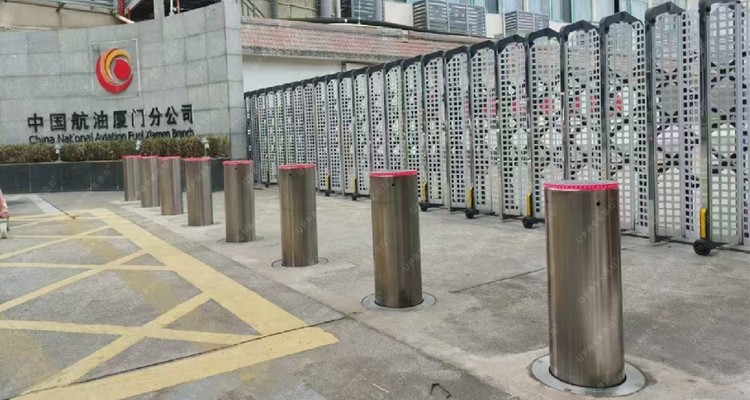
2. Pool and terrace approach. Many Algarve villas are designed with level garden terraces adjacent to paved areas accessible from secondary tracks or shared access roads. A bollard at this access point prevents vehicles from approaching the property from the garden side — a vulnerability that primary-entry security measures completely miss.
3. Garage and collector car storage. Porto and Lisbon's luxury market has a significant collector car element. Garages housing high-value vehicles require physical access control at the garage approach, independent of the main residential entry system.
What Distinguishes Portuguese Residential Installations
Two environmental factors define the specification requirements for Portuguese residential bollards:
- Salt air and Atlantic humidity. Properties within proximity to the Atlantic coast — which accounts for a significant proportion of Portugal's luxury residential market — require marine-grade 316 stainless steel as a baseline. The high ambient humidity and proximity to the ocean accelerate corrosion on lesser materials. A bollard finished in standard 304 stainless steel will develop surface pitting within three to five years in Cascais or the Algarve; a 316 finish maintains its integrity for ten years and beyond.
- Sun and UV exposure. Portugal's Algarve averages over 3,000 hours of sunlight per year. External control panels, wiring insulation, and surface finishes must be rated for sustained UV exposure. UPARK's residential systems are specified with UV-stabilized cable sheathing and powder-coat finishes rated for outdoor southern European climates.
The 36V system simplifies electrical installation under Portuguese regulations managed by DGEG (Direção-Geral de Energia e Geologia). Low-voltage installations bypass the certification requirements associated with high-voltage residential work — a meaningful benefit for property owners managing renovation projects with multiple contractors.
UPARK Automatic Bollards for Portuguese Luxury Properties
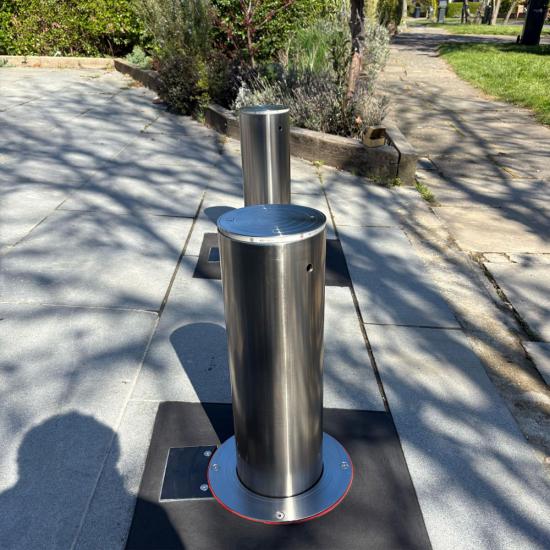
For the Algarve, the standard specification is 316 marine-grade stainless steel with a brushed finish. The 20-centimeter overlap between the rising shaft and the ground sleeve prevents sand, grit, and water from entering the mechanism — a design detail that makes a significant difference in the sandy soil conditions common to Algarve villa properties.
For Lisbon-area estates, the remote control module — available in GSM or IP versions — allows property managers and security teams to operate the bollard system without physical presence. Access can be scheduled around expected service visits, rental periods, or seasonal reopening, reducing the administrative burden associated with managing a partially occupied luxury property.
Bollards integrate with existing smart home systems via dry contact inputs. Whether the property runs Control4, Crestron, or a local Portuguese automation platform, the bollard functions as part of the unified access control interface.
Frequently Asked Questions
Do automatic bollards require planning permission in Portugal?
On private residential land in Portugal, a bollard installation that falls within the building's registered footprint and does not affect public easements or rights of way typically does not require a licença de construção. Properties in environmentally protected zones (ARH, RAN, REN) may be subject to additional restrictions. Consult your architect and the local Câmara Municipal.
What is the installed cost of residential automatic bollards in Portugal?
Installed costs typically range from 8,500 to 18,000 euros per bollard, depending on model, finish, and site preparation. For Algarve properties with soft or sandy soil, additional civil works for the ground sleeve foundation may increase costs by 1,000 to 2,000 euros per unit.
Can automatic bollards be integrated with rental management systems for Algarve villas?
Yes. UPARK bollards with GSM or IP control modules can be integrated with rental property management workflows. Access windows can be programmed remotely to match booking periods, and the system can log entry and exit events for property management reporting.
How do automatic bollards perform in the Algarve's heat and sun exposure?
UPARK bollards are rated for operating temperatures up to plus 60 degrees Celsius. Control electronics are housed in IP67-rated enclosures with UV-stabilized seals. Powder-coat finishes are specified for outdoor southern European conditions. No additional cooling or shading measures are required for Algarve installations.
call us :
+86 18206096507 e-mail : [email protected]




 ipv6 network supported