Most of what gets written about platform edge safety comes out of rail. Track circuits, signal interlocking, train stopping accuracy, platform screen doors. Useful material, but it describes a small share of the platforms where people actually stand next to a moving vehicle.
Bus rapid transit stations, airport kerbsides and ferry berths carry the same basic risk with none of the railway infrastructure that normally manages it. There is no track circuit to tell a door controller that a vehicle has arrived. There is no fixed vehicle position, because a bus stops where the driver stops and a ferry moves with the water. Yet the drop from the platform edge, the gap between vehicle and kerb, and the press of a queue at peak hour are all still there.
That gap is where an automatic platform guardrail earns its place. This article covers how the equipment is applied outside rail, what changes at each type of platform, and which points to settle before a tender goes out.
Why non-rail platforms are harder, not easier
The instinct is that a bus stop or ferry berth must be simpler than a high-speed rail station. In practice the opposite is often true, for four reasons.
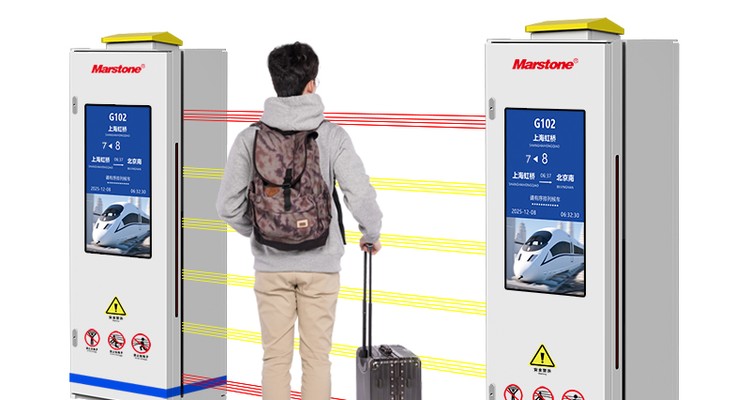
Vehicles vary. A BRT corridor may run 12 m and 18 m articulated buses at the same kerb, with door positions that differ by more than a metre. Airport buses, apron coaches and ground service equipment all meet the kerb at different heights. Ferry hulls change freeboard with load and tide. A gate that assumes a fixed door centre will block the wrong part of the vehicle.
Drivers are not on rails. A rail driver has a stopping mark. A bus driver has a mirror, a queue and a schedule. Any control logic that requires precise stopping will fail on the first wet morning.
Weather is not filtered. Rail platforms are often covered. Airport kerbs catch crosswind, ferry berths take salt spray and surge, and open BRT platforms take everything. The equipment has to be rated for the position it actually occupies, not the position on the drawing.
There is rarely a signal system to talk to. Interfaces usually come down to a push button, a loop detector, a radar, or a dry contact from the operator's own system. That is a simpler integration, but it puts the safety logic on the gate itself.
What the gate actually does
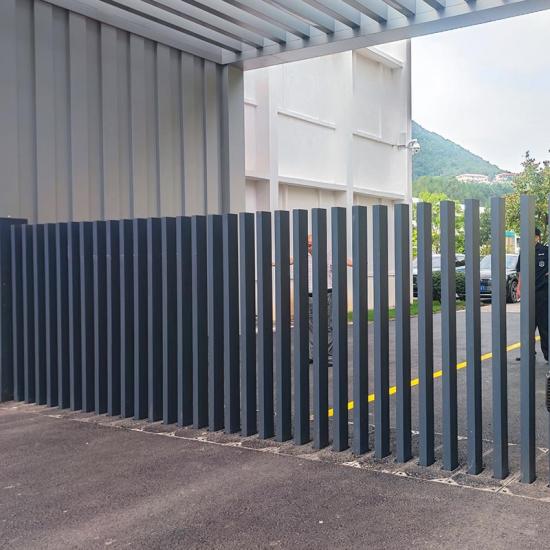
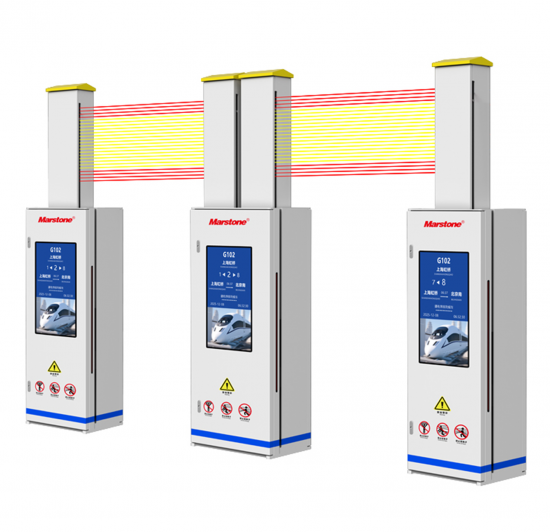
A retractable platform gate is a row of vertical posts set along the platform edge, linked by rope or cable, that lifts to open and lowers to close. The UPARK unit runs on 36 V DC, is rated IP54, works from -40 to +70 degrees C, and is tested to 250,000 open-close cycles. Impact testing follows EN 13231-3 at 300 kg.
The mechanical simplicity is the point. There is no oil-based power pack in the platform, no fluid-dependent actuator to leak into a drainage channel, and no excavation for a pit. Posts mount on a surface plinth, so a berth can be protected without cutting the deck. Where the platform sits over water or over a live road, that matters more than any datasheet figure.
Two release paths are standard: a manual release at each post for staff, and an emergency release that drops the barrier under spring return if power is lost. In a crowd event, the system fails open rather than trapping people against the edge.
BRT stations: cycle time beats everything
A BRT platform may see a bus every 45 seconds at peak. The gate has to open, let the queue through, and close before the next vehicle arrives, without staff intervention. That makes cycle time and repeat accuracy the first specification, not impact rating.
In practice, most operators run the barrier from the driver's cab or from a station attendant's pendant, with a local enable that only arms the gate when a vehicle is present. Loop detectors at the stopping area work well; radar works better where the kerb is shared with taxis or service vehicles.
The other BRT-specific issue is fare control. Where the station is gated for ticketing, the platform barrier has to sit inside the paid area and align with the ticket gate flow. Getting this wrong produces a queue that starts at the barrier and backs up through the gates, which is worse than no barrier at all.
Airport kerbs and apron walkways
Airports use platform gates in two places: the landside kerb where buses and taxis meet the terminal, and the airside walkway where passengers cross to remote stands. Landside, the risk is a passenger stepping into a live lane during a queue. Airside, it is a passenger walking into an apron vehicle path.
Landside installations rarely need full closure. A gate that guards the crossing point and leaves the rest of the kerb open tends to be accepted better than a full-length barrier, because it does not interfere with baggage trolleys or emergency access. Airside installations need a wider opening and a control interface to the airport's own access control, usually a dry contact pair.
Wind is the design case here. A 1.2 m high cable barrier on an exposed kerb takes load from the side, and the post base has to be rated for it. Ask for the wind load figure at the specified height, and ask whether the posts are anchored into the deck or ballasted.
Ferry berths: salt, surge and gangway alignment
A ferry berth is the least forgiving of the three. Salt spray attacks anything with a mild steel fastener. Tide and surge move the vessel, so the gangway landing point changes through the day. Passenger loads compress the fender line and shift the hull away from the edge.
The barrier here is guarding a moving interface, so the design normally stops short of the gangway itself and covers the waiting edge either side. Stainless fasteners and a sealed control box are baseline. Where the berth floods, a surface-mounted post is the only realistic option, because there is nothing to drain a pit into.
Signage and audible warning matter more at a ferry berth than at a bus station. Passengers arrive in bursts off a sailing, they are carrying luggage, and they are not watching the edge. A gate that closes silently behind a queue will be leaned on.
Six points to settle before the tender
First, the guard length. Measure the actual passenger waiting edge, not the whole platform. Over-specifying length is the fastest way to double a budget for no safety gain.
Second, the vehicle mix. List every vehicle type that will use the berth over the next ten years, with door positions. The gate layout has to work for the widest and the narrowest.
Third, the control source. Decide whether the gate is driven by the driver, an attendant, a detector, or the station system. Each option changes the wiring and the failure mode.
Fourth, the power and fallback. Confirm the supply, the battery or spring-return behaviour on loss of power, and who holds the manual release key.
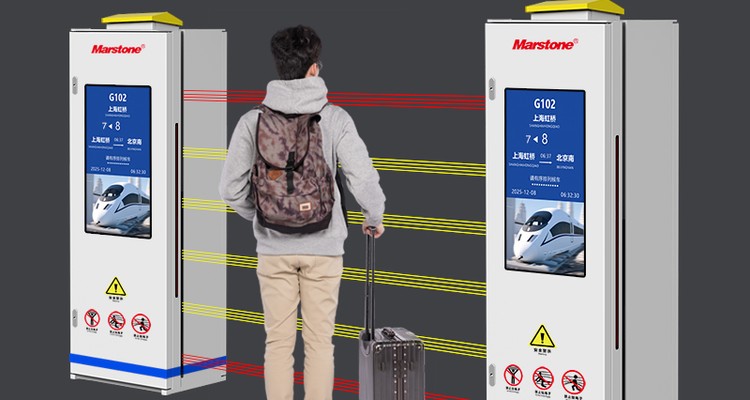
Fifth, the mounting surface. Deck thickness, waterproofing, and whether anchor bolts are permitted determine whether a surface plinth is viable.
Sixth, the maintenance regime. A cable barrier needs cable tension checks and post inspection. Ask what the annual service involves and who does it, before comparing prices.
Where to start
If the platform has no track, no signalling and no fixed stopping point, the barrier has to carry its own logic and survive its own weather. That is a different product from a station screen door, and it should be specified as one.
The automatic platform guardrail range covers berth lengths from a single crossing point to a full platform edge. For lighter structures and listed sites, the retractable cable barrier uses the same control platform with a lower structural load. If you are still deciding between rope, board and cable formats, this comparison of platform barrier types sets out the trade-offs.
Send us the platform drawing, the vehicle list and the power available at the edge. We will come back with a layout and a control scheme rather than a generic datasheet. More about the company is on the about page.
call us :
+86 18206096507 e-mail : [email protected]




 ipv6 network supported